












Proprietary Trading and Prop Traders: A Complete Guide
There’s a quiet revolution happening behind the flashing screens of global markets, and it’s not led by banks. It’s powered by independent firms and individual minds who trade with confidence, speed, and their own capital. This is the world of proprietary trading, where skill meets technology, and where success depends not on client assets but on pure performance.
For decades, the term proprietary trading belonged to Wall Street giants. But times have changed. Today, a new breed of prop traders, agile, analytical, and tech-savvy, are taking the reins. And with platforms like Leverate’s Prop Trading Suite, launching or scaling your own firm has never been easier, faster, or more accessible.
If you’ve ever asked yourself “What is proprietary trading?” or wondered what separates prop firms from hedge funds and brokers, this guide breaks down everything, from how prop trading works to why it’s redefining modern finance.
What Is Proprietary Trading?
Often called prop trading occurs when a financial institution firm trades stocks, currencies, commodities, or derivatives using its own capital, not clients’ funds, to generate profit.
In simple terms, a prop trader uses the firm’s money to trade in global markets. When trades are successful, both the trader and the firm share in the profits. This approach is fundamentally different from traditional brokerage models, where firms earn commissions by executing trades for clients.
According to Investopedia, prop trading allows firms to leverage internal expertise and technology to capitalize on market inefficiencies, often achieving higher returns than client-based trading models.
If you’re curious to learn more about what is prop trading or how to become a prop trader, check out Leverate’s learning hub, where we break down essential trading concepts in plain language.
How Does Proprietary Trading Work?
At its core, it works through the use of firm capital to take positions in financial markets. Unlike traditional investment firms, prop firms don’t depend on client deposits or management fees; instead, their revenue comes directly from trading profits.
1. Funding and Risk Allocation
A prop firm allocates trading capital to its traders based on experience, performance, and risk tolerance. The firm sets clear risk limits to protect its overall portfolio while allowing individual prop traders to execute strategies independently.
2. Profit Sharing
Typically, traders receive a portion of the profits they earn, often between 50% and 90%, depending on the firm’s structure. This incentive model creates a results-driven environment where top-performing traders can scale their earnings quickly.
3. Trading Strategies
Prop strategies may include:
- Algorithmic and quantitative trading — using models to identify patterns and execute trades automatically.
- Market making — providing liquidity by quoting both buy and sell prices.
- Arbitrage — exploiting small price differences across markets.
- Directional trading — taking positions based on market trends or macroeconomic analysis.
As Forbes notes, the sophistication of technology used by prop firms is one of the key differentiators between amateur and professional setups.
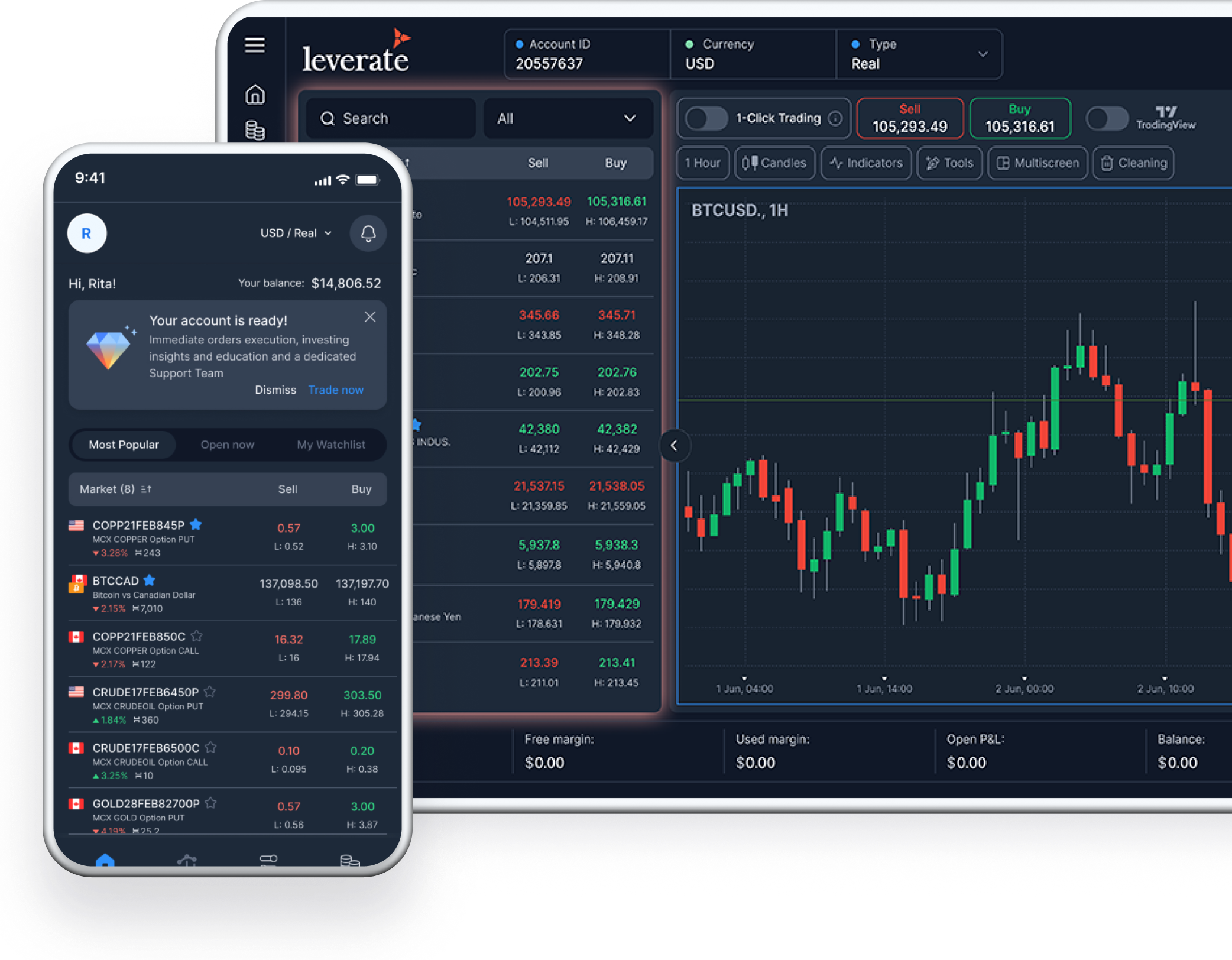
This is where Leverate comes in, providing a Prop Trading Suite that gives firms the infrastructure, liquidity access, and risk management tools they need to operate efficiently and scale securely.

Example of a Proprietary Trading Desk
Let’s consider how a prop trading desk functions in practice.
A prop trader working at a mid-sized firm might focus on trading forex pairs using short-term algorithmic strategies. The firm funds the trader with $200,000 in virtual capital, while implementing strict drawdown limits.
Throughout the trading session, the firm’s technology tracks open positions, profit/loss ratios, and exposure in real-time. The trader uses the firm’s platform to execute trades, monitor risk, and optimize performance.
At the end of the month, the trader achieves a 10% return, $20,000 in profit. The firm takes a 30% share ($6,000) and pays the trader the remaining 70% ($14,000).
This setup, combining firm-funded trading, strict risk oversight, and real-time analytics, is the backbone of every successful firm.
With Leverate’s Prop Trading Suite, you can replicate this entire framework effortlessly. Leverate’s technology provides:
- Real-time performance dashboards
- Customizable risk management rules
- Trader evaluation and funding systems
- Liquidity solutions and platform integration
In short, if you want to start your own prop firm, it couldn’t be easier. Leverate gives you everything, from setup to scaling, in one seamless package.
Benefits of Proprietary Trading
1. Higher Earning Potential
Since prop traders use firm capital, they can take larger positions than individual retail traders. This amplifies potential returns, especially for those with strong discipline and data-driven strategies.
2. No Client Pressure
Unlike asset managers or brokers, prop firms focus solely on their own performance. There are no clients to answer to, just results to achieve.
3. Access to Technology and Liquidity
Top firms use advanced platforms and analytics to stay ahead of the market. Leverate’s Prop Trading Suite, for example, provides institutional-grade trading tools, execution speed, and risk controls that rival large financial institutions.
4. Scalable Model
For firms, the scalability of the prop trading model is unmatched. By onboarding and funding talented prop traders, a company can grow its profit base without managing external funds or facing regulatory complexities tied to client assets.
5. Accessibility
In 2025, entering the prop trading world is easier than ever. Platforms like Leverate have democratized access, allowing firms of any size to launch prop trading operations with integrated compliance, data analytics, and liquidity solutions, all under one roof.
As Glassdoor reports, average annual compensation for prop traders can exceed $120,000, with top performers earning well into the six figures.

Conclusion
Prop trading has evolved far beyond the walls of major banks and hedge funds. With cutting-edge platforms and a new generation of independent firms, the world of prop trading is now open to ambitious traders and visionary entrepreneurs ready to build their own success stories.
If you’ve ever imagined running your own prop firm, there has never been a better time, or a better partner than Leverate.
Leverate’s Prop Trading Suite is more than a platform: it’s an entire ecosystem built for growth. It combines everything a modern firm needs to thrive: institutional-grade infrastructure, liquidity solutions, advanced risk monitoring, and performance evaluation tools that empower you to identify and fund top trading talent.
Another thing that sets Leverate apart is its seamless third-party integrations, from data analytics providers and liquidity partners to CRM and payment systems, all designed to enhance efficiency, transparency, and the trader experience. This means your firm can offer traders a professional, high-performance environment without the complexity of managing multiple disconnected systems.
Whether you’re funding in-house traders or launching a global firm, Leverate gives you the freedom to scale securely, operate compliantly, and manage every aspect of your business from a single, unified dashboard.
At Leverate, we believe success shouldn’t depend on luck, it should be built on smart systems, strong partnerships, and scalable technology. With the right tools and guidance, you’re not just starting a firm, you’re building a legacy of trading excellence.
Building your prop firm shouldn’t be complicated. With Leverate, it’s streamlined, secure, and built for success.
FAQs
Can banks engage in proprietary trading?
Not typically. Due to the Volcker Rule (part of the Dodd-Frank Act), U.S. banks are largely prohibited from engaging in proprietary trading using customer deposits (Investopedia).
What is the difference between a prop firm and a hedge fund?
A proprietary trading firm trades with its own money and profits directly from market activity. A hedge fund, meanwhile, manages investor capital and earns performance and management fees.
Is proprietary trading legal?
Yes, it is fully legal in most jurisdictions. Firms simply need to comply with local financial regulations and risk management standards.
How do prop firms manage risk?
Prop firms use sophisticated technology to monitor positions, enforce stop-loss limits, and track trader behavior in real time. Leverate’s suite provides built-in risk control tools and margin systems to protect both firm and trader capital.
Sources:
Investopedia – Volcker Rule
Investopedia – Proprietary Trading
Forbes – What Is Prop Trading And How Does It Work?
Glassdoor – Prop Trader Salaries