







Prop Firm Technology: Infrastructure Behind Modern Proprietary Trading Firms
Proprietary trading firms have expanded rapidly in recent years, attracting traders worldwide through funded account programs and structured evaluation models. While much of the public attention focuses on traders and performance metrics, the foundation of these firms lies in the systems that support their operations behind the scenes.
This infrastructure is commonly referred to as prop firm technology. In simple terms, prop firm technology includes the platforms, monitoring systems, and operational tools that allow proprietary trading firms to manage trader accounts, track performance, enforce trading rules, and monitor risk exposure.
As prop trading programs scale globally, firms must maintain visibility across thousands of trading accounts while ensuring that trading rules and risk parameters are respected. Understanding how these systems function helps explain how modern proprietary trading firms operate efficiently while maintaining oversight of complex trading operations.
What Is Prop Firm Technology and How Does It Support Trading Operations
At its core, prop firm technology refers to the digital infrastructure that allows proprietary trading firms to run funded trading programs and monitor trader performance. Many proprietary trading firms attract traders through evaluation programs, where performance is assessed under predefined rules before any capital allocation decisions are made.
If the performance assessment is satisfactory, prop firms may provide traders with simulated or funded accounts while evaluating their trading strategies against specific rules.
Technology plays a central role in managing these programs. Platforms track trading activity, calculate performance metrics, and ensure that traders adhere to predefined guidelines such as drawdown limits, position sizing rules, or profit targets. Without automated systems, monitoring thousands of trading accounts simultaneously would be extremely difficult.
Technology Behind Funded Trader Programs
Many proprietary trading firms structure their programs around evaluation phases, where traders must demonstrate consistent performance before gaining access to larger funded accounts. Prop firm technology enables this model by automatically monitoring each trader’s performance against predefined objectives.
Systems typically track metrics such as profit targets, maximum drawdown limits, and trading activity levels. When traders meet the program requirements, the technology allows firms to transition accounts to funded status while maintaining ongoing monitoring.
Operational Infrastructure for Trader Management
Beyond tracking performance, prop firm technology also supports the administrative side of proprietary trading firms. Systems manage trader accounts, process payouts, generate performance reports, and track operational data across the entire firm.
These operational tools allow firms to maintain oversight without requiring manual processes. In practice, the technology serves as a centralized hub that combines trading activity, trader performance, and operational management.
Core Components of a Prop Firm Technology Stack
Modern proprietary trading firms rely on several interconnected systems rather than a single platform. A typical prop firm technology stack includes trading platforms, performance monitoring tools, and back-office management systems that work together.

Trading Platforms and Market Access
Trading platforms are the execution layer of prop firm technology. These platforms allow traders to access financial markets, place orders, and manage positions. In many cases, proprietary trading firms rely on widely adopted trading platforms that support automated monitoring and data integration.
The trading platform is only one part of the overall infrastructure. While it provides market access and execution capabilities, additional systems are required to track performance and enforce program rules.
Performance Tracking and Trader Dashboards
Performance tracking systems monitor metrics like profit and loss, drawdown levels, and trading behavior in real time. Many prop firms provide traders with dashboards that display performance statistics and program requirements.
These dashboards allow traders to understand their current standing within the evaluation program while also providing firms with visibility into overall trading activity.
Back-Office and Operational Management Tools
Behind the trading interface, prop firms rely on back-office systems to manage operations. These systems track trader accounts, manage evaluation phases, generate financial reports, and process payouts.
Some firms build this infrastructure internally, while others rely on specialized providers that offer technology solutions designed for trading environments. Companies such as Leverate develop infrastructure that can connect trading platforms with monitoring and operational systems.
Risk Management and Monitoring Systems in Prop Firm Technology
Risk management is one of the vital elements of prop firm technology. Select proprietary trading firms may allocate capital to traders depending on their evaluation models. If the capital is distributed to traders, prop firms must closely monitor trading activity to ensure that risk limits are respected.
Automated monitoring systems allow firms to track trading activity across all accounts simultaneously. These systems analyze data like position size, drawdown levels, and trading frequency.
Real-Time Monitoring of Trading Activity
Many modern prop firms rely on real-time monitoring tools that continuously evaluate trader performance against predefined risk parameters. These systems let firms detect unusual activity quickly and maintain oversight across multiple accounts. Monitoring tools also provide valuable insights into overall trading behavior, helping firms understand patterns across their trader base.
Automated Rule Enforcement
Another important function of prop firm technology is automated rule enforcement. Many proprietary trading programs include specific rules designed to control risk exposure, such as maximum daily losses or overall drawdown limits.
Technology allows these rules to be monitored automatically. When a trader exceeds predefined thresholds, systems may flag the account, notify administrators, or take automated actions depending on the firm’s policies.
Prop Firm Technology vs Traditional Brokerage Technology
While proprietary trading firms and brokerages both operate within financial markets, the technology behind their operations often differs significantly.
Traditional brokerages typically focus on providing access to liquidity, trading platforms, and account management services. Their infrastructure is designed primarily to support customer accounts and trading execution.
Different Operational Models
Rather than managing external client funds, many prop firms evaluate traders and allocate capital based on performance within structured trading programs. Traders usually operate under specific rules that define profit targets and evaluation phases.
Because of this model, prop firms focus less on deposit management and more on monitoring trading activity. As a result, prop firm technology is built to track trader performance, enforce program rules, and manage multiple trading accounts simultaneously.
Different Technology Priorities
Proprietary trading firms often need technology that brokerages do not prioritize. While brokerages focus on client accounts, liquidity access, and regulatory reporting, prop firms focus on performance tracking and rule enforcement.
Systems such as rule engines, trader dashboards, and automated monitoring tools play a central role in prop firm technology. These tools help firms track drawdowns, monitor trading behavior, and detect rule violations while giving administrators a clear view of trader activity.
Scalability and Security Considerations in Prop Firm Infrastructure
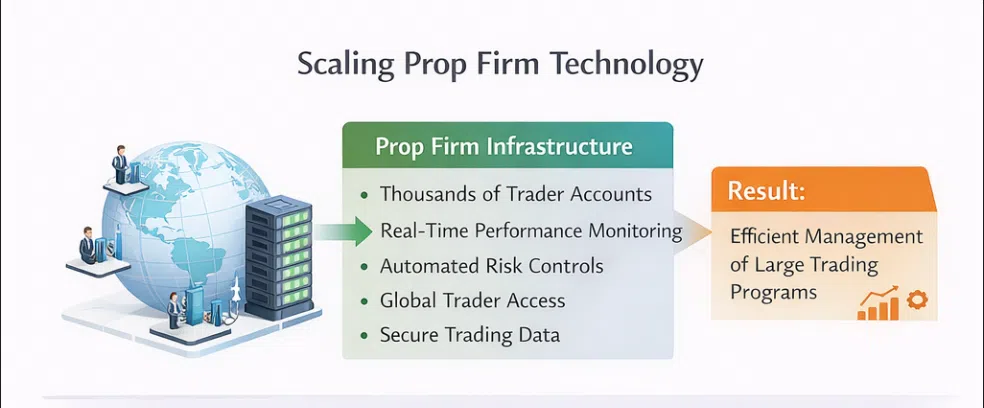
As proprietary trading firms grow, scalability becomes a critical factor in their technology infrastructure. Many firms operate globally, with thousands of traders participating in funded trading programs simultaneously.
Handling Large Volumes of Traders
Prop firm technology must support large volumes of trading accounts while maintaining accurate monitoring and reporting. Systems must process significant amounts of trading data without delays, ensuring that performance metrics and risk indicators remain up to date.
Scalable infrastructure allows firms to expand their operations without compromising monitoring capabilities or operational stability. Without seamless scalability in place, prop firms may experience significant growth issues, with systems struggling to keep up with large user numbers. Latency and bandwidth aside, it can become hard to maintain enforceable digital rules for users, which can significantly hinder the growth projections for prop firms.
Protecting Trading Data and System Integrity
Security is another key consideration in prop firm infrastructure. Trading data, account information, and operational systems must be protected from unauthorized access or disruption.
Many firms implement layered security measures designed to protect both operational systems and trader data. As proprietary trading firms continue to expand internationally, maintaining system stability and data protection becomes increasingly important. Crossing borders can often result in heightened security risks, as prop firms become targets for malicious actors in different regions.
Final Thoughts
Modern proprietary trading firms depend heavily on technology to operate efficiently. As funded trading programs expand and trader participation increases, automated monitoring systems and integrated infrastructure become essential.
Prop firm technology provides the framework that allows firms to track trader performance, enforce program rules, and manage operational workflows at scale. By connecting trading platforms, monitoring tools, and back-office systems into a single environment, these technologies help proprietary trading firms maintain oversight across complex trading operations.
As the brokerage industry continues to evolve, prop firms will likely gain more traction and become a core part of brokerage offerings. Early 2026 trends are pointing to this exact shift in the industry, with many notable brokerage firms adopting proprietary trading practices for their traders. This trend is likely to strengthen in the long term.
FAQs
- What technology do prop firms use to track trader performance?
Prop firms typically rely on performance monitoring systems that analyze trading data such as profit and loss, drawdowns, and trading activity. These tools often include dashboards that display metrics in real time. - How does prop firm technology manage risk in real time?
Many prop firms use monitoring systems that continuously track trading activity against predefined rules. These systems can flag potential risk issues such as drawdown limits or position size violations. - Is prop firm technology different from regular trading platform technology?
Yes. While trading platforms handle market access and order execution, prop firm technology usually includes additional monitoring tools that track performance and enforce trading rules.
- Can a prop firm’s technology detect rule violations automatically?
In many cases, automated monitoring systems are used to detect rule violations such as exceeding drawdown thresholds or breaking trading guidelines. - What platforms and tools are commonly used in prop firm technology stacks?
Prop firm technology stacks often include trading platforms, monitoring dashboards, analytics tools, and operational management systems that help firms track performance and manage trader accounts.
Disclaimer:
This content is based on multiple sources and is provided for educational purposes only. It does not constitute financial, legal, or investment advice.