Dive into our blog for the latest updates, strategies, and analysis in the world of brokerage. Join us on a journey to maximize your trading potential and achieve your financial goals.
One vendor or many? This guide maps the hidden handoffs in a broker's tech stack, matches each sourcing model to your growth stage and gives you a swap test to run before you sign.
MetaTrader is still the centre of gravity for most of the retail trading world. MT4 and MT5 are what the majority of traders know, trust, and expect, and for a broker that is a strong foundation to build on rather than a problem to solve. The platforms are proven, the client base is comfortable with them, and the liquidity and tooling around MetaTrader are mature.
Latin America has become one of the most compelling growth regions in the brokerage industry. A young, increasingly connected, mobile-first population, growing interest in FX, CFD, and crypto trading, and markets that many established brokers have not yet fully served combine to make LATAM a genuine opportunity in 2026. But it is not a region a broker can win by simply translating an existing offering.
Leverate Marketing7 min read
Scale your brokerage today!
CRM & Client Portal, Trading Platform, MT4 & MT5 - All built for you.
Prediction markets have gone from a fringe curiosity to one of the fastest-growing products in trading, and for brokers the question is no longer whether they matter but how to offer them. Prediction markets for brokers means giving clients a way to trade the outcomes of real-world events, elections, sports, economic releases, entertainment, alongside the FX, CFD, and crypto they already trade. The category has scaled at a pace few products ever match: global prediction market volume quadrupled from 2024 to 2025 and kept climbing through 2026, and the trend is carrying that momentum into 2027, drawing both retail traders and institutional attention.
Forex trading technology has moved from a support function to the main arena of competition. Brokers no longer win primarily on price; they win on the technology that shapes retention, differentiation, and margin, and demand for brokerage technology keeps climbing, with the market on track to nearly double by 2034.
Few brokers rely on a single source. Liquidity aggregation combines prices from several providers into one consolidated stream and presents the best available bid and offer at any moment. The result is tighter effective spreads, deeper combined books, and resilience if one source weakens, plus reduced dependence on any single counterparty, which is a risk-management benefit as much as a pricing one.
A broker can lose a funded client before that client has placed a single trade. Research from Fenergo, reported by FinTech Global in 2025, found that 70 percent of financial institutions lost clients in the previous year because onboarding took too long, up from 67 percent the year before and 48 percent two years earlier. The number is moving in the wrong direction, and it is moving in an industry where the technology to fix it has existed for a decade.
Not all order flow is equal. Some client trades are, over time, profitable for a broker to internalise; some are consistently costly. That second category, toxic flow, is one of the quietest threats to a brokerage’s margins, because it looks like ordinary volume until the losses add up. Managing it is not about refusing clients but about seeing flow clearly and routing it intelligently.
Ask ten brokers what forex broker solutions means, and you will get ten answers, because the term covers everything a firm needs to launch and run a brokerage. That breadth is the point: a brokerage is not one product but a connected set of systems, and getting the full set right is what separates firms that scale from those that stall.
The term market maker is used constantly in trading and understood precisely by relatively few. At its simplest, the market maker meaning is this: a firm that stands ready to both buy and sell an instrument, quoting two prices at once and profiting from the difference between them.
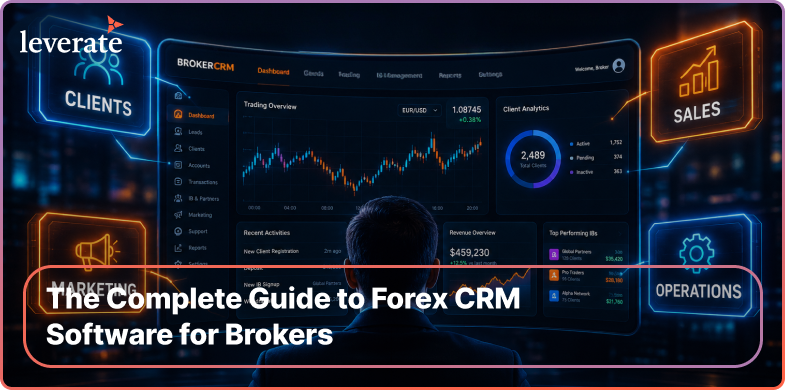
A brokerage can spend between 150 and 400 dollars to win a single client and still finish the month behind if that client never funds an account or quietly goes dormant. Forex CRM software is the system that decides which way that goes. It is the least visible part of a brokerage and one of the most consequential, because it governs whether leads convert, whether deposits arrive, and whether traders stay.
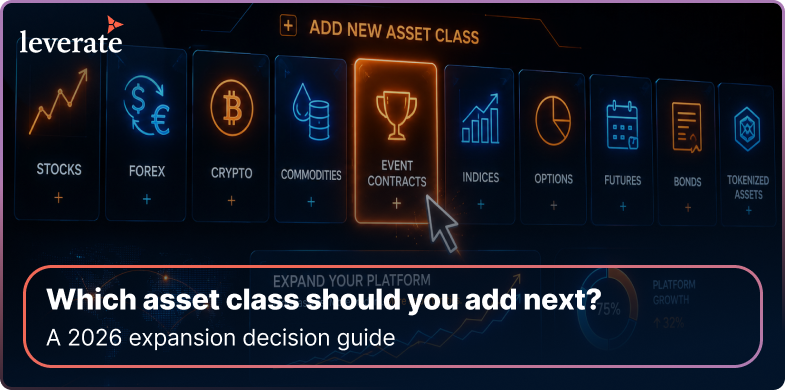
Adding a new asset class can expand trading activity, improve retention and attract new clients. But market popularity alone does not guarantee a strong business case.
Leverate Marketing9 min read
Scale your brokerage today!
CRM & Client Portal, Trading Platform, MT4 & MT5 - All built for you.