











CFD Trading Explained: How Contracts for Difference Work
The demand for accessible, high-speed trading instruments has completely reshaped retail financial markets. Retail traders want immediate exposure to global assets without the friction of traditional ownership. This sustained shift in consumer behavior places massive operational demands on the firms facilitating these trades. Operators must deploy reliable technology, secure robust liquidity, and manage risk with exceptional precision to remain competitive.
Understanding the core mechanics of these derivative products is not just an exercise for traders. For business operators, a deep understanding of these mechanisms dictates how infrastructure is built, how risk limits are enforced, and how revenue is generated. Getting the technology right ensures seamless trade execution, while getting the operational logic wrong can expose a firm to unnecessary risk.
What Is CFD Trading and How Does It Work in Practice
A Contract for Difference (CFD) is a financial derivative that allows traders to speculate on the price movements of underlying assets, such as equities, indices, commodities, or cryptocurrencies, without actually owning the asset itself. The buyer and the seller agree to exchange the difference in the current value of an asset and its value at the end of the contract.
For the trader, the process appears straightforward. They open a position based on whether they believe an asset’s price will rise (going long) or fall (going short). When the position is closed, the profit or loss is realized based on the price difference.
For operators, the mechanics are far more complex. Behind the screen, running a successful CFD brokerage requires an enterprise-grade ecosystem. When a trader clicks “buy,” the brokerage’s infrastructure must instantly process the order, route it through an automated risk management protocol, and execute it against deep, institutional-grade liquidity. The technology must handle thousands of these micro-transactions simultaneously with low latency and high throughput. Seamless integration between the trading platform, the CRM, and the liquidity provider enables the brokerage to maintain a high level of control over trade execution while delivering a smooth user experience.
Key Features of CFD Trading: Leverage, Margin, and Short Selling
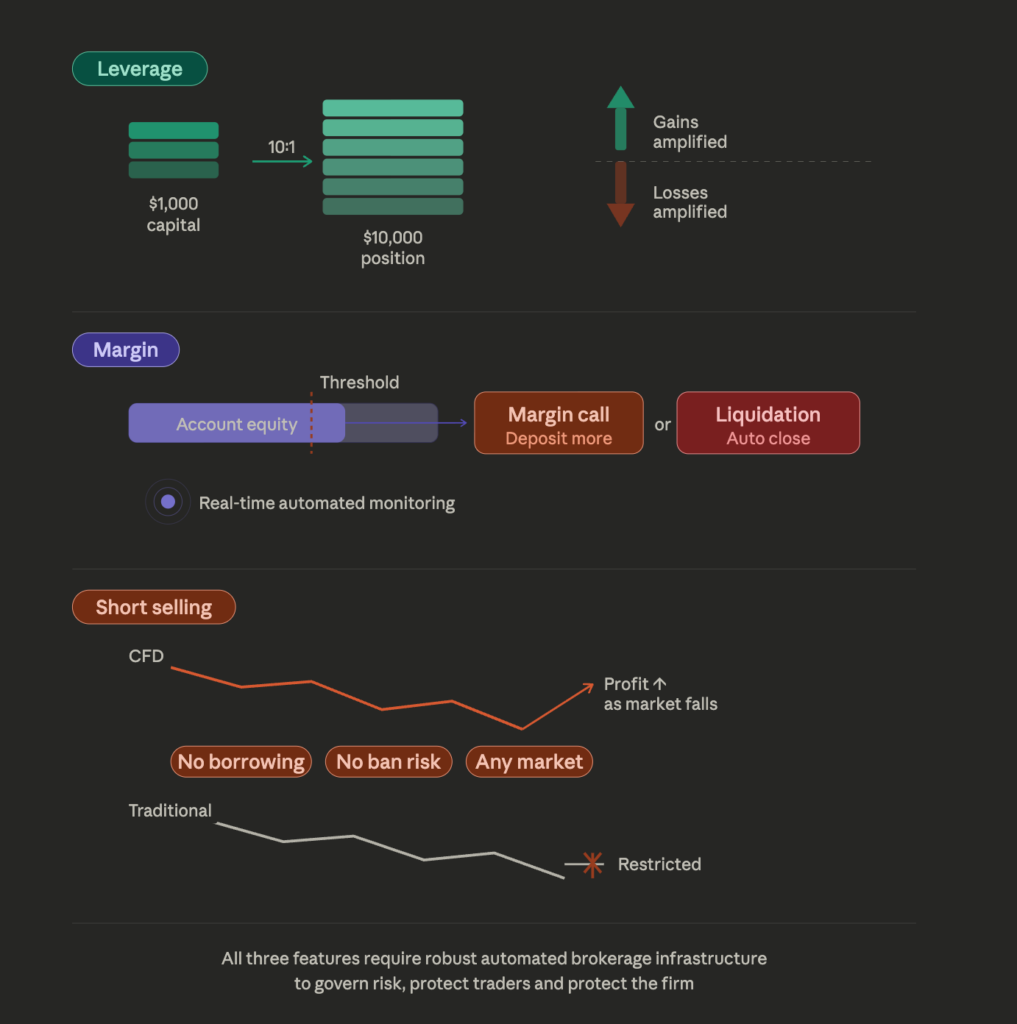
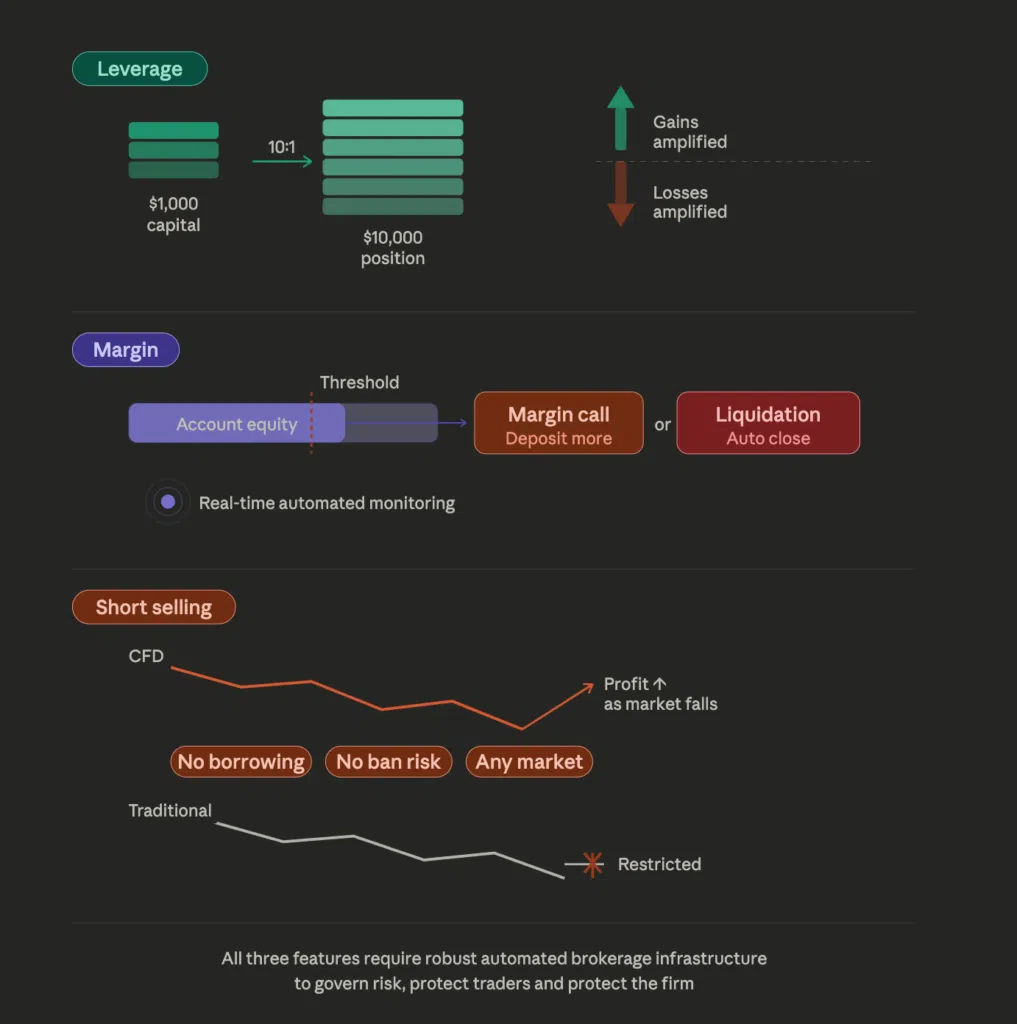
The appeal of CFDs lies in their structural flexibility. Three core features define the product and drive user engagement, but they also require strict governance from the brokerage side.
Leverage is the primary driver of retail interest. It allows traders to open large positions with a relatively small amount of capital. For example, a 10:1 leverage ratio means a trader can control a $10,000 position with just $1,000. While this magnifies potential returns for the trader, it also amplifies potential losses.
Margin acts as the collateral required to maintain these leveraged positions. Brokerages must utilize automated back-office systems to monitor margin levels in real time. If a trader’s account equity drops below a specified threshold, the system is designed to trigger an automatic margin call or liquidate positions in an effort to reduce the risk of negative balances and limit the firm’s exposure to unsecured liabilities. According to the financial framework outlined by Investopedia, standard margin requirements heavily dictate the overall risk profile of the trade.
Short selling provides traders the ability to profit from falling markets. Traditional asset classes often impose strict borrowing requirements or outright bans on short selling. CFDs reduce much of this friction. Since the underlying asset is never physically exchanged, brokerages can offer frictionless shorting opportunities across global markets, keeping trading volumes high even during macroeconomic downturns.
CFD Trading vs Traditional Asset Trading: Main Differences
Traditional investing revolves around ownership. An investor buys shares in a company, holds them in a designated account, and accumulates value over months or years. This model is inherently rigid. Settlements take days, short selling is restricted, and capital requirements limit market participation.
CFD trading operates on speed, flexibility, and capital efficiency. Because traders are merely exchanging contracts based on price movement, the barriers to entry drop significantly.
For brokerage operators, this distinction fundamentally alters the business model. Traditional stockbrokers act as custodians and rely heavily on clearinghouses. CFD providers act as liquidity facilitators. Your technology stack must support multi-asset trading, allowing users to pivot from foreign exchange pairs to global equities within the same interface. Providing a centralized platform where clients can execute trades in milliseconds defines your competitive advantage.
Costs, Spreads, and Fees in CFD Trading
Understanding how CFDs are priced is essential for structuring a profitable and sustainable brokerage model. Unlike traditional brokers who charge fixed commissions per trade, CFD providers primarily generate revenue through dynamic pricing mechanisms.
The spread is the primary cost for the trader and the core revenue engine for the broker. It represents the difference between the buy (ask) price and the sell (bid) price of the asset. Tight spreads attract high-frequency traders and algorithmic systems. To offer competitive spreads without eroding profit margins, brokerages must connect to top-tier liquidity providers that aggregate pricing from multiple global institutions.
Overnight funding fees, commonly known as swaps, apply to positions held open past the daily market close. These fees reflect the interest cost of holding a leveraged position. Traditional legacy platforms often rely on rigid, outdated swap logic. Modern brokerages utilize advanced administrative tools to deploy dynamic swap settings. This allows operators to configure swap multipliers based on the specific day of the week or the asset class, optimizing monetization for 24/7 instruments like cryptocurrencies while maintaining transparency for the end user.
Commission fees may also apply, particularly for Direct Market Access (DMA) models or specific equity CFDs. Implementing a transparent fee structure directly within the trader’s dashboard builds trust, increases retention, and lowers support ticket volume.
Risks and Limitations Traders Should Understand Before Trading CFDs
The structural advantages of CFDs inherently carry substantial risk. Market volatility can cause prices to fluctuate wildly in seconds. When combined with high leverage, minor price movements can result in total account depletion.
Gap risk is a specific limitation inherent to financial markets. If a market closes on a Friday and significant geopolitical news breaks over the weekend, the asset’s price may open substantially lower or higher on Monday. This gap bypasses standard stop-loss orders, potentially leaving traders with significant losses. Brokers mitigate this by offering guaranteed stop-loss orders or utilizing sophisticated B-Book risk management algorithms to hedge exposure.
Regulatory compliance remains the most rigorous limitation. Financial authorities globally enforce strict guidelines to protect retail consumers from excessive risk. For example, the UK’s Financial Conduct Authority consistently updates rules and warnings to ensure firms meet strict expectations regarding the distribution and marketing of these derivatives. Brokerages must implement technology that automatically adapts to varying jurisdictional requirements, seamlessly applying the correct leverage limits and margin close-out rules based on the user’s geographic location.
Frequently Asked Questions
What is CFD trading in simple terms?
CFD trading allows individuals to predict whether the price of a financial asset will go up or down without purchasing the asset itself. If the trader predicts the market direction correctly, they earn a profit based on the price difference from when the contract was opened to when it was closed. If the market moves against them, they incur a loss.
How does leverage work in CFD trading?
Leverage allows traders to gain full market exposure while only depositing a fraction of the total trade value upfront. The broker essentially lends the trader the remaining capital. While this structure allows traders to maximize potential gains from small price movements, it identically multiplies the risk of loss if the market moves in the opposite direction.
Is CFD trading legal and regulated in different countries?
Yes, CFD trading is legal and heavily regulated in many major financial hubs, including the UK, Australia, and various European nations. Regulatory bodies strictly monitor leverage limits, marketing practices, and margin requirements. However, CFDs are outright banned for retail traders in certain jurisdictions, most notably the United States, due to restrictions imposed by the SEC and CFTC.
What are the main risks of CFD trading for beginners?
The primary risk stems from the misuse of leverage, which can rapidly accelerate capital depletion. Beginners often underestimate how quickly volatile markets can trigger margin calls. Additional risks include rapid market gapping, where prices jump past stop-loss protections, and a lack of clear risk management strategies, resulting in emotional or impulsive decision-making.
How are profits and losses calculated in CFD trading?
Profits and losses are determined by multiplying the total number of contracts by the difference in the opening and closing price of the asset. For example, if a trader buys 100 contracts of an asset at $50 and sells them at $55, the profit is $500 (100 contracts x $5 price difference), minus any applicable spreads, commissions, or overnight swap fees charged by the broker.
Disclaimer:
This content is based on multiple sources and is provided for educational purposes only. It does not constitute financial, legal, or investment advice.