












Understanding Liquidity in Cryptocurrency: Why It Matters and How to Measure It
When traders navigate digital asset markets, one concept keeps reappearing: liquidity in crypto. It influences price stability, trade execution, market depth, and overall user experience. Yet many market participants struggle to define it clearly or understand why it plays such a central role.
This guide breaks down the liquidity meaning in crypto, explains why it matters, shows how to measure it, and highlights how institutional-grade providers, like Leverate, offer advanced liquidity solutions that support 24-hour trading across crypto markets.
What Is Liquidity in Cryptocurrency?
Liquidity in crypto refers to how quickly and easily a trader can buy or sell a digital asset without significantly affecting its price. A cryptocurrency is considered highly liquid when large orders can be executed smoothly with minimal slippage.
This aligns with the general definition of liquidity used in traditional finance, which Investopedia describes as “the degree to which an asset can be quickly bought or sold in the market at a price reflecting its intrinsic value” (Source: https://www.investopedia.com/terms/l/liquidity.asp).
Liquidity meaning in crypto (simplified):
- High liquidity → tight spreads, deep order books, stable prices
- Low liquidity → wider spreads, price jumps, unstable market conditions
Crypto liquidity meaning in practice
For instance:
- Bitcoin and Ethereum typically show deep market depth and tight spreads, making them highly liquid.
- Small-cap or newly launched tokens may show thin trading activity, meaning even small trades can push prices up or down significantly.
Liquidity is not just about trading volume. It also includes:
- Number of participants
- Market-making activity
- Order book depth
- External liquidity sources
- Institutional involvement
In short, liquidity in crypto means everything that ensures smooth, stable, efficient trading activity across cryptocurrency markets.
Importance of Liquidity in Cryptocurrency
Liquidity is essential for both individual traders and institutional participants. High liquidity creates an environment where markets behave predictably and efficiently. Several notable financial publications highlight this importance; for example, the Bank for International Settlements (BIS) links liquidity to market resilience and price stability (Source: https://www.bis.org/publ/qtrpdf/r_qt2303b.htm).
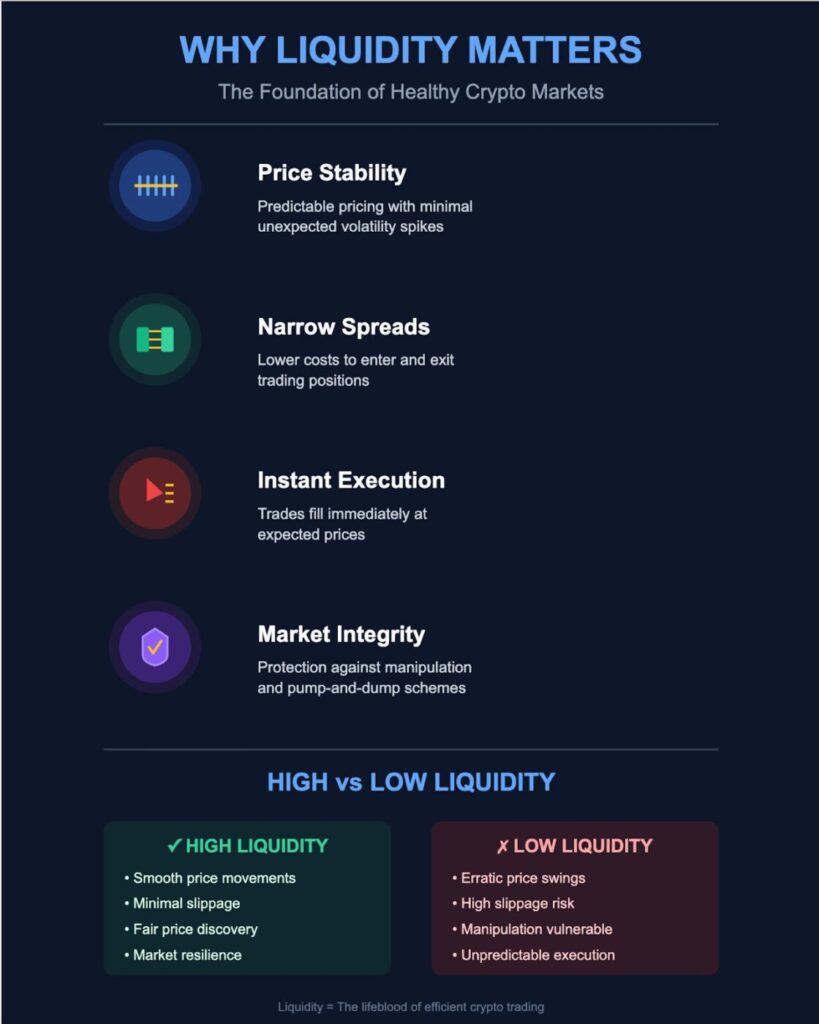
Here’s why liquidity matters:
1. Stable Prices and Reduced Volatility
Markets with high liquidity in crypto experience:
- Lower price manipulation risk
- Less dramatic swings
- More efficient price discovery
Illiquid markets, by contrast, can create sudden price spikes and drops when relatively small trades enter the market.
2. Tight Bid-Ask Spreads
A low spread signals a healthy market.
A wide spread, common in low-liquidity markets, means traders must pay more to enter or exit positions.
According to Coinbase Institutional research, tighter spreads correlate strongly with mature, liquid crypto markets (Source: https://www.coinbase.com/institutional/research-insights).
3. Faster, More Reliable Trade Execution
High liquidity means your trade is more likely to be filled instantly at the expected price.
Low liquidity markets often lead to:
- Partial fills
- Significant slippage
- Slow execution
4. Enhanced Market Integrity
Highly liquid markets are more resistant to:
- Pump-and-dump schemes
- Whale manipulation
- Flash crashes
Greater liquidity supports fairer and more transparent price formation.
Measuring Liquidity in Cryptocurrency
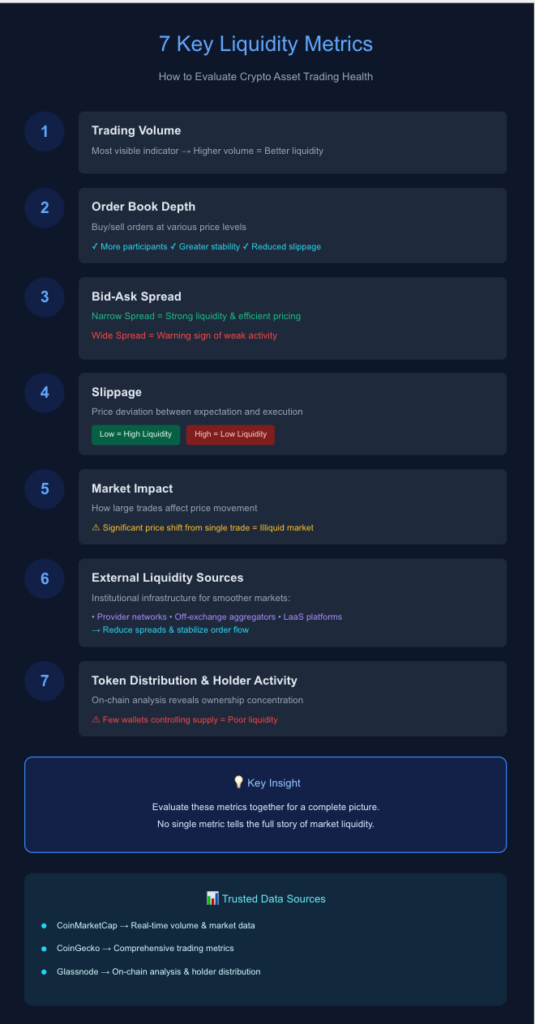
Measuring liquidity in crypto involves evaluating multiple factors that collectively reveal how actively an asset trades and how stable its price is.
Below are widely recognized metrics used by exchanges, market analysts, and institutional players.
1. Trading Volume
This is the most visible and straightforward metric.
Higher trading volume typically signals healthier liquidity. Platforms like CoinMarketCap and CoinGecko provide real-time volume insights:
2. Order Book Depth
Order book depth reveals how many buy and sell orders exist at various price levels.
A deep order book means:
- More market participants
- More stability
- Less slippage for large trades
3. Bid-Ask Spread
A narrow spread implies:
- High liquidity
- More efficient price discovery
A wide spread is a warning sign of weak market activity.
4. Slippage
Slippage occurs when the trade execution price deviates from the expected price.
Low slippage = high liquidity
High slippage = low liquidity
5. Market Impact
This reflects how strongly a large trade affects the asset’s price.
If a single trade significantly moves the price, the market is illiquid.
6. External Liquidity Sources
Institutional crypto markets often rely on:
- liquidity provider networks
- off-exchange aggregators
- liquidity as a service platforms
These sources smooth market behavior, reduce spreads, and maintain stable order book flow.
7. Token Distribution and Holder Activity
On-chain analysis platforms like Glassnode (https://glassnode.com) reveal how widely a token is held.
Assets with concentrated ownership often suffer from poor liquidity because a few wallets control the majority of the supply.
Leverate’s 24-Hour Crypto Liquidity Service
Crypto markets don’t pause, and neither should your liquidity. Leverate’s 24-Hour Crypto Liquidity Service is built for a new era of trading, one defined by constant motion, global participation, and uncompromising performance.
Unlike generic liquidity feeds, Leverate delivers an institutional-grade network engineered for resilience, providing brokers, exchanges, and trading platforms with continuous, deep, and stable liquidity that adapts to market shifts in real time.
Every component of this service is designed with precision: from multi-source aggregation and low-latency execution, to custom integrations that match your trading environment. It’s liquidity with structure, not just access.
Key Advantages
- True 24/7 Coverage across major crypto pairs
- Aggregated Depth from top-tier global providers
- Ultra-Fast Execution powered by advanced infrastructure
- Tailored Integration for brokers and exchanges of any scale
- Liquidity-as-a-Service Architecture built for stability and growth
Whether your firm is expanding into digital assets or enhancing an existing trading operation, Leverate delivers the one thing crypto demands most: liquidity you can rely on, every second of every day.
Conclusion
Understanding liquidity in crypto is essential for anyone who participates in digital asset markets. Liquidity influences price stability, trading efficiency, market depth, spreads, and overall trading experience. By learning how liquidity works and how to measure it, traders and businesses can navigate the cryptocurrency ecosystem more confidently.
As the digital asset industry continues to mature, the role of institutional liquidity providers like Leverate, becomes increasingly important. Leverate’s 24-hour crypto liquidity service empowers platforms to offer stable pricing, deep markets, and seamless execution, elements that define a professional and competitive trading environment.
FAQs
Why does liquidity matter in crypto markets?
Liquidity helps ensure:
- Stable prices
- Tight spreads
- Fast execution
- Lower slippage
- Reduced manipulation risk
High liquidity markets are more efficient and trustworthy.
What happens in low-liquidity markets?
Low-liquidity markets experience:
- Wide spreads
- High slippage
- Greater volatility
- Market manipulation issues
- Difficulty executing large trades
How is crypto liquidity measured?
Liquidity is measured using:
- Trading volume
- Order book depth
- Bid-ask spreads
- Slippage
- Market impact
- On-chain activity
- External institutional liquidity sources
What are the risks of being a liquidity provider?
Liquidity providers may face:
- Impermanent loss (in AMM environments)
- Market volatility exposure
- Smart contract risks
- Counterparty risks
- Regulatory uncertainty
This is why many institutions rely on established firms like Leverate for professional, secure liquidity solutions.