












What Is a Prop Firm Challenge and How Does It Work
The prop trading industry has grown at a pace few anticipated. Between 2020 and 2024, global search interest in prop firms rose approximately 607%, according to FinTech Statistics. Yet despite the surge in participation, the mechanics behind how firms actually evaluate traders remain widely misunderstood, both by the traders attempting challenges and, increasingly, by the operators building these businesses. Understanding what a prop firm challenge is, how it functions, and what it means structurally for a firm running one is not a matter of surface-level familiarity. It determines how you build, price, retain, and ultimately could potentially profit from an evaluation-based model.
How a Prop Firm Challenge Works Step by Step
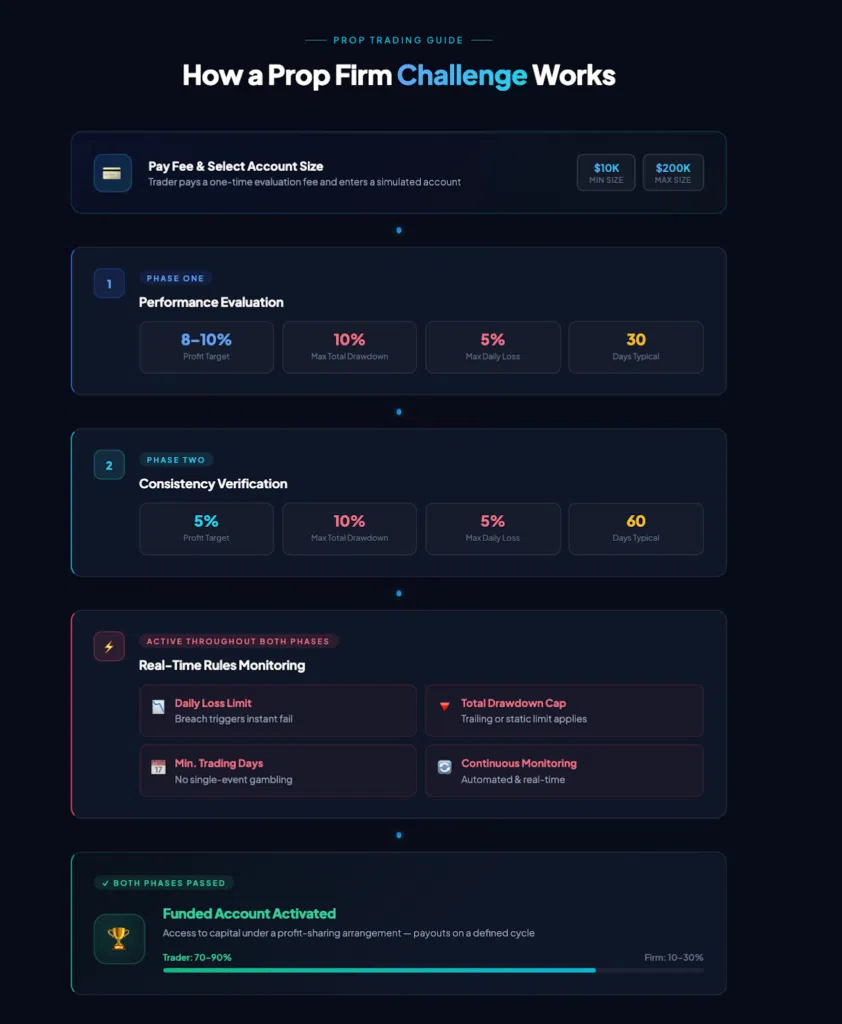
At its core, what is a prop firm challenge? It is a structured performance evaluation that a trader must complete before a proprietary trading firm will allocate real capital to them to trade with. The challenge operates under a defined set of parameters, a profit target, a maximum drawdown limit, a daily loss cap, and often a minimum number of trading days, all of which the trader must satisfy within a set timeframe.
The typical structure runs in two phases. In Phase 1, the trader is given a simulated account of a specific size (commonly ranging from $10,000 to $200,000) and must achieve a profit target, typically between 8% and 10%, without exceeding any of the risk thresholds. Phase 2 is a verification stage with a lower profit target, often around 5%, designed to confirm the consistency demonstrated in Phase 1. Some firms now offer one-phase or instant-funding models, though the two-phase structure remains the industry standard.
Throughout the evaluation, every trade is monitored in real time. If the trader breaches the daily loss limit (typically 5%) or the total drawdown ceiling (typically 10%), the challenge is failed, regardless of overall account performance to that point. The measurement is continuous and, in most structures, automatic.
Once a trader completes both phases within the rules, they are offered a funded account, meaning access to capital under a profit-sharing arrangement, usually giving the trader 70% to 90% of the profits generated.
Why Prop Firms Use Challenges to Evaluate Traders
The evaluation model exists because funded capital carries real risk to the operator. Whether a firm runs an A-Book model where trades are executed into live markets, a B-Book model where they take the opposite side, or a hybrid of both, exposing capital to undisciplined traders is operationally untenable. The prop firm challenge functions as the firm’s primary risk filter.
What is a prop firm challenge doing, fundamentally? It is testing whether a trader can execute a repeatable, rule-based strategy under controlled conditions without reverting to emotional or impulsive decision-making. Pass rates across the industry consistently reflect how demanding this standard is. Most public data sources place the evaluation pass rate at somewhere between 5% and 10%, with Finance Magnates reporting that only around 7% of prop trading accounts ever reach a payout.
For firms, this has a secondary commercial dimension. Challenge fees, typically ranging from $50 to several hundred dollars depending on account size, represent a revenue stream that is separate from profit splits. When the vast majority of participants fail and repurchase, the challenge itself becomes a meaningful part of the business model. This is why the design, pricing, and rules of an evaluation are not just trader-facing decisions; they are business decisions with direct financial consequences.
Common Rules and Restrictions in Prop Firm Challenges
While rules vary across firms, the structure of what is a prop firm challenge converges around several consistent parameters:
Profit Target: The trader must reach a defined percentage return, usually 8–10% in Phase 1 and 4–5% in Phase 2. This is not a bonus; it is a mandatory threshold.
Maximum Drawdown: The account cannot fall below a defined percentage of its starting or peak value. Some firms use a static drawdown (calculated from the initial balance), while others use a trailing drawdown that adjusts as profits grow. The trailing model is considerably more restrictive and is a frequent source of unexpected disqualification.
Daily Loss Limit: Even if the overall drawdown is intact, exceeding the permitted single-day loss, usually 5%, results in immediate challenge failure. This rule specifically targets overreaction trading and emotional decision-making during volatile sessions.
Minimum Trading Days: Many challenges require a trader to be active for a minimum number of days, preventing traders from gambling on a single high-volatility event to meet their profit target quickly.
Restricted Instruments or Strategies: Depending on the firm’s risk model, certain instruments, holding positions over weekends, or news trading during high-impact events may be prohibited.
Consistency Rules: Some firms add a cap on the maximum percentage of total profits earned in any single day, discouraging single-trade gambling and encouraging steady performance over time.
Understanding these parameters is not optional preparation; it is the primary reason why traders could potentially fail. Missing a rule or misreading a trailing drawdown is among the most common causes of disqualification, independent of whether the trader was otherwise profitable.

What Happens After You Pass a Prop Firm Challenge
Passing a prop firm challenge moves the trader into a funded account phase. The firm provides access to simulated capital under a profit-sharing arrangement, and the trader begins generating returns under the same rule set, though typically with slightly more relaxed drawdown parameters than the evaluation.
Profit withdrawals operate on a defined cycle, most commonly bi-weekly or monthly. The trader’s share, usually between 70% and 90%, is paid after the payout period closes, subject to the account remaining compliant with all active rules at the time of the request.
High-performing funded traders are often eligible for scaling, meaning their allocated capital increases over time based on consistent monthly profitability. Some firms offer paths to accounts of $500,000 or more through structured scaling plans, though the conditions for advancement are firm-specific.
It is worth noting that funded account compliance is not a one-time achievement. A trader who breaches a drawdown limit on a funded account loses the account, not just a challenge fee. This post-evaluation risk management requirement is where a substantial number of initially funded traders exit, and it underscores why the challenge’s emphasis on disciplined trading is not procedural but operationally foundational.
How Leverate’s White-Label Prop Suite Redefines Challenge Management
For operators building or scaling a prop firm, the challenge model is only as effective as the infrastructure behind it. Designing the rules is one task; enforcing them in real time, managing trader retention, and administering the commercial mechanics of retries and resets is another matter entirely.
Leverate’s white-label prop suite was built around this operational reality. Rather than offering a fixed challenge template, the platform gives prop firm operators full control over how their evaluation environment is constructed and managed through a dedicated Broker Portal that requires no code to configure.
Firms can define challenge limitations from scratch: profit targets, drawdown thresholds, trading day requirements, restricted instruments, and consistency parameters are all configurable within the portal. This means a firm is not constrained to industry defaults; it can build challenge structures that reflect its specific risk model, client demographics, or market positioning.
Two features within Leverate’s prop suite are particularly significant from a retention and revenue standpoint. The Challenge Keeper tool enables firms to offer traders the option to extend an active challenge when they are approaching but have not yet exceeded the time limit, thereby converting a near-failure into a continued engagement rather than a lost client. The Challenge Retry function enables firms to offer structured second attempts, reducing trader drop-off and creating a potential additional revenue touchpoint within the challenge lifecycle itself.
Beyond the challenge mechanics, the platform includes a real-time trader dashboard, leaderboard functionality, and a certification feature to mark funded trader milestones, all operating under the firm’s own branding. The entire infrastructure means every interface the trader sees, registration, dashboard, challenge tracking, payout requests, carries the firm’s identity, not Leverate’s.
The result is a prop firm environment that an operator can genuinely call their own, without the technical overhead of building it from scratch. Firms can go live in as little as 10 to 14 days (subject to each individual case).
Conclusion
What is a prop firm challenge, in practical terms? It is the mechanism through which a prop firm protects its capital, filters for consistent traders, and generates revenue, all within the same process. The rules are not arbitrary; they mirror the discipline requirements of institutional risk management and exist to separate traders who perform under structure from those who do not.
For traders, the challenge represents a defined pathway to funded capital that removes the barrier of personal capital risk. For operators, it represents both a risk control system and, if designed intelligently, a commercial model with predictable revenue mechanics.
What separates well-run prop firms from the rest is rarely the rules themselves; it is the infrastructure, the configurability, and the retention tooling behind those rules. Getting the evaluation design right matters. Getting the technology to administer it reliably, at scale, under your own brand is where the operational difference is made.
To learn more about prop firm challenges or to start your own white-label prop firm, contact Leverate today.
FAQs
Is a prop firm challenge real trading or just a simulation?
In most cases, the challenge phase operates on a simulated account, meaning the capital is not live, and the trades do not execute into real markets. The conditions mirror live trading in terms of spreads, order execution speed, and market data, but the underlying capital is virtual. Once a trader passes and moves to a funded account, the execution model depends on the firm: some operate A-Book (live market execution), some B-Book (internal), and others use a hybrid approach. Traders should verify the execution model before assuming their funded account trades are placed in real markets.
How hard is it to pass a prop firm challenge on the first attempt?
Statistically, it is difficult. Industry data consistently places the first-attempt pass rate at between 5% and 10% across retail prop firms. The primary reasons are not strategic failure, most traders have functional approaches, but rather risk management errors: exceeding the daily loss limit, breaching the trailing drawdown, or chasing losses after a bad session. Traders who treat the challenge as a rules compliance exercise, rather than a profit maximisation exercise, are measurably more likely to pass.
What are the most common reasons traders fail prop firm challenges?
The leading causes are drawdown violations, both daily loss limit breaches and total account drawdown breaches. Beyond these, the most frequent disqualifying behaviours include: overtrading after losses to recover equity quickly, position sizing that is disproportionate to the account relative to the drawdown threshold, failing to account for spreads during high-volatility events, and misunderstanding trailing drawdown mechanics. In firms where consistency rules apply, generating a disproportionate share of profits in a single session is also a disqualifying factor that many traders overlook.
Can you withdraw profits immediately after passing a prop firm challenge?
Not usually, passing the challenge grants access to a funded account, not an immediate payout. Most firms operate on a defined withdrawal cycle, with the first payout available after a set number of trading days on the funded account (commonly 14 to 30 days), and subject to the account remaining rule-compliant at the time of the request. Some firms also require a minimum profit threshold before the first withdrawal is approved. Traders should review the funded account payout terms before entering a challenge, as these conditions are separate from the challenge evaluation rules themselves.
Disclaimer: This content is based on multiple sources and is provided for educational purposes only. It does not constitute financial, legal, or investment advice.