








Forex CRM in 2026: What Modern Brokers Should Look For
The brokerage landscape is more demanding than ever. Client acquisition costs are rising, regulatory pressure is increasing, and traders expect seamless experiences across platforms. In this environment, operational precision matters more than branding alone.
At the center of that precision is the Forex CRM.
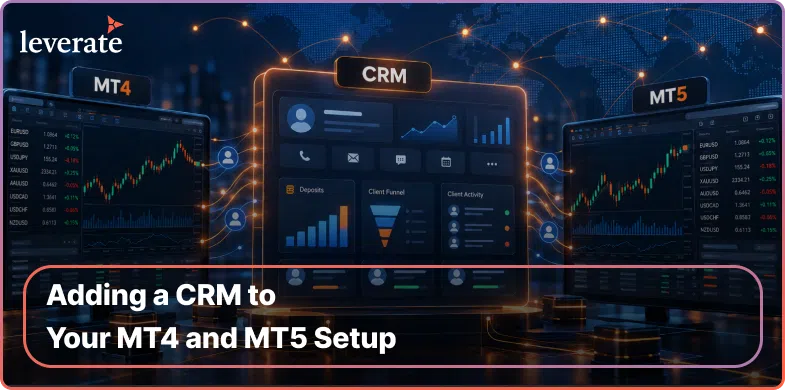
In 2026, a Broker CRM is no longer just a client database. It serves as the operational backbone of a brokerage, linking onboarding, compliance, IB management, payments, trading visibility, and retention into a single system. For both brokerages and prop firms, the right CRM can strengthen scalability, efficiency, regulatory compliance, and the overall bottom line.
Integrated solutions such as Leverate’s Brokerage CRM reflect this shift, positioning CRM as part of a unified brokerage ecosystem rather than a standalone tool.
Key Takeaways
- A modern Forex CRM serves as a brokerage infrastructure rather than just a sales tool.
- Integration with trading platforms is critical for operational clarity.
- IB and affiliate automation require specialized Broker CRM architecture.
- Prop CRM functionality is increasingly important in hybrid brokerage models.
Why CRM Has Become Mission-Critical in Brokerage
Modern brokerages manage multi-step onboarding processes that include KYC documentation, verification approvals, deposit tracking, and account segmentation. They coordinate complex IB networks, integrate multiple payment service providers, and monitor trading activity in real time. At the same time, they must maintain compliance across jurisdictions with different regulatory requirements.

Generic CRM systems were never designed for this environment. While they may support lead management and communication tracking, they cannot natively connect to trading data, automate commission structures tied to volume, or support compliance-specific workflows required in financial markets.
A purpose-built Brokerage CRM bridges sales operations and trading infrastructure. Without this connection, brokerages operate through fragmented systems, forcing departments to rely on exported reports and manual reconciliation.
Industry leaders like Leverate build their Forex CRM specifically for brokerage environments, allowing operational data to flow between trading platforms, CRM dashboards, and back-office systems. This alignment reduces internal friction and improves visibility across the organization. But does it constitute a modern, well-designed forex CRM, exactly? Let’s dive in.
What Makes a Strong Forex CRM in 2026?
In a standardized brokerage market, evaluating a Forex CRM requires more than reviewing features. Brokers must prioritize structural integration, operational visibility, and long-term scalability. A modern Broker CRM should be a complete infrastructure that supports growth, compliance, and risk control simultaneously. Here’s what you should consider when choosing the right option:
1. End-to-End Client Lifecycle Management
A strong Forex CRM begins with seamless client lifecycle automation. From the moment a lead enters the system, the CRM should guide every stage of the journey: onboarding, document submission, KYC, deposit confirmation, account activation, and post-activation segmentation.
The goal is not just efficiency, but consistency. Manual onboarding processes introduce friction, delays, and compliance gaps. A well-structured Broker CRM automates document reminders, verification tracking, and status updates while keeping internal teams aligned. The result is swift onboarding that scales without complications.
Leverate’s Brokerage CRM incorporates lifecycle automation directly within its ecosystem. Because it operates alongside the trading platform and back-office tools, brokers can manage onboarding and activation without relying on disconnected systems or external plugins. This reduces operational bottlenecks and improves the client experience from day one.
2. Advanced IB and Affiliate Infrastructure
Introducing brokers and affiliates remains one of the most powerful growth engines in the forex industry. However, managing IB networks requires precision. Commission structures often include multi-tier hierarchies, hybrid payout models, and performance-based adjustments.

A robust Forex CRM must handle this complexity natively. Commission calculations should reflect actual trading volume in real-time, without manual reconciliation. Performance dashboards should allow brokers and IBs to monitor activity transparently.
Leverate’s system integrates IB tracking directly with trading volume and client behavior, assisting brokers in keeping the commission logic accurate and automated. This not only reduces disputes but also strengthens affiliate trust – a critical factor in long-term partnership retention.
3. Deep Trading Platform Integration
Deep integration with the trading platform is arguably the most critical differentiator between a basic CRM and a true Brokerage CRM.
A modern Forex CRM must provide real-time visibility into balances, deposits, withdrawals, open positions, and overall trading behavior. Without this integration, sales and retention teams operate without context, and compliance teams rely on delayed reports.

Leverate’s integrated CRM connects directly to its white-label trading platform, creating a unified operational environment. Client segmentation can adapt dynamically based on live activity rather than static exports. High-value traders, inactive accounts, or risk-prone profiles can be identified instantly. This shared visibility enables faster decisions and more targeted engagement strategies across departments.
4. Built-In Compliance and Regulatory Support
In 2026, regulatory scrutiny continues to intensify across major financial jurisdictions. Brokers must ensure that onboarding workflows, document storage, and communication tracking meet compliance standards.
A strong Broker CRM should include automated KYC status tracking, secure document archiving, and audit-ready communication logs. Compliance monitoring should be embedded within the CRM rather than managed through external tools.
Leverate’s Brokerage CRM incorporates compliance-ready reporting modules aligned with brokerage-specific regulatory requirements. By integrating compliance into the same environment as onboarding and trading visibility, brokers reduce operational risk and simplify regulatory oversight.
5. Scalability Across Brands and Regions
Growth often introduces complexity. Many brokers expand into multi-brand structures, new jurisdictions, and multilingual markets. A Forex CRM that performs well at early stages may struggle under increased volume or structural expansion.
If implemented properly, Leverate’s infrastructure supports multi-brand and multi-region operations within a unified framework. This allows brokers to maintain centralized oversight while managing separate brand identities and regional workflows. Selecting a scalable Brokerage CRM early helps prevent difficulties with scaling once the business starts growing.
6. Integrated Payment Visibility
Payment processing is central to brokerage operations. Delays or lack of visibility into deposits and withdrawals directly impact client trust and retention.
A modern Forex CRM should provide real-time insight into funding activity, allowing brokers to monitor transaction status, identify failed payments quickly, and segment clients based on funding behavior.
Leverate’s ecosystem connects CRM dashboards with payment processing visibility, ensuring that support and sales teams operate with a full financial context. This integration enhances transparency and client experience, and shortens resolution times. On the business side, efficient payment processing can improve liquidity for brokers.
The Rise of Prop CRM and Hybrid Brokerage Models
The rapid growth of proprietary trading firms has introduced new CRM demands. Prop firms must track challenge phases, monitor rule compliance, evaluate performance thresholds, and automate profit splits.
A standard Broker CRM is rarely equipped to manage these workflows without customization. Leverate’s approach to CRM within a broader brokerage ecosystem allows integration with performance tracking and account logic, supporting hybrid models where brokerages operate both retail and prop divisions.
As the boundaries between traditional brokerage and prop trading continue to blur, CRM flexibility becomes increasingly valuable. Infrastructure that can support both models within a unified environment reduces duplication and simplifies management.
Why Ecosystem Integration Beats Standalone CRM Tools
Many CRM providers compete on features. However, in brokerage operations, integration outweighs feature count. A generic CRM tracks leads. A basic Forex CRM may include trading-related fields. An integrated Brokerage CRM, such as Leverate’s, connects CRM data directly with trading platforms, back-office reporting, and IB management systems.

This ecosystem alignment eliminates barriers. Instead of exporting data between departments, teams access a shared operational view. IB commissions update automatically based on real trading activity. Compliance alerts trigger within the same interface used for onboarding. Client segmentation adjusts dynamically according to behavior.
The Hidden Costs of Choosing the Wrong Broker CRM
CRM decisions often appear secondary during brokerage setup, but the long-term impact is significant. Switching CRM providers mid-growth introduces data migration challenges, disrupts IB logic, and requires retraining staff.
Compliance documentation must be reorganized, and reporting workflows rebuilt. These transitions consume time and resources that could otherwise support expansion.
By choosing an integrated Forex CRM solution early – particularly one designed within a broader brokerage ecosystem like Leverate’s – brokers reduce the likelihood of disruptive system replacements. Infrastructure stability supports growth.
Choosing the Right Forex CRM in 2026
When evaluating a Broker CRM or Prop CRM, brokers should consider whether the system integrates directly with trading infrastructure, supports advanced IB automation, maintains compliance-ready workflows, and scales across regions and brands.
Leverate positions its Brokerage CRM as part of a unified white-label trading platform ecosystem, rather than as a disconnected software module. This integrated model appeals to brokers seeking operational alignment and long-term scalability.
In a market where many brokerages share similar access to liquidity and trading platforms, internal infrastructure increasingly determines competitive resilience.
Final Thoughts: CRM as Strategic Infrastructure
The brokerage landscape in 2026 is defined by maturity. Core asset access is widely available, and technology stacks are increasingly standardized. Growth now depends on operational precision.
A modern Forex CRM is not just a client management tool. It is a strategic infrastructure. It connects marketing, compliance, IB networks, payments, and trading visibility into one coordinated environment.
For brokers navigating competitive markets, the decisive question is no longer whether to use a CRM, but whether the CRM is structurally aligned with brokerage complexity and growth ambitions. That distinction may define operational advantage in the years ahead.
Disclaimer:
This content is based on multiple sources and is provided for educational purposes only. It does not constitute financial, legal, or investment advice.