












Market Prediction Software: How It Works and How to Choose the Right Solution
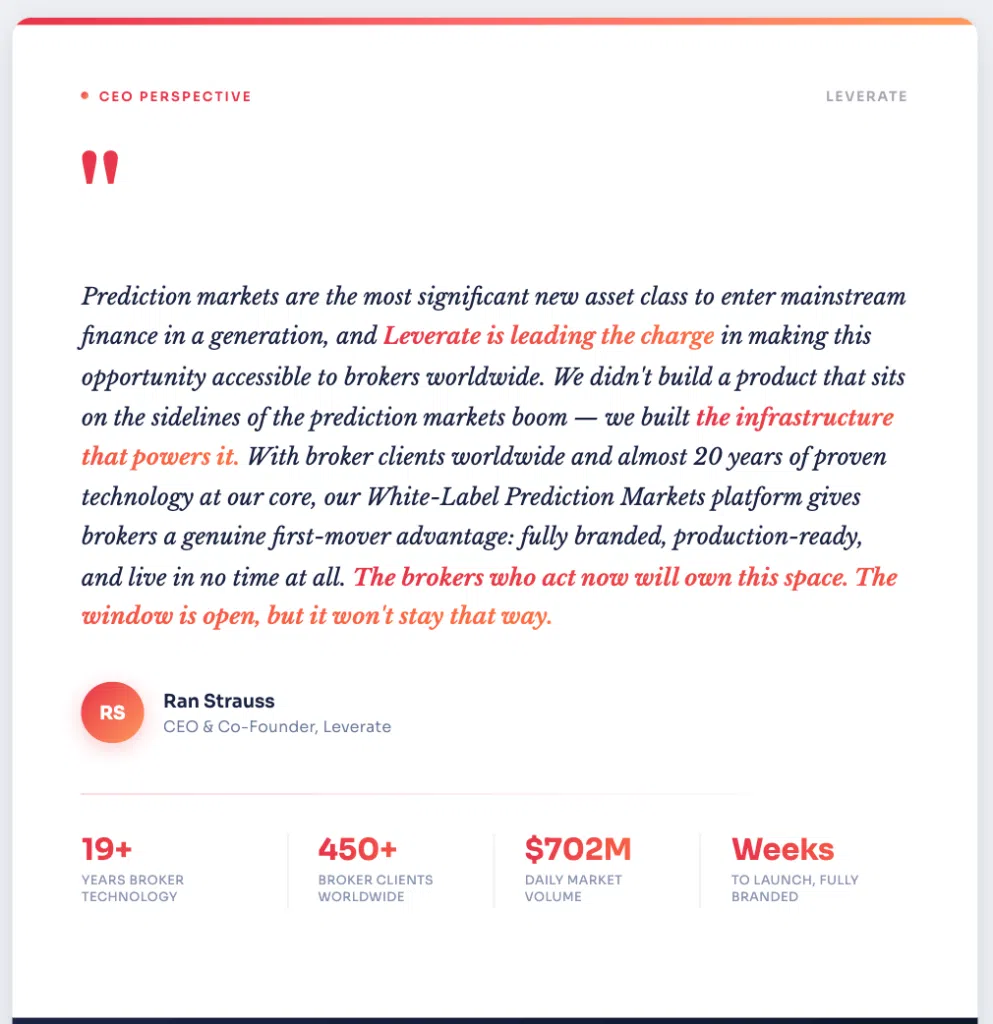
In 2025, prediction markets recorded over $700M in daily trading volume, yet most retail brokers still do not offer them. That gap represents one of the largest untapped revenue opportunities in fintech. As the infrastructure behind this software matures, the question for brokers is no longer whether predictive tools belong in their product stack, but how quickly they can deploy them.
This article examines how these platforms work, what separates capable solutions from inadequate ones, and where they fit, and where they don’t, in a professional trading or brokerage context. For brokers looking to expand into this space, it also introduces the role that platforms like Leverate’s White-Label Prediction Markets solution are playing in lowering the barrier to entry.
What Is Market Prediction Software and How Does It Actually Work
It refers to systems that process financial, economic, or event-based data in order to generate probabilistic forecasts about future market movements, asset prices, or outcome scenarios. The word “prediction” is used broadly here: some tools produce quantitative price targets; others generate directional signals; others, like prediction markets platforms, aggregate collective intelligence from a participant base to arrive at crowd-sourced probability estimates.
At the core of most modern predictive platforms are several distinct technical layers:
Data ingestion and normalization: Real-time and historical feeds from exchanges, economic databases, news APIs, social sentiment trackers, and alternative data sources are cleaned, structured, and made analysis-ready.
Statistical and machine learning models: Ranging from classical regression and time-series analysis (ARIMA, GARCH) to gradient boosting, neural networks, and transformer-based architectures, these models identify patterns and generate forward-looking signals.
Signal generation and scoring: Raw model outputs are translated into actionable signals, confidence scores, or probability estimates that inform trading decisions or platform mechanics.
Delivery and interface layer: Signals are surfaced via dashboards, APIs, embedded widgets, or directly within trading platform interfaces.
Prediction markets represent a distinct but complementary approach. Rather than relying solely on algorithmic models, they harness the aggregated judgement of informed participants trading binary outcomes, “Will the S&P 500 close above 5,500 this week? Yes or No.” The market price, updated in real time as traders take positions, reflects a collective probability estimate.
Key Features to Look for in Professional Market Prediction Software
Not all predictive platforms are built to the same standard. For finance professionals, brokers, and institutions evaluating solutions, the following capabilities separate professional-grade tools from consumer-facing novelties:
Multi-source data integration: The platform should ingest structured market data alongside unstructured inputs, news sentiment, macroeconomic indicators, and social signals and reconcile them at speed.
Transparent methodology: Black-box predictions without explainability are operationally risky. Professional market prediction software should expose model logic, confidence intervals, and the data inputs underpinning each signal.
Low-latency performance: In active markets, stale predictions are worse than no predictions. Architecture must support real-time data processing and near-instant signal delivery.
Risk controls and admin oversight: For broker-facing applications, configurable position limits, exposure caps, circuit breakers, and full audit trails are non-negotiable.
Compliance and KYC/AML compatibility: Any predictive tool deployed within a regulated brokerage environment must integrate cleanly with compliance infrastructure.
White-label and API flexibility: For brokers deploying prediction capabilities as a client-facing product, the ability to brand, configure, and integrate via API is essential.
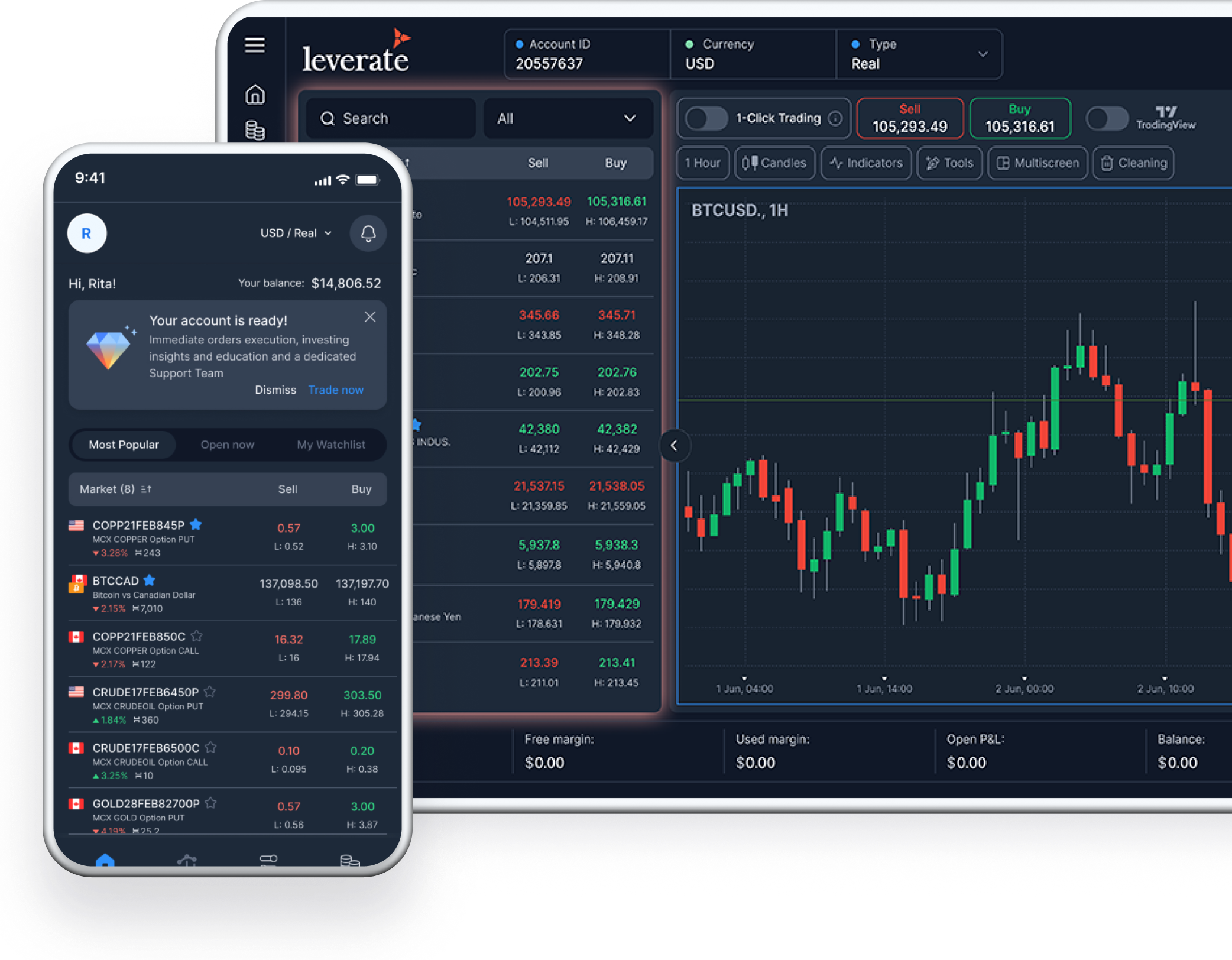
Leverate’s White-Label Prediction Markets platform is specifically engineered to address broker deployment requirements. It ships with a full admin dashboard for market creation and resolution, configurable fee structures, real-time order book mechanics, mobile-first design, and compliance-compatible infrastructure, all under the broker’s own brand.
Market Prediction Software vs Traditional Forecasting Tools
It is worth drawing a clear line between this software and the traditional analytical tools that have long been standard in financial workflows.
Traditional forecasting tools, technical analysis charting platforms, fundamental valuation models, and econometric packages are analytical aids. They process historical data and present it in forms that support human decision-making. The forecasting is performed by the analyst; the tool supplies the data and visualisation framework.
Market prediction software goes further. It automates the analytical process, applying statistical or machine learning models to generate forward-looking outputs without requiring manual interpretation at each step. The system does not just show you a moving average crossover; it tells you the historical predictive value of that crossover and assigns a probability to the outcome.
Prediction markets represent an even more distinct model: the “software” in this context is the market mechanism itself. Price discovery through participant trading creates a continuously updated forecast that reflects the collective assessment of all active traders, a dynamic that no single model replicates.
Each approach has its place. Traditional tools remain valuable for in-depth fundamental analysis. Algorithmic stock prediction software excels at processing large datasets at speed. Prediction markets, as demonstrated by platforms such as Leverate’s, add a social and engagement dimension that drives trader participation, retention, and new revenue for brokers.
Common Use Cases Across Finance, Trading, and Business Analytics
Prediction software is deployed across a wide range of contexts. Understanding where it adds genuine value helps practitioners make better technology choices:
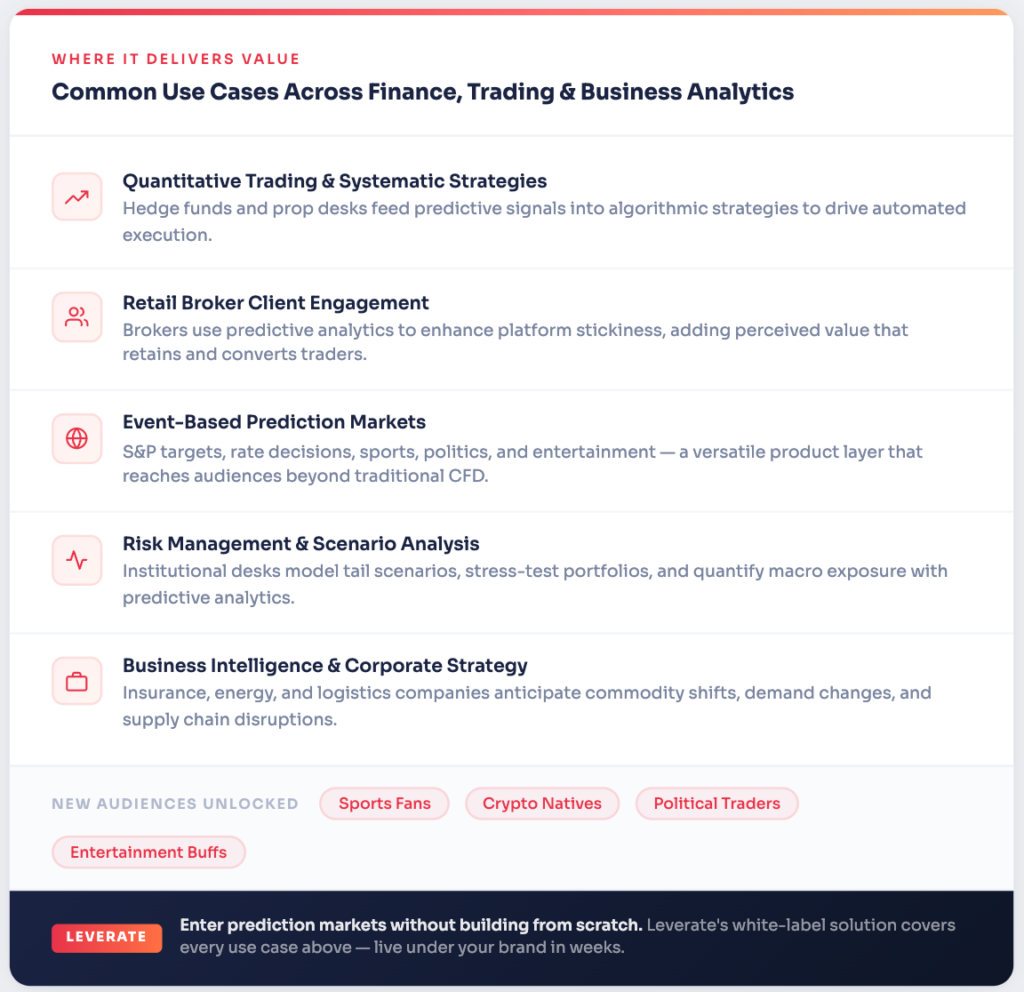
Quantitative trading and systematic strategies: Hedge funds and prop trading desks use predictive models as inputs to algorithmic strategies, generating signals that inform automated execution.
Retail broker client engagement: Brokers use stock prediction software and predictive analytics tools to provide clients with analytical capabilities that enhance platform stickiness and perceived value.
Event-based prediction markets: Covering financial outcomes (S&P targets, earnings calls), macroeconomic events (central bank rate decisions, inflation prints), sports, politics, and entertainment, prediction markets create a versatile product layer that attracts audiences beyond traditional CFD or forex traders.
Risk management and scenario analysis: Institutional desks use predictive analytics to model tail scenarios, stress-test portfolios, and quantify exposure to macroeconomic variables.
Business intelligence and corporate strategy: Outside pure finance, companies in insurance, energy, and logistics deploy these tools to anticipate commodity price movements, demand shifts, and supply chain disruptions.
For brokers specifically, the prediction markets use case has become commercially significant. With regulatory clarity expanding in major jurisdictions and daily trading volumes now measured in the hundreds of millions, the asset class has moved from niche to mainstream. Leverate’s white-label solution lets brokers enter this market without building from scratch, capturing demand from sports fans, crypto-native audiences, and politically engaged traders who have historically sat outside the traditional brokerage funnel.
According to research published by Good Judgment Inc., prediction markets have potentially outperformed traditional expert panels and polling methods on forecasting accuracy across economic, political, and financial domains, reinforcing the structural case for integrating prediction market mechanics into broker platforms.
What to Look for When Evaluating Market Prediction Software
Understanding the technical considerations behind market prediction software is not a reason to hesitate; it is the foundation for choosing the right platform. The most capable solutions are purpose-built to address these challenges, and knowing what to look for puts brokers and operators in a far stronger position when evaluating their options.
Model adaptability over time: Markets evolve, and professional-grade platforms are built with this in mind. The best market prediction software incorporates dynamic model updating and regime detection, ensuring that signals stay relevant as conditions shift rather than relying on static historical assumptions.
Robust validation standards: Reputable platforms go beyond back-tested performance and provide out-of-sample validation data. This is a mark of quality, not a caveat; it separates platforms with genuine predictive value from those trading on historical curve-fitting.
Data quality as a competitive advantage: The sophistication of a platform’s data infrastructure is one of its most important differentiators. Enterprise-grade solutions invest heavily in low-latency feeds, data reconciliation, and alternative data integration, turning data quality from a risk factor into a performance edge.
Compliance-ready architecture: Regulatory alignment is not a burden for well-designed platforms; it is a built-in feature. Leading solutions ship with KYC/AML integration, audit logging, and disclosure tooling, allowing brokers to deploy confidently within their regulatory framework without custom development overhead.
Human intelligence, amplified not replaced: The most effective deployments of this software treat probabilistic outputs as a powerful input to human decision-making, not a substitute for it. Platforms that present confidence intervals and scenario ranges empower traders and analysts to act with greater conviction, not less.
The same principle applies to prediction markets specifically. Platform quality, the depth of the order book, the breadth of market categories, and the engagement tools that drive active participation are what transform the underlying mechanism into a commercially valuable product. This is precisely where Leverate’s White-Label Prediction Markets platform is engineered to excel: delivering the infrastructure, liquidity dynamics, and trader experience that make prediction markets work at scale, from day one.
How Leverate’s White-Label Prediction Markets Platform Fits the Picture
For brokers seeking to enter the prediction markets space, building infrastructure is neither a realistic nor efficient option. Development timelines of 12–18 months, significant engineering overhead, and the operational complexity of running a live trading platform from scratch represent barriers that few businesses outside Tier 1 institutions can justify.
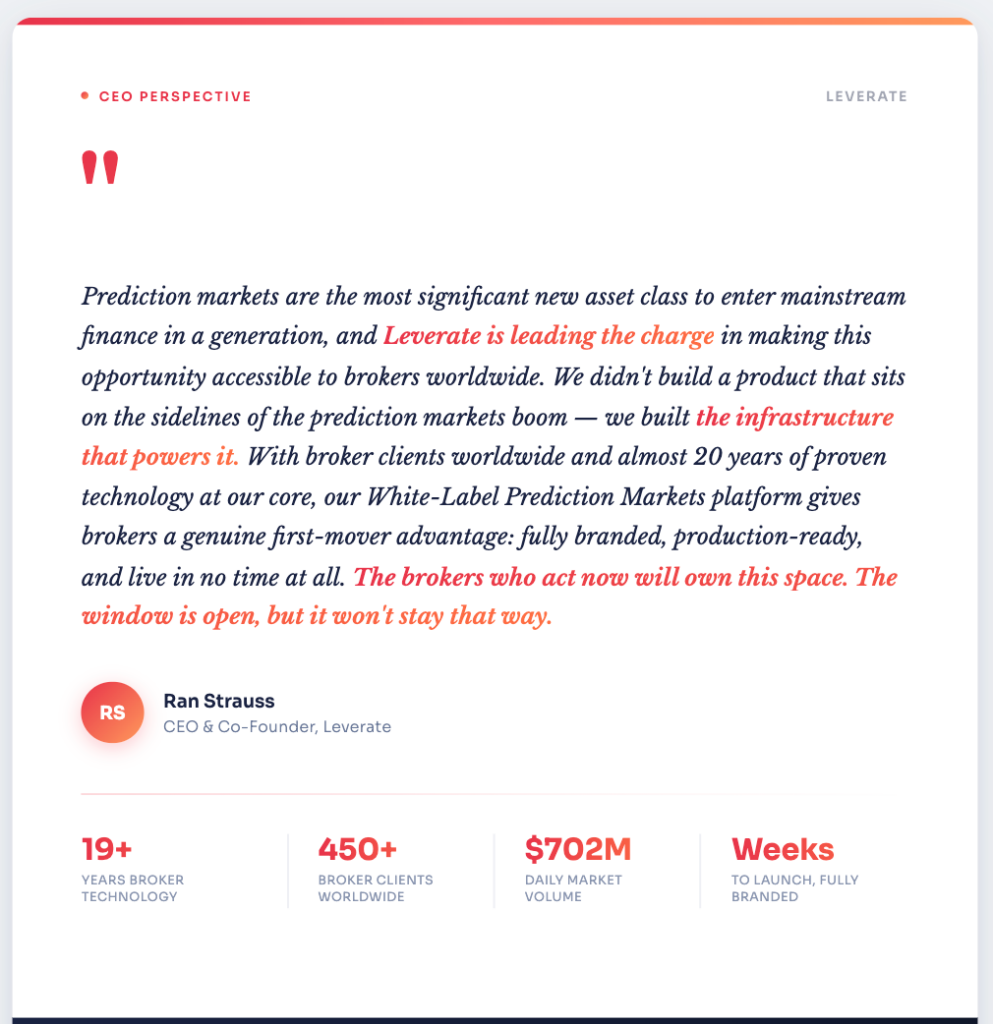
Leverate’s White-Label Prediction Markets platform addresses this directly. Available as a standalone product or as an integrated component to your brokerage’s offerings, the platform is production-ready from day one.
Key capabilities include a dynamic market lobby with real-time order book mechanics, one-click Yes/No trading, a full portfolio dashboard with P&L tracking, social leaderboards and engagement tools, mobile-first design with dark mode, and complete back-office controls for market creation, resolution, and fee configuration. No external oracles are required; brokers maintain full control over outcomes and platform parameters.
The platform supports markets across financial instruments (index targets, earnings, rate decisions), cryptocurrency milestones, sports events, political elections, and entertainment, giving brokers the category breadth to attract audiences that traditional CFD offerings cannot reach. Operators deploying the platform report an estimated 3x user acquisition rate improvement, up to 15–25% additional revenue from spreads and fees, and in some cases up to 85% monthly retention uplift driven by the open-position re-engagement mechanics inherent to prediction market structures.
For brokers already operating on Leverate’s infrastructure, the integration is seamless. For those on MT4/MT5 or proprietary platforms, API connectivity is available with dedicated technical support and typical go-live timelines of two to four weeks.
The scale of the market opportunity is growing, and most retail brokers have yet to act on this. The window for first-mover positioning remains open, but not indefinitely.
Frequently Asked Questions
How accurate is market prediction software in real market conditions?
Accuracy varies significantly by platform, asset class, and market regime. Algorithmic predictive tools generally perform best in stable, trend-following conditions and struggle during structural breaks or low-liquidity events. Reputable platforms publish out-of-sample performance metrics and confidence intervals rather than headline accuracy figures. Prediction markets, as a distinct model, derive their accuracy from participant diversity and trading incentives, a structural property that makes them robust to the individual model failure modes that affect conventional software.
Can market prediction software really forecast stock or crypto prices reliably?
Stock prediction software and crypto forecasting tools can generate statistically significant signals in specific market contexts, but “reliable forecasting” is a high bar. No platform consistently predicts prices with precision across all conditions; if one did, arbitrage activity would eliminate the predictive edge. The more useful framing is that professional predictive tools improve probabilistic decision-making: they raise the quality of analysis and reduce the reliance on intuition, rather than replacing judgement entirely.
What data sources does market prediction software use to generate predictions?
Professional platforms typically draw on exchange price and volume data, economic indicator feeds (CPI, employment, GDP), central bank communications, earnings reports, news sentiment analysis, social media signal aggregation, and, in more advanced deployments, alternative data including satellite imagery, web traffic metrics, and credit card transaction flows. The breadth and quality of data ingestion is one of the primary differentiators between enterprise-grade and retail-facing platforms.
Is market prediction software suitable for beginners or only for professionals?
The answer depends heavily on product design. Institutional stock prediction software platforms are built for professionals with a quantitative background to interpret probabilistic outputs correctly. Prediction market platforms, however, are specifically designed for broad accessibility; the Yes/No binary mechanic requires no chart-reading or financial modelling expertise. This accessibility is central to their value proposition for brokers: they open the platform to demographics that traditional trading interfaces cannot serve.
How is market prediction software different from AI trading bots?
Market prediction software generates forecasts and signals; AI trading bots act on them. The former is an analytical layer that informs decision-making; the latter automates execution. In practice, many institutional deployments combine both, a prediction model generates a signal, and an execution system acts on it within pre-defined parameters. For retail and broker-facing applications, the distinction is operationally important: predictive platforms surface information to traders, while trading bots remove the human decision step entirely, which carries distinct regulatory and risk management implications.
To Sum Up
Market prediction software is not a static category. It spans quantitative analytics platforms, AI-driven signal generators, stock prediction software tools, and prediction market mechanisms that harness collective intelligence at scale. For brokers and financial businesses evaluating their technology stack, the relevant question is not which category is superior but which fits the commercial objective.
For operators seeking to add a client-facing, revenue-generating prediction product without the development burden, white-label prediction market platforms represent the most direct path. Leverate’s solution combines institutional-grade infrastructure with the commercial flexibility brokers need, deployable as a standalone product or as part of a complete brokerage ecosystem and backed by 19 years of broker technology experience across more clients worldwide.
To explore how Leverate’s White-Label Prediction Markets platform can fit your brokerage, visit the product page or book a demonstration with the Leverate team.
Disclaimer:
This content is based on multiple sources and is provided for educational purposes only. It does not constitute financial, legal, or investment advice.