
There is a quiet gap opening up in the brokerage industry, and it is not the gap between firms that use AI and firms that do not. Almost everyone uses AI now. The gap is between firms that have added AI to what they already do and firms that have started rebuilding what they do around AI. The first group has a chatbot on the website and a copilot in the marketing team. The second group has AI sitting underneath onboarding, retention, risk, and reporting, reading from the same data the whole business runs on. Both groups will tell you they are investing in AI. Only one of them is becoming AI-native.
This article is about that second move, the harder and more valuable one. It looks at what actually changes when AI stops being a feature you bolt on and becomes the operating layer your brokerage runs on, why so few firms have made the shift despite near-universal adoption, and the practical steps to get there in 2026. The short version: the tools are no longer the differentiator. What you connect them to is.
The problem: everyone has AI, few have an operating layer
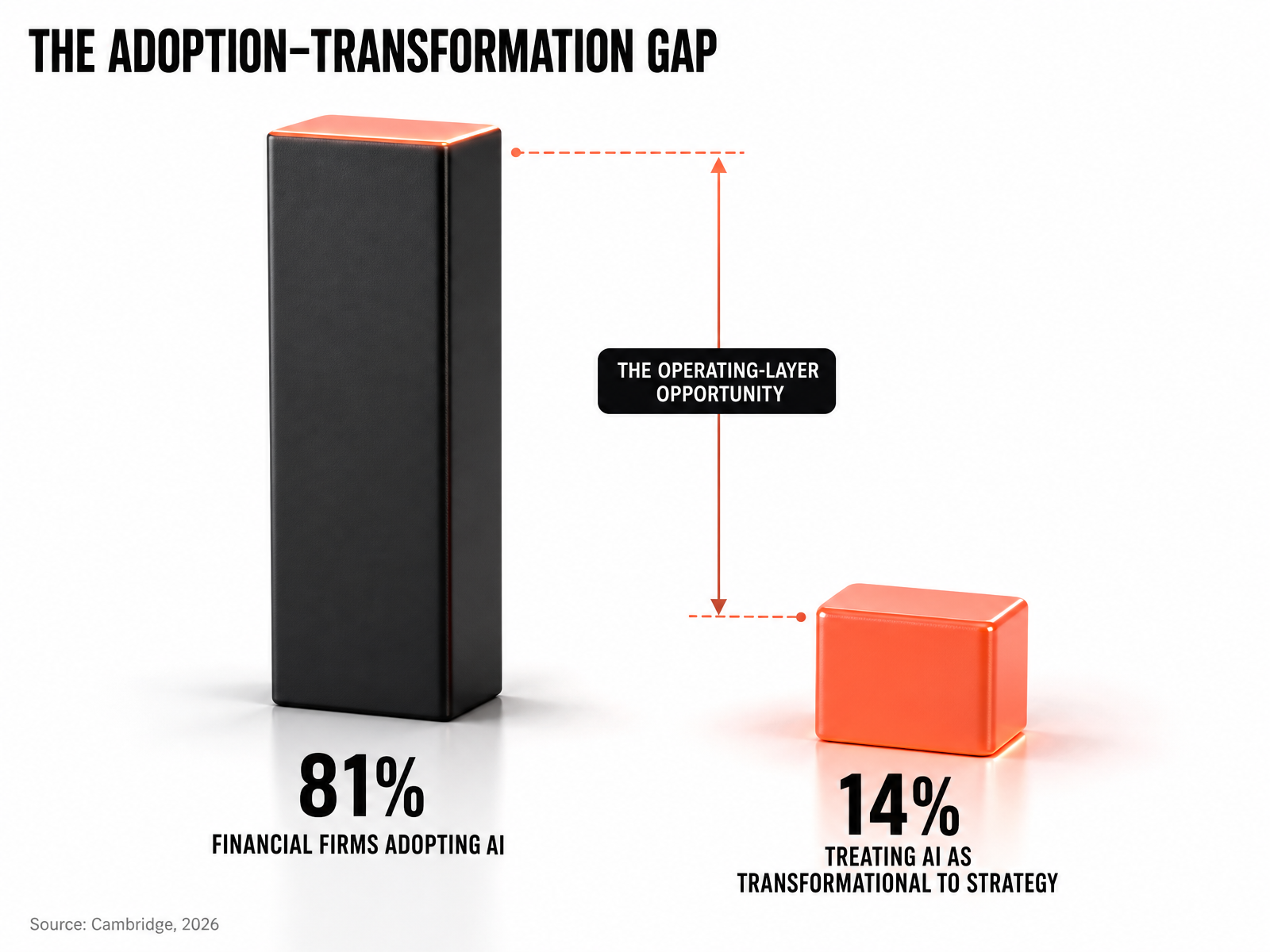
Adoption is no longer the story. In Gartner’s 2025 survey of chief financial officers and senior finance leaders, 59 percent reported using AI in their finance function, up from 37 percent as recently as 2023. Zoom out to financial services as a whole and the picture is even starker: the Cambridge 2026 Global AI in Financial Services Report, which surveyed 352 institutions across 151 jurisdictions, found 81 percent of firms adopting AI at some level. When four in five of your peers are already using the same class of tools, owning them stops being an advantage. It becomes the price of entry.
So where does the advantage go? The same Cambridge research points straight at it. Only 14 percent of industry respondents currently see AI as transformational to their strategy and competitive advantage. Read those two numbers together and the gap is impossible to miss: 81 percent are using AI, but barely one in seven has turned it into something that changes how the business competes. That distance between adoption and transformation is the whole game. It is the difference between a brokerage that bought AI and a brokerage that was rebuilt around it. Most firms are stuck on the near side of that gap because they treated AI as a set of features to install rather than a layer to build on. The tell is easy to spot. Ask a firm what its AI has changed, and if the honest answer is a faster support queue and a tidier inbox, the AI is a helper, not an operating layer. When AI is genuinely underneath the business, the answer is different: decisions that used to take days now take minutes, and work that used to need a person now needs only a review.
Scale your brokerage today!
CRM & Client Portal, Trading Platform, MT4 & MT5 - All built for you.
Scale NowWhat AI-native actually means
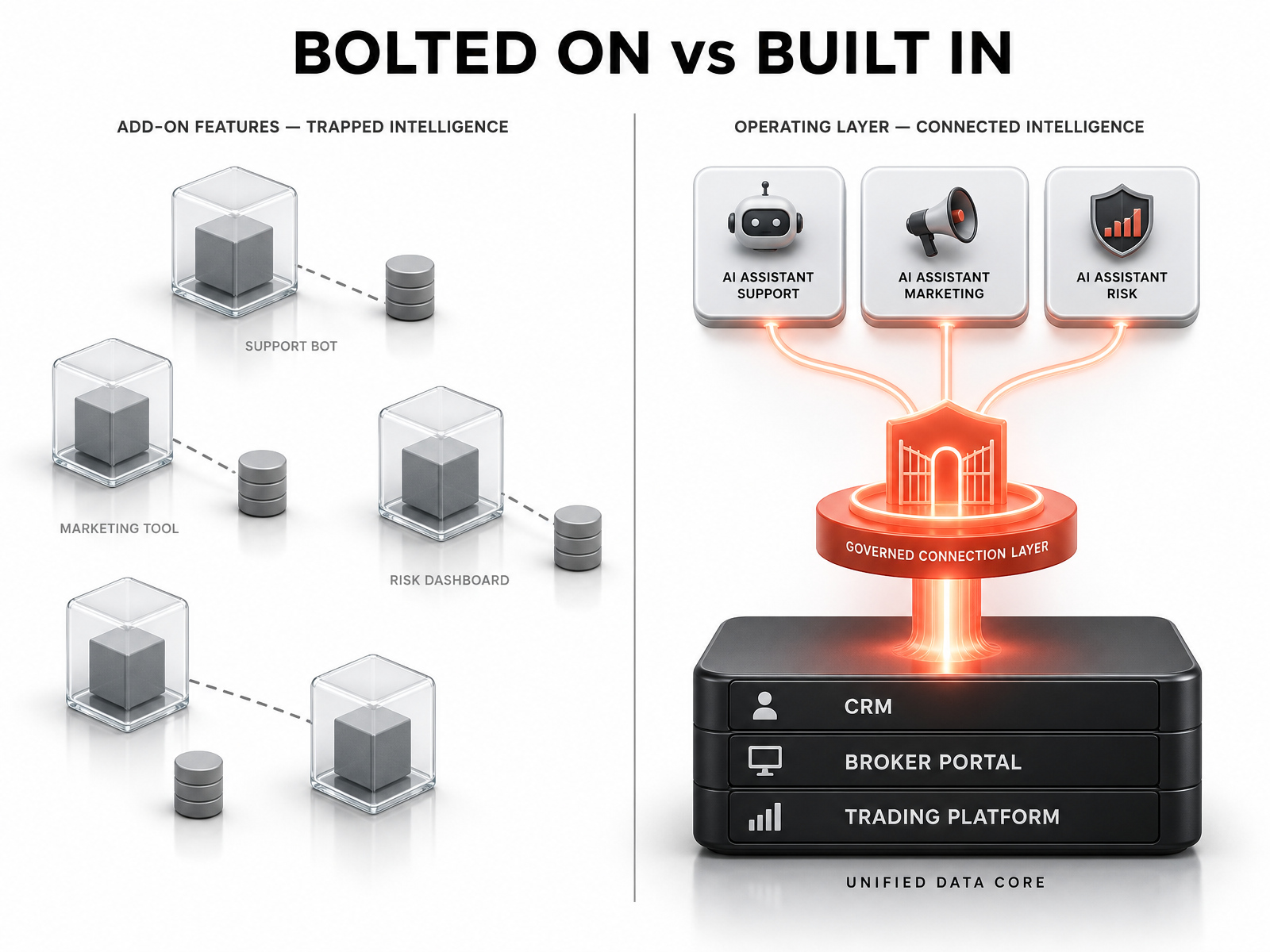
An add-on sits beside your operations. An operating layer sits underneath them. That distinction sounds abstract until you look at how work actually flows. In a bolt-on setup, AI lives in silos: a support bot that cannot see the CRM, a marketing tool that cannot see trading activity, a risk dashboard that cannot answer a follow-up question. Each tool is clever in isolation and blind to everything else. The intelligence is real, but it is trapped, because none of it is connected to the data that gives it meaning.
An AI-native brokerage inverts that. The data stays where it lives, under the permissions already set, and AI reaches across all of it through one governed connection. Now the same assistant that reviews a marketing funnel can also see where those clients went on the trading platform, because it is reading from a single, permissioned view of the business rather than a handful of disconnected exports. The question stops being ‘which tool do I open’ and becomes ‘what do I want to know’. That is the practical meaning of AI-native: not more AI, but connected AI, wired into the systems the business already runs on.
This is exactly the problem the Leverate MCP server was built to solve. Built on the open Model Context Protocol standard, it lets brokers securely connect AI assistants such as Claude, ChatGPT, and other compatible models directly to their permissioned Leverate data across CRM, Broker Portal, and Trading Platform, through a single governed connection your team configures in the Broker Portal. The word governed is doing the heavy lifting. An operating layer is only safe to build on if access follows the permissions you have already set, so the assistant sees precisely what a given role is allowed to see and nothing more. Because the protocol is open, you are also not locked into one AI provider, which matters when the layer underneath your business needs to outlast this year’s favourite model.
AI across the brokerage: automation, retention, and risk
When AI becomes the operating layer, the payoff shows up in the parts of the business that never made it into the marketing brochure. Automation is the first. The repetitive, rules-heavy work that quietly eats a team’s week, moving a client from registration through verification, reconciling activity, drafting the routine communication, can be handled by AI-driven automation that reads live data rather than a static export. The people you freed up do not disappear. They move to the work that actually needs judgement, which is where a brokerage earns its margin.
Retention is the second, and it is where predictive AI quietly outperforms human attention. A client rarely announces they are leaving. They just log in a little less, trade a little smaller, go quiet after a bad run. A model watching behaviour across the book catches those signals early and flags the account while an intervention still means something. The same connected intelligence powers acquisition and engagement through Algo Studio, where traders build and run their own strategies without developers, giving them a reason to stay active that has nothing to do with a discount. Retention stops being a monthly report and becomes a live signal the business can act on.
Risk is the third, and it is the one where the operating-layer model matters most, because risk is where blind spots are expensive. AI can watch exposure, flow, and account activity across desks continuously and surface the outlier before it becomes a loss, so the risk team is deciding sooner rather than reconstructing later. Crucially, the model never pulls the trigger. It surfaces, summarises, and suggests, and a person decides, which is exactly the right division of labour in a regulated business. This is the design principle running through everything Leverate builds into the Leverate MCP server: every output supports a human decision, and the broker stays in control. AI-native does not mean hands-off. It means better informed, faster, and still accountable.
How to become AI-native: four practical moves
Start by finding your gap, not your tools. Most brokerages already own more AI capability than they use well. The first move is not to buy anything. It is to map where decisions are still slow because the data is hard to reach: the funnel question that takes a day to answer, the churn you only spot in hindsight, the exposure you reconcile after the fact. Those bottlenecks are your roadmap. They tell you exactly where a connected operating layer would pay for itself first.
Then connect before you expand. The instinct is to add another point tool for each problem. The AI-native move is the opposite: give the AI you already have a safe, governed line into the data it needs, then let one connection serve many jobs. A single permissioned connection that spans CRM, Broker Portal, and Trading Platform can answer a marketing question, a risk question, and an operations question without three separate integrations. Consolidating access is what turns scattered cleverness into a layer, and it is usually cheaper than the pile of disconnected subscriptions it replaces.
Keep the human in the loop by design, not by accident. The firms that scale AI safely are the ones that decided early which calls a model may inform and which a person must make. Write that line down. In practice it means the assistant surfaces the churn risk and the human runs the retention play, the assistant flags the exposure and the risk officer sets the limit. Accountability cannot be delegated to a model, and in a regulated business that is a feature, not a constraint. Building on an open standard rather than a single vendor keeps that control in your hands as the technology moves.
Finally, measure transformation, not activity. It is easy to count how many AI tools you have switched on. That number belongs to the 81 percent. The number that puts you in the 14 percent is different: how many decisions are now made faster and from evidence rather than instinct, how much manual work has left the week, how much churn was caught early enough to act on. Those are the metrics of an operating layer. The brokerages that track them are the ones quietly closing the gap between owning AI and being changed by it, and the tools to do it are already on the table. What remains is the decision to build on them.
One last thing, and it is the reason this matters now. What we have described here is the foundation, not the finish line. Leverate is building a next-generation AI ecosystem that goes beyond a connected operating layer, designed to help brokers build the business they have always pictured. We are not sharing the specifics yet, but if the idea of AI as real infrastructure interests you, the next chapter is worth watching.
**Disclaimer:
**This content is based on multiple sources and is provided for educational purposes only. It does not constitute financial, legal, or investment advice.