







How Back Office Systems Use Full Client History to Reduce Trader Churn
Trader attrition rarely announces itself. There is no formal exit, no cancellation email, no conversation. A trader simply stops logging in, and by the time a brokerage takes notice, the window for intervention has already closed. This pattern is not inevitable; it is largely the result of operational blind spots. When the systems managing a brokerage cannot connect the dots between client behavior, account history, and front-line response, churn becomes a structural outcome rather than an avoidable one.
The brokerages that consistently retain traders are not necessarily offering better spreads or more instruments. What separates them, operationally, is their ability to act on information before it becomes irrelevant. That capability lives in the back office, specifically in how client data is collected, surfaced, and acted upon across every function of the business. Investing in purpose-built back office software for brokers is no longer a back-end convenience; it is a primary mechanism for retention.
Centralized Client Data Across Trading Operations
The foundational problem with trader churn is not a lack of data; it is fragmented data. Most brokerages accumulate substantial information about their clients across different systems: trading activity in the platform, deposit and withdrawal history in payment tools, support tickets in a helpdesk, and onboarding records in compliance workflows. When these data sets exist in isolation, the operational picture they produce is incomplete.
Effective churn-reduction software starts here: data unification. A centralized back office infrastructure means that every touchpoint a trader has with a brokerage is recorded, timestamped, and accessible from a single environment. The sales team, support agents, compliance officers, and account managers are all working from the same client record. There are no version conflicts, no manual reconciliation, and no gaps where context disappears between departments.
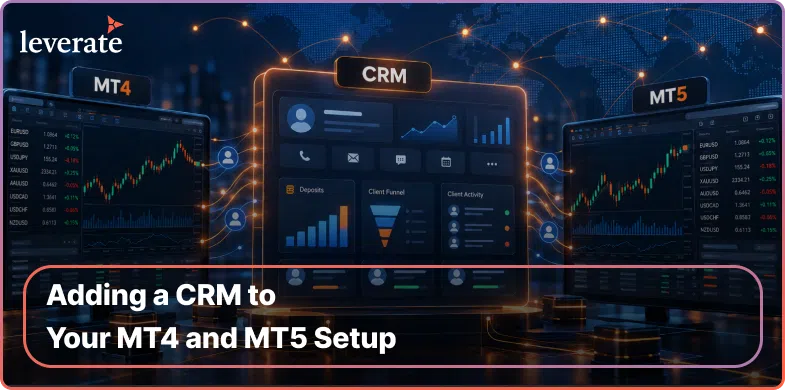
Leverate’s CRM is built on this principle. Designed specifically for the needs of forex and CFD brokers, it aggregates client data across the brokerage’s operational layers, giving teams a continuous, unified view of each trader. Rather than toggling between disconnected platforms, client-facing staff can access deposit history, communication logs, trading activity, and account status in one interface. This kind of data continuity is not just an operational convenience; it is a prerequisite for any serious effort to reduce churn rate across a live client base.
Behavior Patterns and Activity Signals in Trading Accounts
Understanding why traders leave requires looking at what they do before they leave. Inactivity rarely appears overnight. It tends to follow a predictable sequence: declining trade frequency, reduced deposit activity, an unresolved support issue, or a withdrawal that was never followed by a re-deposit. Each of these is a measurable signal, and together they constitute an early warning system, provided the back office infrastructure is capable of surfacing them.
The value of full client history lies precisely in this predictive capacity. When a system can show that a trader who was previously executing ten trades per week has reduced to two, or that a client who deposited consistently for three months has gone quiet following a failed transaction, those data points become actionable. The business no longer has to wait for an account to go dormant; it can identify at-risk traders while there is still time to act.
This is where the behavioral intelligence embedded in modern churn reduction software differentiates itself from basic reporting tools. Rather than simply recording what happened, it helps brokerages identify potential future behavior patterns, configure alerts, segment clients accordingly, and prioritize outreach based on real signals rather than assumptions. For a brokerage managing hundreds or thousands of active accounts, this kind of intelligent segmentation is the difference between proactive retention and reactive damage control.

Operational Responses Driven by Full Client Visibility
Identifying an at-risk trader is only useful if the organization can respond with sufficient speed and relevance. A retention effort that arrives three weeks after a trader has mentally moved on is functionally no different from no effort at all. The operational architecture of the back office determines how quickly client intelligence translates into action.
When support teams have full visibility into a trader’s history, including previous interactions, outstanding issues, account tier, and trading preferences, their responses are materially better. They can personalize outreach rather than sending generic re-engagement messages. They can resolve issues with context rather than starting from scratch. And critically, they can prioritize the accounts where intervention is most likely to have an impact, rather than distributing attention uniformly across the client base.
Leverate’s back office software for brokers addresses this directly through the combination of CRM and the Leverate Broker Portal. The CRM equips support and success teams with complete client histories, smart ticketing, and integrated communication tools, including built-in VOIP and messaging, so that every trader interaction is informed by the full context of the relationship. The platform’s segmentation capabilities allow teams to build targeted campaigns based on behavioral data, ensuring that re-engagement efforts are specific, timely, and relevant.
This operational responsiveness is a core mechanism of churn reduction. It shifts the brokerage from a reactive posture, dealing with attrition after it occurs, to a proactive one, where the systems themselves surface risk and equip teams to address it.
Coordinated Back Office Processes That Prevent Trader Drop-Off
A single failure rarely causes trader drop-off. More often, it is the compounding effect of several small friction points: an onboarding process that took too long, a delayed deposit without communication, a KYC verification that left a trader in limbo, or a withdrawal that created more doubt than confidence in the platform. Each of these moments is a decision point. How the brokerage handles them, and how quickly, shapes whether a trader deepens their engagement or starts looking elsewhere.
This is where coordinated back office processes become retention infrastructure. When KYC, risk management, payment processing, and client communication operate from a connected platform, the experience traders have is smoother and more consistent. Delays are reduced. Exceptions are flagged before they become complaints. Compliance processes run in the background without creating friction at the client level.
Leverate’s Broker Portal is purpose-built for this kind of operational coordination. As a plug-and-play solution for brokers, it brings risk oversight and client-facing operations into a single, configurable environment. The portal integrates with leading KYC and AML providers, including automated verification workflows that keep traders informed of their status in real time, reducing the onboarding drop-off that represents one of the most common and preventable sources of early churn. Risk management capabilities allow brokerages to configure trading rules by group, region, and instrument, with live visibility into positions and exposure, without requiring manual intervention that slows operations down.
The plug-and-play architecture of the Broker Portal matters because time-to-operation is itself a retention variable. Brokerages that can go live quickly with a fully integrated back office, rather than spending months on custom integrations, are able to deliver consistent, professional client experiences from day one. And consistent, professional experiences are what keep traders engaged over the long term.
When CRM and the Broker Portal operate as an integrated system, the coordination between data, compliance, and communication creates a structural advantage for retention. Client history informs support. Compliance workflows do not delay trading. Risk parameters are applied consistently. The combined effect is a brokerage environment where operational friction, one of the most underestimated drivers of trader attrition, is systematically minimized. This is churn reduction software operating at the level of business infrastructure, not just client management.

Conclusion
The conversation around trader retention in the brokerage industry too often defaults to product and pricing. While these factors matter, they rarely explain the majority of churn. What explains it, consistently, is the operational experience, how traders are onboarded, how quickly their issues are resolved, how well the brokerage communicates across the lifecycle, and whether the systems underpinning those interactions are capable of working in concert.
Back office infrastructure, when designed around full client visibility, transforms retention from a reactive effort into an operational discipline. The ability to reduce churn rate meaningfully depends less on individual gestures toward at-risk traders and more on whether the systems themselves are built to surface risk early, coordinate response, and remove friction before it accumulates.
Leverate’s combination of CRM and the Broker Portal provides brokers with exactly this kind of infrastructure, purpose-built back office software for brokers that integrates client history, compliance, risk management, and communication into a unified environment. It is not a collection of standalone tools bolted together, but a coordinated system designed to keep traders engaged, supported, and active.
For brokerages serious about reducing trader attrition, the starting point is not a new promotion or a better spread. It is a back office that knows each client well enough to act, and a platform built to turn that knowledge into results.
FAQs
How can trading firms spot churn before it actually happens?
The clearest indicators of impending churn are behavioral shifts that precede outright inactivity: declining trade frequency, a drop in deposit activity, unresolved support tickets, or a withdrawal not followed by re-engagement. Effective churn reduction software tracks these signals over time and flags accounts that show early warning patterns. The critical factor is not just having the data, but having it in a unified system where it can be acted on by the right team member at the right moment.
What client data really matters when traders become inactive?
The most operationally useful data points are trading frequency trends, deposit and withdrawal history, support interaction logs, and onboarding completion status. Together, these paint a picture of how deeply embedded a trader is in the platform and where the relationship may have experienced friction. Full client history, accessible in a single system rather than spread across disconnected tools, allows support and retention teams to approach re-engagement with genuine context rather than generic outreach.
Is trader churn usually about performance or about experience?
While trading losses can accelerate disengagement, research and operational experience consistently show that experience-related factors, slow onboarding, unclear communication, unresolved issues, and platform friction, are major contributors to churn across all performance segments. Even traders who are performing well will disengage if the operational experience is poor. This is why back office systems that streamline processes and reduce friction are central to any strategy to reduce churn rate, not just a supporting element.
How often do traders leave because of operational friction?
More often than brokerages typically account for. Operational friction encompasses a wide range of issues: delayed KYC verification, payment processing errors, slow support response times, and inconsistent communication. Each of these is individually addressable, but when they compound, which they tend to do in brokerages with fragmented back office systems, the cumulative effect on retention is significant. Industry observations suggest that brokerages investing in coordinated back-office software for brokers can see improvements in trader lifetime value, potentially associated with fewer operational delays and reduced support failures.
Can back office systems actually influence trader retention?
It can potentially be possible in cases. Churn reduction software that connects client data, compliance workflows, and communication tools enables brokerages to act faster, personalize at scale, and remove the friction points that cause traders to disengage. Leverate’s CRM and Broker Portal are specifically designed to give brokers this capability, providing full client histories to support teams, automating KYC and compliance processes, and enabling targeted retention campaigns based on real behavioral signals rather than assumptions. The impact can often be observed in the quality and consistency.
Disclaimer:
This content is based on multiple sources and is provided for educational purposes only. It does not constitute financial, legal, or investment advice.