







Social Trading 2.0: PAMM, MAMM & Copy Trading for Brokers
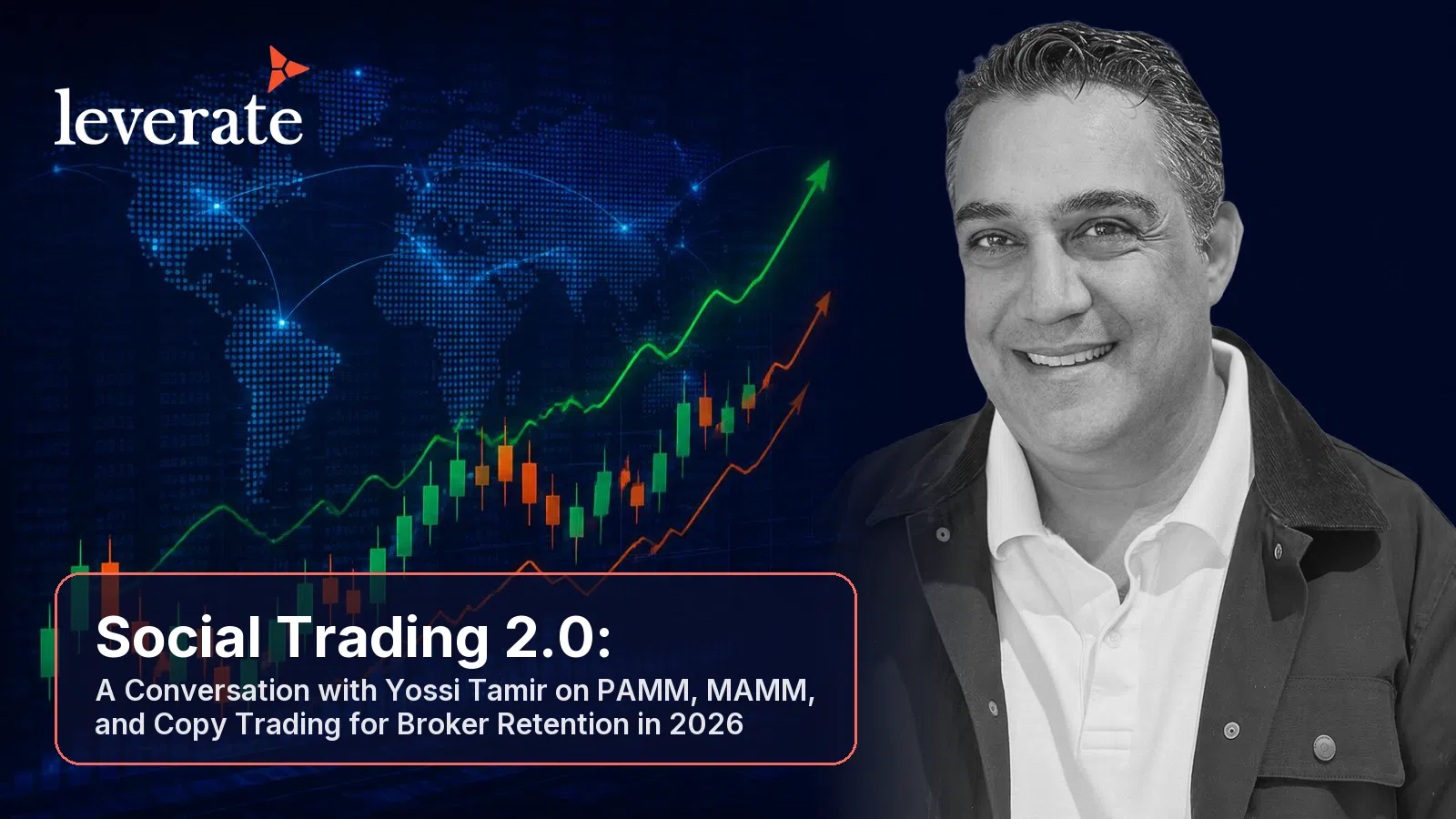
Social trading has moved from a bolt-on novelty to a core part of how brokers keep traders active. We sat down with Yossi Tamir, Head of Business Development at Leverate, to unpack what PAMM, MAMM, and copy trading are actually contributing to broker retention this year, and where the model is heading next.
Why the Math Stopped Working on Acquisition Alone
Every broker knows the number that quietly decides their year: what it costs to acquire a funded trader versus what that trader is worth before they go quiet. For a long stretch, that gap was forgiving enough that you could grow by buying more traffic and tightening the funnel. It is not forgiving anymore. The same affiliate pools and ad inventory are being bid up by more operators chasing the same audiences, so cost-per-acquisition keeps climbing while first-deposit values sit flat. Meanwhile, the one thing that used to justify the spend, a distinctive platform, can now be stood up by a competitor in days, which means the platform on its own has stopped being the reason anyone stays.
That combination turns a brokerage into a leaky bucket. You can pour acquisition spend in the top, but if engaged traders drain out the bottom faster than you replace them, the spend never compounds. The operators pulling ahead are the ones who spotted the leak before their cost-per-acquisition did, and reframed the question from “how do we find more traders” to “how do we give the ones we already have a reason to come back tomorrow.” That reframing is what put social trading at the centre of the retention conversation.
Q: What changed in the way operators think about retention?
Yossi Tamir: The honest answer is that brokers ran the numbers and the maths stopped working. When the cost of acquiring a trader rises faster than the revenue that trader generates in their first weeks, you cannot grow on acquisition alone. So the question quietly flipped. Instead of “how do we find more traders,” the better operators started asking “how do we keep the engaged ones engaged for longer?” Retention is not a feature you add at the end. It is the part of the business that decides whether the acquisition spend was worth anything.
Yossi Tamir: What we have seen across our broker and prop client base is that engagement and retention move together. A trader who feels connected to the platform, who has a reason to log in beyond placing their own orders, tends to stay active longer. Social trading sits right at that intersection, which is why the category has gone from a nice-to-have to something operators ask about in the first conversation.
The commoditisation problem
When every operator can offer similar instruments, similar spreads, and a similar interface, the experience becomes the battleground. Social trading reframes the platform from a solitary tool into a community, and that shift in experience is difficult for a competitor to copy quickly because it is built on participation, not just code.
Personalisation reinforces the same point. McKinsey research indicates that getting personalisation right can lift conversion meaningfully, and a community layer is one of the most natural ways to make a platform feel tailored to the individual trader.
What PAMM, MAMM, and Copy Trading Actually Do
The three terms get grouped as “social trading,” but they solve different problems and suit different traders. Understanding the distinction lets an operator position each one correctly rather than treating them as a single undifferentiated feature.
Q: Can you separate the three for operators who use the labels interchangeably?
Yossi Tamir: They overlap in spirit but differ in mechanics, and the difference matters when you are deciding who each one is for.
Copy and social trading
Copy trading is the most accessible entry point. A trader browses a leaderboard of other traders, reviews their published statistics, and chooses to mirror their activity. On Leverate’s premium Trading Platform, the social layer is built in rather than bolted on through a third party: traders can follow top performers, view real-time leaderboards, and copy strategies directly from the dashboard. Because it is native, it uses the same single sign-on across the Trading Platform and Client Portal, so a trader does not have to juggle separate logins to participate.
The mechanism that drives retention here is participation. A trader who is following others, comparing performance, and engaging with a community has more reasons to return than a trader staring at a single chart alone.
Recently, Leverate introduced a different approach to copy trading through Algo Studio. The environment lets advanced traders build custom strategies from a rich set of indicators and market patterns; once constructed, the strategy runs automatically, opening trades according to its own logic and closing them with automated Stop Loss and Take Profit orders.
What matters for retention is what happens next. A trader who joins Algo Studio but lacks the background to build their own algorithm can browse a library of ready-built automated strategies and copy them directly. That is a departure from traditional “blind” copy trading. Instead of relying on dry performance statistics alone, the copying trader can see the underlying strategy, inspect the technical logic, and choose the approach that fits their own risk profile. It offers full transparency into both the trading style and the mechanics behind how a strategy has behaved, which is a very different proposition from following a number on a leaderboard.
PAMM – percentage allocation
PAMM, the Percentage Allocation Management Module, is built for investors who want a hands-off approach. Capital is allocated to a money manager, and the manager’s trades are mirrored proportionally across the participating accounts. Profit and loss are distributed according to each investor’s share of the pool, and real-time equity curves and statements give participants visibility into what the manager is doing. Multi-manager support lets an investor spread capital across several managers rather than concentrating it with one.
For the operator, PAMM does two useful things. It opens the platform to a different audience, people who want exposure to managed strategies without trading themselves, and it gives existing traders who would rather delegate a reason to keep their capital on the platform instead of moving it elsewhere.
MAMM – multi-account management
MAMM, multi-account management, addresses the manager’s side of the same relationship. Where PAMM is structured around proportional capital pooling, a multi-account manager setup lets a professional manage many individual client accounts from a single master interface, allocating trades across them by lot or by a defined ratio while each account remains distinct. It suits managers who run larger books and need granular control over how each sub-account is handled.
Taken together, copy trading lowers the barrier for the everyday trader, PAMM serves the delegating investor, and MAMM equips the professional manager. An operator who offers all three covers the full spectrum of how people want to participate, rather than forcing everyone into one model.

| Dimension | Copy / Social Trading | PAMM | MAMM |
| Best suited to | Everyday traders wanting guidance | Hands-off investors | Professional money managers |
| Core mechanism | Follow and mirror selected traders | Proportional capital allocation to a manager | One manager, many distinct accounts |
| Operator value | Higher participation and engagement | Attracts delegating investors | Supports larger managed books |
What This Looks Like on a Broker’s Platform in 2026
The theory only matters if the tools are usable day to day, for the trader and for the operator running the business. This is where the integration of the social layer with the rest of the stack becomes the deciding factor.
Q: Where does the social layer connect to the rest of the operator’s stack?
Yossi Tamir: Everywhere, and that is the point. The copy trading features live inside the Trading Platform and the mobile app, so a trader can browse performers, review their statistics, and follow them without leaving the platform. Single sign-on carries them across the Trading Platform, the Client Portal, and copy trading without re-authenticating, which removes one of the quiet drop-off points operators rarely measure. And on the operator side, the Broker Portal gives the firm control over the trading conditions, risk parameters, and segmentation that sit underneath all of it.
Yossi Tamir: That same social principle now reaches into automated trading. Because the strategies built in Algo Studio can be published, followed, and copied directly within the platform, the community layer covers algorithmic strategies as well as manual ones, people learning from and following each other, just applied to code. Across our client base it has been one of the faster-adopted additions, with a majority of clients having activated it.
A neutral example
Consider a trader who registers, completes onboarding, and places a few orders based on predefined parameters. On a solitary platform, if those early sessions are uneventful, the account can go quiet. With a social layer available, the same trader can follow an experienced participant, observe how positions are structured, and stay engaged with the platform while they learn. The platform is providing tools for analysis and observation; it is infrastructure that supports participation, not a driver of any particular financial outcome.
What Operators Should Weigh Before Rolling This Out
Offering social trading is not the same as offering it well. The operators getting the most from it treat it as a considered part of the platform strategy rather than a checkbox, and they pay attention to a few things in particular.
Q: If a broker is evaluating this now, what should guide the decision?
Yossi Tamir: Start with who your traders actually are, then map the model to them. If you serve a lot of newer or self-directed traders, the copy and social layer is the natural first move because it has the lowest barrier to participation. If you have a base of investors who would rather delegate, PAMM earns its place. If you are courting professional managers, MAMM is what they will ask for. You do not have to launch everything at once; you sequence it to your audience.
Yossi Tamir: The second thing I would stress is transparency. Social and managed trading only build loyalty if participants can see what they are following. Real-time statistics, clear equity curves, and honest reporting are what turn the feature into trust. The third is integration. A social layer that sits apart from your CRM, your risk controls, and your reporting creates more operational work than it removes. It needs to be native to be worth running.
A note on risk and positioning
Two points are worth keeping in mind. First, copy trading and managed-account models involve risk like any form of trading; past performance of a strategy or manager is not an indication of future results, and any use of leverage can amplify exposure as well as potential returns, which is why it carries significant risk. Operators should present these tools accordingly. Second, this is a B2B conversation. The features described here are infrastructure for brokerages and fintech companies to enhance operational efficiency and trader engagement, not a promise of trading success for any individual.
Q: Where is social trading heading from here?
Yossi Tamir: We are standing at the dawn of an entirely new era, one defined by absolute data transparency and radical information sharing. The future of social trading is not just about copying someone else’s positions; it is about AI-driven strategic empowerment. The sky really is the limit here.
The element that will reshape the social trading space is the integration of conversational and analytical AI directly into the community layer. Imagine a platform where a trader does not just see a Master Account’s past returns, but can ask the AI to dissect that Master’s exact trading strategy. The AI reverse-engineers the strategy, breaks down its technical indicators, and gives a clear, plain-language explanation of how and why that Master trades.
And we do not stop there. Before a follower allocates a single dollar, they can run an on-demand backtesting simulation through the AI to audit how that Master’s strategy logic would have behaved across different market cycles and historical downturns. It turns the platform into a visual algorithmic studio for everyone.
Beyond that, this AI layer continuously scans the markets to surface real-time information on emerging conditions, which users can then choose to act on under an AI Master Account, bringing automation within reach of the wider community. We are moving away from the black-box models of old. The future belongs to smart, automated, and highly transparent ecosystems where technology bridges the gap between expert strategy and community execution.
Explore how the social and managed-trading layer fits into Leverate’s platform ecosystem.
Frequently Asked Questions
What is the difference between PAMM and MAMM?
PAMM pools investor capital and allocates a money manager’s trades proportionally across participants, with profit and loss split by each investor’s share. MAMM keeps each client account distinct while letting a single manager allocate trades across many accounts by lot or ratio. PAMM is structured around pooled, hands-off investment; MAMM is structured around a professional managing many separate books.
Is copy trading the same as social trading?
Copy trading is one part of social trading. Social trading is the broader category that includes leaderboards, following other traders, and community features. Copy trading specifically refers to mirroring a chosen trader’s activity. On Leverate’s premium Trading Platform these features are native and connected through single sign-on.
How does social trading relate to retention for brokers?
Engagement and retention tend to move together. A trader who participates in a community, follows others, and has reasons to return beyond their own orders generally stays active longer. The platform supports that engagement; it is infrastructure rather than a guarantee of any financial result for the trader.
How is native copy trading different from third-party copy trading tools?
A native social layer runs inside the platform itself, so it shares the same login, account data, and reporting as everything else the trader uses. With an approach like Algo Studio, the copying trader can also inspect the underlying strategy and its technical logic rather than following performance statistics blind. Third-party tools typically bolt on from outside, which adds separate logins and less visibility into how a strategy actually works.
Are PAMM, MAMM, and copy trading available on mobile?
The copy trading features are accessible through the desktop Trading Platform and the mobile app, with full synchronisation across devices, so a trader can follow, review, and manage participation from desktop or mobile with a single login.
About Yossi Tamir
Yossi Tamir is Head of Business Development at Leverate, leading strategic partnerships and client growth. With over a decade in fintech and trading technology, he works with brokers worldwide on how they build, operate, and scale.
Explore the platform’s capabilities. To see how Leverate’s social and managed-trading layer fits into your brokerage, book a demo with the team.
Disclaimer:
This content is based on multiple sources and is provided for educational purposes only. It does not constitute financial, legal, or investment advice.