












Broker Infrastructure in 2026: The Four Pillars That Separate Leaders from the Rest
In 2026, only brokers and prop firms that master the art of purpose-built infrastructure will thrive. The market is evolving at a relentless pace, automation, global competition, and new models for trader engagement are redefining what it takes to lead. If you want your operations to scale seamlessly, adapt to fast-shifting requirements, and deliver a consistently excellent client experience, the four pillars outlined in this article are non-negotiable. Read on to discover not just what’s changing, but the blueprint for future-proof growth in a rapidly transforming landscape.
The challenge is that most brokers are still running on architecture built for a different era. Systems designed when compliance was simpler, when traders were less sophisticated, and when the idea of running a prop firm alongside a CFD brokerage would have seemed exotic. That era is over.
What follows isn’t a product checklist. It’s a framework for thinking about where operational complexity is increasing, where the critical decisions actually live, and what separates firms that scale from those that stall.
Pillar One: AI Automation – From Reactive to Predictive Operations
The first wave of fintech automation was about eliminating manual tasks. The second wave, happening now, is about eliminating the need for human judgment in low-value decisions so that expertise can be redirected toward high-value ones.
The scale of this shift is significant. According to Grand View Research, the global AI trading platform market was estimated at $11.23 billion in 2024 and is projected to reach $33.45 billion by 2030, growing at a CAGR of 20% from 2025 to 2030, according to Statista. The practical implication for brokers isn’t just competitive, it’s operational. Firms that don’t embed AI into core workflows will increasingly be running at a structural disadvantage against those that do.
The difference between basic automation and genuinely intelligent systems matters here. Basic automation handles KYC document requests and sends triggered emails. Agentic AI monitors trader behavior across thousands of accounts simultaneously, identifies breach conditions before they occur, flags toxic flow patterns before they become capital risk, and adapts onboarding journeys in real time based on user behavior.
For CFD brokers, this means risk teams stop firefighting and start strategizing. Instead of reacting to margin call situations, systems surface exposure concentrations earlier, allowing measured responses rather than emergency ones.
For prop firms, the implications are more acute. Challenge economics depend on the firm’s ability to distinguish legitimate trading edge from rule exploitation. Static rules create static loopholes. Adaptive systems, ones that learn from behavioral patterns across the entire trader population, create a significantly more resilient operating model.
This shift is also reshaping what traders expect from the platforms they use. Algorithmic trading tools, once the exclusive domain of institutional desks, are now an expectation for serious retail traders. Brokers who can offer integrated algo trading capabilities, strategy building, backtesting, and automated execution within the same environment where traders are already active, retain more of the high-value segment that would otherwise migrate to specialist platforms. This is an area where the infrastructure decision has a direct revenue consequence, not just an operational one. Leverate has integrated algorithmic trading support directly into its ecosystem for exactly this reason, keeping advanced traders engaged within the broker’s environment rather than losing them to standalone tools.
The key question for any operator in 2026 is not whether to adopt AI automation, but which decisions are genuinely improved by automation and which still require human judgment. The firms getting this distinction right are building competitive moats. The ones applying automation indiscriminately are creating new categories of operational risk.

Pillar Two: Global Scalability – The Hidden Cost of Fragmented Infrastructure
Expansion is straightforward to plan and expensive to execute poorly. The operators discovering this most painfully are those who built strong domestic operations and assumed that adding a new geography was primarily a marketing problem.
It isn’t. The operational surface area of global expansion, localized payment methods, currency-specific pricing, region-appropriate KYC flows, compliance requirements that vary not just by country but by instrument and client type, creates compounding complexity that fragmented infrastructure handles badly.
The concrete consequence is conversion leakage. A prop trader in LATAM who encounters a checkout flow that doesn’t support their preferred payment method, prices displayed in a non-native currency, or onboarding documentation in a language they don’t read fluently simply leaves. That trader isn’t converted by better marketing; they’re converted by better infrastructure.
What global scalability actually requires is the ability to configure localized experiences, payment gateways, pricing logic, challenge structures, regulatory disclosures without engineering sprints for each new market. Firms that achieve this can test new regions in days rather than quarters, which fundamentally changes how they think about geographic risk. Among prop firms already running localized challenge plans, where traders see pricing in their own currency and relevant payment options, the conversion uplift is substantial, with some operators reporting up to three times higher plan conversion rates in targeted markets compared to a single global setup.
The less obvious benefit is what this capability does to partnership quality. When an introducing broker or affiliate in a new region knows that their clients will have a frictionless, locally relevant experience, the partnership conversation changes from “can you support our market?” to “how quickly can we scale?”
Pillar Three: Advanced Prop Firm Architecture – Building for Second and Third Order Effects
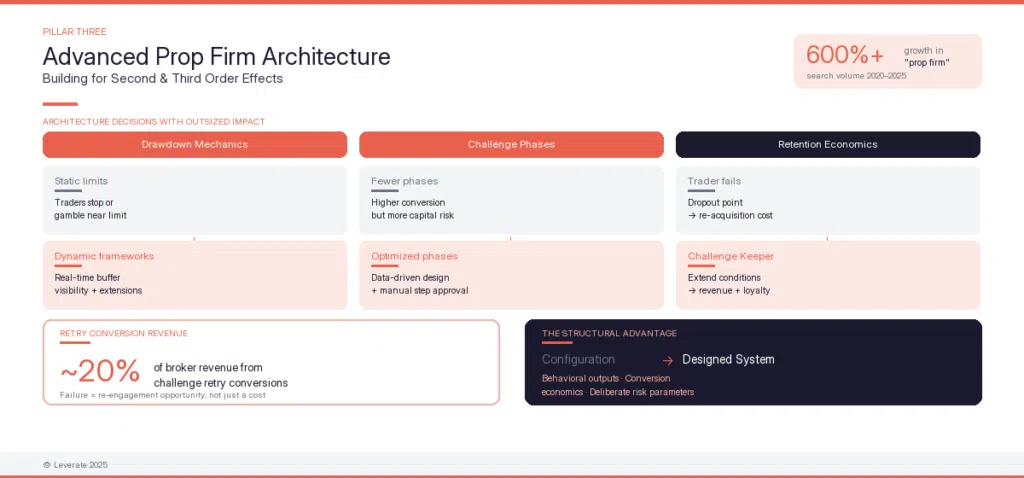
Prop trading has matured faster than most expected. According to PropFirmApp’s industry data, global monthly search volume for the term “prop firm” grew from 880 in January 2020 to nearly 50,000 by late 2025, a rise of over 600%, reflecting a fundamental shift in how traders think about accessing capital Investing.com. But the early model, simple two-step challenges with binary pass/fail outcomes, created a generation of traders who understood exactly how to game static rules. The firms still running purely static rule sets are competing on price, which is a race worth avoiding.
In order to stay competitive in today’s fast-paced and ever-changing market, it is crucial for firms to have adaptive risk capabilities. The ability to analyze and manage trader behavior at scale is a key factor in protecting capital and maintaining profitability.
One way that firms can develop adaptive risk capabilities is by incorporating artificial intelligence (AI) and machine learning (ML) technology into their trading systems. These advanced technologies can help identify patterns and trends in trader behavior, allowing for more effective risk management strategies.
Another important aspect of developing adaptive risk capabilities is having a diverse team with varied backgrounds and perspectives. This diversity can help identify potential risks that may not be apparent to everyone on the team, reducing the likelihood of costly oversight or blind spots that could impact the firm’s operations and performance.
The operators building defensible prop businesses in 2026 are thinking about challenge architecture the way financial engineers think about product design: what behaviors does this structure incentivize, and are those the behaviors that create long-term value for both the firm and the trader?
A few specific examples of where architecture decisions have outsized consequences:
Drawdown mechanics. Static daily loss limits often create a perverse outcome: traders who are close to the limit either stop trading entirely, reducing activity, or take on concentrated risk to either recover or fail quickly. Dynamic drawdown frameworks that provide real-time visibility into the remaining buffer, and potentially allow conditional extensions, change trader behavior in ways that are better for the firm’s economics and better for the trader’s development.
Challenge phase design. The number of phases, the conditions for progression, and the degree of manual oversight at each stage create a risk/conversion tradeoff that most firms haven’t formally optimized. More phases generally means better trader quality at the funded stage, but higher dropout. Fewer phases improves conversion but increases capital risk. The right answer is firm-specific and market-specific, and it should be informed by data rather than convention. Manual step approval; the ability to hold a trader at a given phase for human review before capital is deployed, gives firms a meaningful control lever without significantly disrupting the trader experience when implemented transparently.
Retention economics. Challenge Retry conversion rates, accounting for around 20% of broker revenue, illustrate that challenge failure is not purely a cost. With the right architecture, it’s a re-engagement opportunity. Leverate’s Challenge Keeper takes this further: when a trader approaches their Max Daily Loss limit, they’re offered the option to extend their challenge conditions for a fee, at precisely the moment their intent to continue is highest. What would otherwise be a dropout point becomes a revenue event and a loyalty signal. The economics are meaningfully better than re-acquiring the same trader through paid channels.
The firms that understand their challenge architecture as a designed system, with intended behavioral outputs, measurable conversion economics, and deliberate risk parameters, have a structural advantage over those treating it as a configuration problem.
Pillar Four: Partner-Led Growth – The Acquisition Channel That Compounds
Direct acquisition costs in financial services continue to climb. This is not a cycle; it’s a structural shift driven by increased competition for the same audiences across the same channels.
The operators who’ve recognized this earliest have been rebuilding their growth models around networks, introducing brokers, affiliate partnerships, community-driven acquisition, and referral mechanics, that compound over time rather than requiring constant spend to maintain.
The distinction that matters here is between partnership infrastructure and partnership programs. A partnership program is a commission structure and a spreadsheet. Partnership infrastructure is an automated, transparent system that allows partners to monitor their own performance, understand their earnings in real time, and trust that commissions will be paid accurately and promptly.
The quality of the infrastructure determines the quality of the partnership. An IB who has to chase manual reports and wait for reconciliation puts less energy into referring new clients. An IB who has instant visibility into their book, automated payouts, and a genuinely frictionless experience for their referred clients compounds their effort over time.
For prop firms specifically, trader-led referral programs represent one of the highest-quality acquisition channels available. A funded trader who refers someone from their network is providing implicit qualification; they know what the challenge demands and they’re putting their credibility behind the referral. Leverate’s Refer & Earn program is built around this mechanic: traders receive personal referral links, a real-time dashboard showing their earnings, and automated reward processing, while firms benefit from acquisition costs that run significantly lower than paid channels and retention rates that are meaningfully higher. The compounding effect comes from the fact that successful referrals often become referrers themselves.
The strategic implication is that partner-led growth requires investment in infrastructure before it generates returns. Firms that treat it as an add-on tend to build programs that don’t attract the quality of partners needed to generate meaningful volume. Firms that treat it as a core channel and invest accordingly are building distribution advantages that become increasingly difficult to replicate.
The Integration Point: Why Pillars Compound Together
The reason these four areas function as pillars rather than independent initiatives is that they interact. AI automation becomes more valuable when the data set it’s working with is consistent across a unified infrastructure rather than fragmented across vendors. Global scalability becomes achievable when challenge architecture is configurable rather than hardcoded. Partner-led growth becomes sustainable when the client experience partners are sending people to is frictionless.
The operators who approach 2026 by improving one area in isolation, better AI with fragmented back office, or global expansion with static challenge logic, tend to find that the gains are smaller than expected because the constraint shifts elsewhere.
Leverate’s approach is to build these pillars into a single connected ecosystem, trading platform, CRM, Broker Portal, liquidity, and prop infrastructure, so that improvements in one area propagate across the rest rather than being contained within it. That integration is what allows a firm to launch a localized prop challenge in a new market, with automated approval logic, funded by a partner-referred trader, tracked through a real-time affiliate dashboard, without those being four separate projects requiring four separate vendor conversations.
The question worth asking now is which of these four areas is the current binding constraint for your business. That’s where the next investment has the highest leverage.
Frequently Asked Questions
How does Challenge Keeper affect challenge economics? Challenge Keeper can create a monetization moment at the point of highest trader engagement, when they’ve reached a limit and are deciding whether to continue. By offering a conditional extension for a fee, firms convert what would otherwise be a failed challenge into an additional revenue event. The pricing is configured per plan in the Broker Portal, and the structural benefit is that dropout points become re-engagement opportunities rather than simple churn.
What does global scalability require technically? At minimum: configurable payment gateway integration by region, currency-specific plan display, localized onboarding flows, and the ability to set compliance rules by jurisdiction without engineering involvement. The practical test is whether a new market can be launched in days rather than months.
What distinguishes agentic AI from basic automation in this context? Basic automation executes predefined rules, send an email when X happens. Agentic AI can reason across multiple inputs simultaneously, identify patterns that don’t fit predefined rules, and take multi-step actions based on that reasoning. In a trading context, the relevant difference is between a system that alerts on a known breach condition versus one that identifies emerging risk patterns before a breach condition is met.
How should brokers evaluate their current infrastructure against these pillars? The most useful starting point is identifying where manual human intervention is currently required to maintain normal operations, not exception handling, but routine processes. Each instance is a signal that automation hasn’t reached that area yet, and an indication of where operational leverage is available.
Disclaimer:
This content is based on multiple sources and is provided for educational purposes only. It does not constitute financial, legal, or investment advice.