







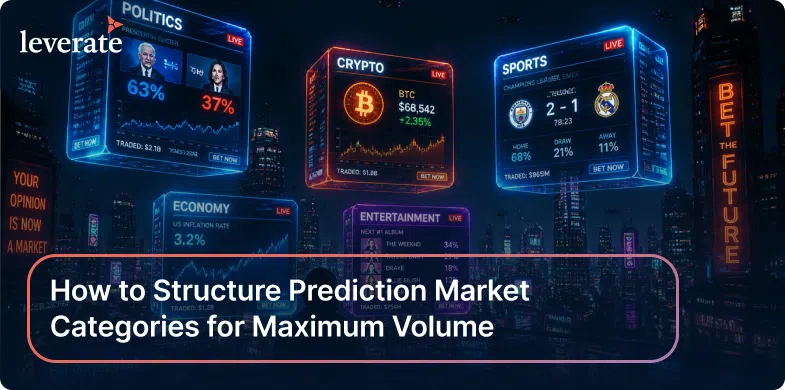
How to Structure Prediction Market Categories for Maximum Volume
Prediction markets grew from a niche concept into a commercially viable product category faster than most in the industry anticipated. The US presidential election cycle of 2024 drew billions in notional volume through regulated and unregulated platforms, and the appetite among traders for event-based markets has not receded since. For brokers evaluating or already operating a prediction market offering, the category question is now the central product decision: which events to list, how to group them, and how to sequence them to sustain meaningful trading activity.
Getting prediction market categories right isn’t just a content task; it’s a revenue architecture decision. Brokers who treat it that way tend to hold onto volume far better than those who just list whatever’s trending at the time.
What Prediction Market Categories Mean for Brokers
A prediction market category is the structural grouping used to organise the events available for trading. Common categories include politics, economics, sports, financial markets, and entertainment, though the specific taxonomy varies by operator. For brokers, the choice of categories is not simply cosmetic. It determines which trader segments engage with the platform, how frequently those traders return, and how predictable the volume profile is across a calendar year.
A platform that lists only major sporting events will see concentrated activity around fixtures and significant quiet periods in between. A platform with a broader category spread across economics, geopolitics, and financial indicators can maintain more consistent daily engagement. The trade-off is operational: each category adds content management overhead and, depending on jurisdiction, may carry different regulatory treatment.
Understanding how prediction market categories function as a product architecture layer, rather than just a content decision, is the starting point for building a volume-generating event-based product. Operators who define their category strategy before launch are significantly better positioned than those who iterate on it reactively.
Which Categories Drive the Highest Trading Volume
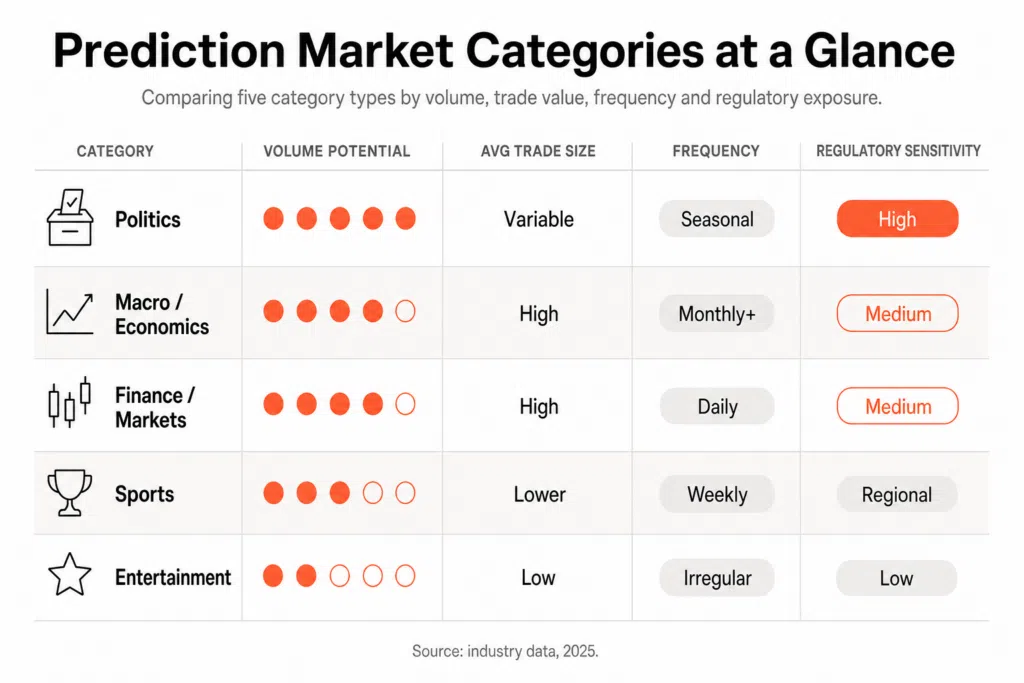
Volume in prediction markets is not distributed evenly across categories. Data from platforms operating in markets where event-based trading is permitted suggests that political and macroeconomic categories tend to generate the highest sustained volume, particularly in periods around scheduled events such as elections, central bank meetings, and major economic data releases.
According to a 2025 report from FX News Group, prediction markets tied to macroeconomic outcomes, specifically interest rate decisions and inflation data, saw a notable increase in trader engagement as monetary policy uncertainty remained elevated across major economies.
Source: FX News Group, 2025
Sports categories perform well for trader acquisition because the events are broadly understood and the outcomes are binary, which makes them accessible to first-time prediction market participants. However, sports categories tend to have lower average trade size and shorter engagement windows compared to macroeconomic or financial categories.
Financial market outcome categories, such as whether a given index closes above a particular level on a defined date, attract traders who are already engaged with CFD or forex products and are familiar with the underlying markets. These categories may generate lower headline trade counts but often produce higher notional values per trade.
| Category | Volume Profile | Avg Trade Size | Frequency | Regulatory Sensitivity |
| Macro/Economics | High, event-driven | High | Monthly+ | Medium |
| Politics | Very high, cyclical | Variable | Seasonal | High |
| Sports | Medium, frequent | Lower | Weekly | Varies by region |
| Finance/Markets | Consistent | High | Daily | Medium |
| Entertainment | Spike-driven | Low | Irregular | Low |
Trending vs Evergreen Categories: What Works Best
The distinction between trending and evergreen prediction market categories matters considerably to volume planning. Trending categories are built around specific events with a defined resolution date, such as a particular election, a one-off referendum, or a scheduled product launch. Evergreen categories recur on a reliable schedule and can be listed continuously without rebuilding the content from scratch each cycle.
Brokers managing prediction market categories for sustained volume tend to maintain a mix of both. Trending events attract traders who are following those events in the news and generate spikes in new registrations and deposits. Evergreen categories, particularly those tied to recurring economic data releases, provide the consistent background volume that supports a healthier daily active trader metric.
The practical challenge with trending categories is resolution logistics. A broker must have clear rules for how the outcome is determined, who the authoritative source is, and what happens in edge cases such as disputed results or delayed announcements. Building these rules into the platform before listing an event is essential; retrofitting resolution logic after a market has opened creates compliance and reputational risk.
How Category Structure Impacts Trading Activity
Category structure influences not just which traders participate but how they behave. A platform where all prediction market categories are displayed in a flat list with no hierarchy treats a monthly central bank decision with the same prominence as a minor local election. That structure makes it harder for traders to find the events most relevant to them, which can reduce session depth and repeat visit rates.
Brokers who invest in the UI logic around prediction market categories, grouping by theme, surfacing upcoming resolution dates, and showing volume indicators next to each market, tend to report better engagement metrics. This is compared to those who default to chronological or alphabetical listing. The structure communicates to the trader which markets are active and where the community is concentrated, which in turn draws more participants to those markets.
Leverate’s White-Label Prediction Markets solution provides the category management infrastructure that supports this kind of structured presentation. Operators can configure category hierarchies, set weighting rules for how markets surface in the UI, and manage the content lifecycle for both trending and evergreen events from a centralised administrative environment.
Regulatory Constraints in Structuring Prediction Market Categories
Regulatory treatment of prediction markets is not uniform. In the United States, the Commodity Futures Trading Commission has taken an active role in defining which event contracts are permissible. In Europe, the classification question is still evolving, with some jurisdictions treating certain prediction market structures as derivatives requiring licensing and others applying lighter-touch frameworks. Brokers operating across regions need category-level clarity on the applicable rules before listing.
Political prediction markets carry the highest regulatory sensitivity in most jurisdictions. Some regulators have expressed concern that political markets may influence behaviour rather than simply reflect it, which has led to specific restrictions in certain markets. Macroeconomic outcome markets tend to face fewer restrictions, particularly where the underlying data sources are official and transparent.
Category-level compliance mapping, establishing which categories can be offered to which client segments in which jurisdictions, is a prerequisite for sustainable prediction market operations. It is also an area where platform providers can assist by building jurisdiction-aware rules into the product configuration layer rather than requiring the broker to manage these constraints manually.
Frequently Asked Questions
What are prediction market categories?
Prediction market categories are the groupings used to organise event-based markets available for trading. Common categories include politics, economics, sports, financial market outcomes, and entertainment. For brokers, the choice of categories functions as a product architecture decision that determines which trader segments engage with the platform and how consistent the volume profile is across a year.
Which categories generate the most trading volume?
Macroeconomic and political categories tend to generate the highest sustained volume, particularly around scheduled events such as central bank decisions, election cycles, and major economic data releases. Financial market outcome categories attract higher per-trade values, while sports categories generate higher trade counts but lower average size. A balanced mix of evergreen and trending events is generally associated with more consistent daily volume.
How do brokers structure prediction market categories?
Brokers typically organise categories into a hierarchy that reflects both event frequency and trader interest, with top-level groupings such as politics, economics, and sports, and sub-categories for specific event types within each. The UI logic matters as much as the taxonomy: surfacing upcoming resolution dates, showing volume indicators, and grouping by theme helps traders find relevant markets more efficiently.
What is the difference between trending and evergreen markets?
Trending prediction markets are built around specific one-off events with a defined resolution date. Evergreen markets recur on a reliable schedule and can be listed continuously, such as monthly central bank meetings or quarterly economic data releases. Brokers managing for volume typically maintain both, using trending events to attract new traders and evergreen categories to sustain background activity.
How does regulation affect prediction market categories?
Regulatory treatment varies by jurisdiction and category type. Political prediction markets carry the highest sensitivity in most regulated markets. Macroeconomic outcome markets face fewer restrictions where underlying data sources are official and transparent. Brokers operating across regions need category-level compliance mapping to establish which markets can be offered to which client segments before listing.
Do I need a separate licence to offer prediction markets?
The licensing requirement depends on the jurisdiction and how the prediction market product is structured. In some markets, event contracts are treated as derivatives and require the same regulatory authorisation as other financial instruments. Brokers should seek jurisdiction-specific legal guidance before launching, and should build compliance rules into the platform configuration so they can be enforced automatically rather than managed manually.
How many categories should a prediction market platform offer at launch?
A focused launch with three to five categories that have reliable recurring events tends to perform better than a broad launch with thin volume spread across many markets. Categories can be added as the trader base grows and as the operational team develops the content management workflow. Launching too broadly before the platform has an established user base risks diluting liquidity across too many markets.
Can prediction market categories be managed without custom technology?
White-label prediction market platforms, such as the solution offered by Leverate, include category management infrastructure as part of the product. Operators configure the category hierarchy, resolution rules, and UI presentation through an administrative environment without needing to build or maintain the underlying systems. This reduces time to market considerably and allows the operator to focus on content curation and compliance rather than technology development.
Disclaimer:
This content is based on multiple sources and is provided for educational purposes only. It does not constitute financial, legal, or investment advice.