

Prediction markets for iGaming operators let players buy and sell contracts on real-world events, inside the brand, account and wallet they already use. Unlike a sportsbook, the operator does not set fixed odds and keep the risk on every bet. Prices come from trading, and revenue comes mainly from fees or spread.
Most pages on this topic are vendor pitches or market-size forecasts. This guide is about operations. You already have payments, KYC, a player base and pricing talent. What you may lack is a trading desk: the people and tools that seed liquidity, settle contracts cleanly and keep traders active between big events. Below you will find how the model differs from a sportsbook, a readiness scorecard, a path for choosing a launch route and a daily playbook drawn from how brokerages run trading businesses.
Why Event Trading Is Now an iGaming Product Expansion Question
The forecasts are large. Bloomberg Intelligence projected in September 2026 that prediction markets could reach $1 trillion in annual volume by 2030. Earlier in the year, research from Eilers & Krejcik covered by the Las Vegas Review-Journal put a mature market at about the same $1 trillion, with roughly $435 billion coming from sports contracts.
That sports share is the key number for gaming businesses. If a big slice of future volume is sport, event contracts sit right beside the products your players use every week. Large books have already moved. Covers reported in August 2026 that annualised prediction volume at the second-largest US sportsbook by handle rose nearly fivefold between April and July.
For a mid-sized operator, the lesson is not to chase those totals. It is that iGaming product expansion into event trading is shifting from experiment to standard menu item. Players who meet event contracts elsewhere will soon expect them in your lobby too. That is why prediction markets for iGaming operators now belong on the product roadmap, not in the innovation backlog.
Scale your brokerage today!
CRM & Client Portal, Trading Platform, MT4 & MT5 - All built for you.
Scale NowHow a Prediction Market Differs From a Sportsbook
A prediction market is an exchange where players trade contracts that pay a fixed amount, usually 1 unit, if an event happens and nothing if it does not. Each contract trades between 0 and 1, so its price reads as the market's view of the event's probability.
The idea sounds close to betting. Running it is not. Sportsbook prediction markets change three things: who sets the price, how you earn and where your risk sits.
Price Discovery Instead of Set Odds
In a sportsbook, your traders set a price and players accept or decline it. In a prediction market, the price moves with every trade. Buyers and sellers meet in an order book or a pool, and the last trade becomes the price. Your pricing team stops being the only voice in the market. Instead, it acts as one participant, posting bids and offers and adjusting them as orders arrive.
Players feel the change too. A position has a live value that rises and falls as the event unfolds. That makes the product feel closer to trading than betting, which is why the interface needs positions, live prices and charts, not just a bet slip.
Take Rate Instead of Hold
A sportsbook earns hold: the margin built into its odds, plus the result of the risk it keeps. A bad weekend of results can wipe out a good month. A prediction market earns a take rate: a fee on each trade, a spread between the bid and the ask, or both. Revenue follows volume, not outcomes. If you also make markets yourself, you earn spread but hold inventory, so results matter again in a smaller way. Our guide to pricing models in event-based trading covers fee structures in more depth.
Risk Moves From Liability to Liquidity
A sportsbook's main risk is liability on a single outcome. In an exchange model, the bigger risks are thin markets, unclear settlement and the positions your own market-making desk carries. These are operational risks more than pricing risks, and they shape the rest of this guide.
Prediction Markets for iGaming Operators: The Launch Readiness Scorecard
Use the table below to score your business against what event trading needs. Mark each row green if you have it today, amber if you have part of it and red if you do not.
| Capability | What a sportsbook already has | What event trading adds | How to close the gap |
|---|---|---|---|
| Accounts and wallet | Player accounts, KYC, payments, one wallet | Contract balances and open positions shown in that wallet | Connect the event product to your existing account layer by API |
| Pricing | Odds compilers and data feeds | Two-sided quotes that move with order flow | Set up a market-making function with clear spread and size rules |
| Liquidity | Liability managed on your own book | Resting orders so the first trades fill | Seed every market with house or partner liquidity from day one |
| Resolution | Grading rules for standard bet types | A written rule per contract, a named result source and a dispute path | Build rule templates per category and staff a resolution desk |
| Player interface | Bet slip, lobby, cash-out | Positions, live prices and trading-style charts | Use a white-label front end built for trading, not betting |
| CRM and reporting | Bonus engine, VIP tiers, GGR reports | Triggers on price moves and settlements, plus contract-level P&L | Link CRM workflows to the event calendar and report fees and spread separately |
Most operators score green on accounts and amber or red on liquidity and resolution. That is normal. Those are trading-desk skills, and they are exactly the gaps a white label event trading partner should fill. Leverate's prediction markets white label lets you add event trading under your own brand, next to your existing player base, so your team works on the red rows instead of rebuilding the green ones.
Pick a Launch Route: Build, Partner or White Label
There are three ways to put event contracts in front of players. Each one trades control against speed and cost.
- Build in-house. You own the matching engine, the risk tools, the front end and the settlement workflow. Control is total, but so is the bill. You need engineers who understand exchange technology and a desk that can run it, and launch usually takes many quarters.
- Partner with an existing exchange. You route players to someone else's markets. This is often the quickest start, but players may leave your brand, you share economics and you see less of the data that drives retention.
- White label. A provider runs the engine and tooling, and you launch under your brand, on your domain, connected to your wallet. You give up some control over the roadmap, but you keep the player relationship and the data.
The right route depends less on ambition than on what you already have in place: your desk, your timeline and your appetite for upfront spend. The decision path below turns those factors into a short series of yes or no answers.
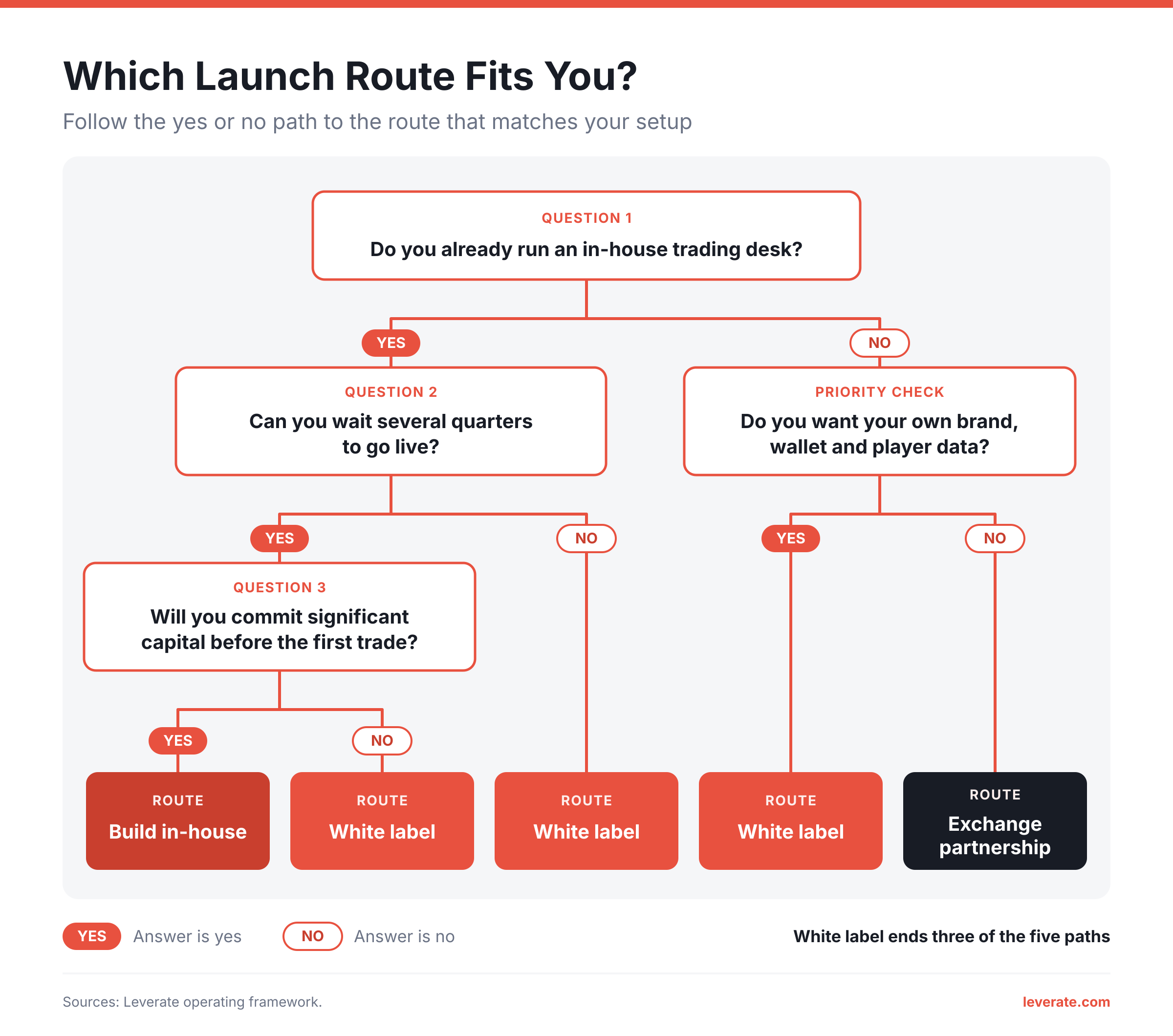
For most gaming businesses the answer is a white label, because the hardest parts to build are trading-desk skills, not gaming skills. Prediction markets for iGaming operators tend to succeed when the gaming team owns the player and the provider owns the plumbing. Leverate comes to this from brokerage technology, where order flow, reporting and trader retention are daily problems rather than new ones.
Run the Markets Day to Day
Launch is the easy part. The daily work is keeping prices live, settling contracts cleanly and controlling exposure. Each contract follows the same life cycle, and every stage needs a named owner.
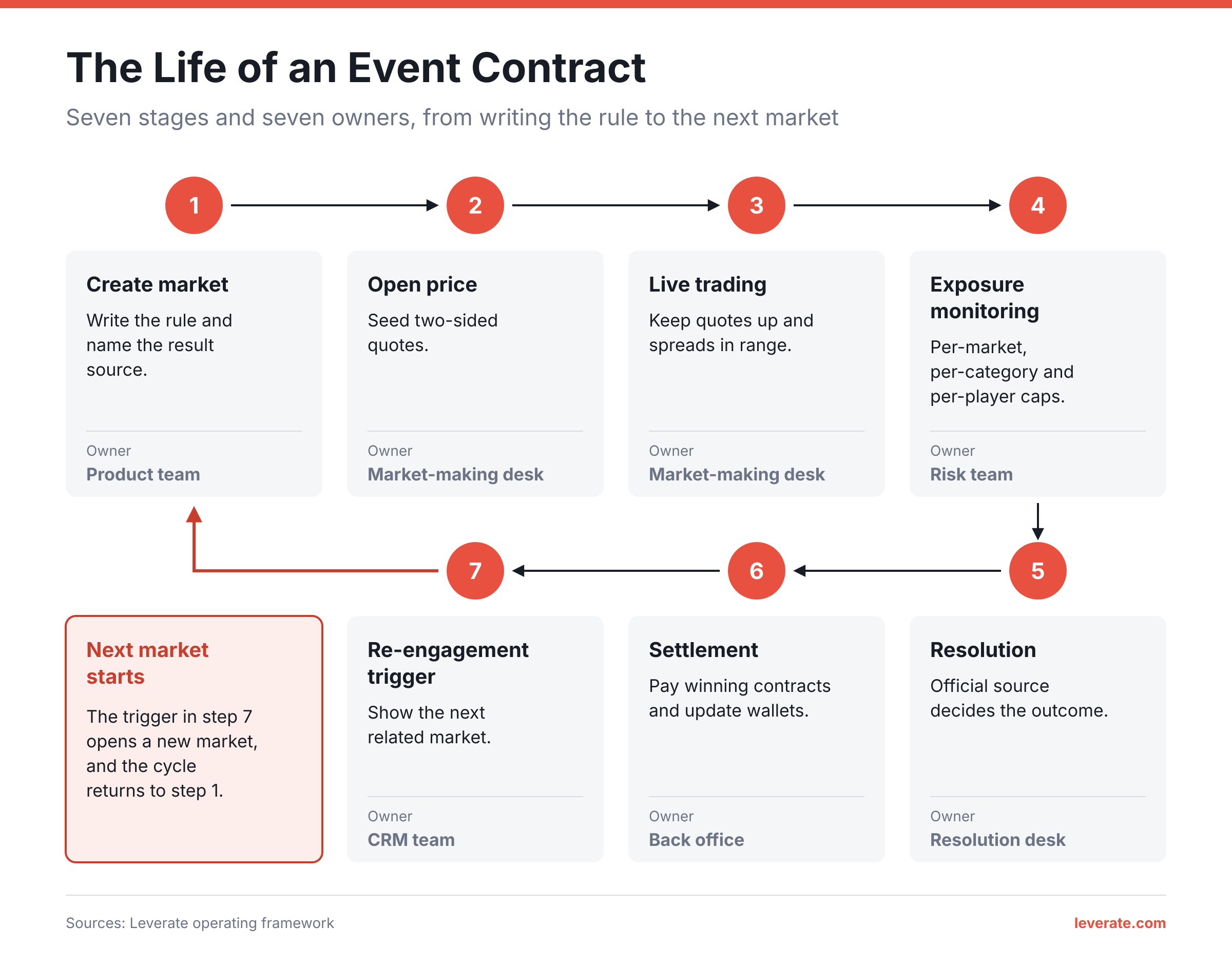
Seed Liquidity and Make Markets
An empty order book kills a new market. A player who sees no price, or a huge gap between buy and sell, leaves and rarely comes back. Someone has to quote both sides from the moment a market opens, and in the early months that someone is usually you or your provider.
Quoting well is harder than it looks. Eilers & Krejcik research reported by iGaming Business in May 2026 found that sportsbooks making markets on prediction exchanges ran average overrounds above 5%, with the widest above 8%. The best average uptime was 86%, so even the strongest quoter left gaps.
Give your desk written quoting rules: a maximum spread by market type, a minimum size at the top of the book, when to widen around team news and when to pull quotes entirely. Then measure uptime every day. Prediction markets for iGaming operators live or die on whether a player can always see a fair two-sided price.
Write Resolution Rules Traders Trust
Settlement is where trust is won or lost. A sportsbook settles bets under grading rules players already know. An event contract settles on whatever its rule says, so the rule must be exact before trading opens. Every contract rule should state:
- The precise question, in plain words, with no room for two readings.
- The single source that decides the result, such as an official league feed.
- The cut-off time, including the time zone players see on screen.
- How ties, overtime and partial results count.
- Who reviews disputes and how fast they respond.
Build templates by category, so a new football market reuses a tested rule rather than a fresh draft written at midnight.
Set Exposure Limits
If your desk makes markets, it carries positions. Cap that exposure at three levels: per market, per category and per player. Watch for linked markets too. A team winning tonight's match and the same team winning the league are separate contracts, but they move together, so your limits should treat them as one risk. A strong back office for positions, fees and settlements makes these limits practical rather than a spreadsheet exercise.
Grow and Keep Traders
Retention in prediction markets for iGaming operators follows a different rhythm from betting. A sportsbook player returns for the next fixture. An event trader returns when a price moves, a market closes or a contract settles.
Turn the Event Calendar Into CRM Triggers
Map your CRM to the life of each market. Alert a player when a market they hold moves sharply. Remind them before trading closes. When a contract settles, use that moment to open a conversation about what comes next. These loops turn one-off curiosity into repeat activity. Our piece on retention loops in prediction markets sets out more patterns you can borrow.
Cross-Sell to Players and Partners
Your strongest early audience is the players you already have. Sports bettors understand the events, which makes them the easiest group to convert. Start with prompts on the bet slip and in the sports lobby, then test casino players with big, simple markets on major tournaments.
Affiliates are the second channel. Your partners already send sports traffic, so give them event-market landing pages, tracking links and creative built around big events. Leverate's affiliate and IB tools let you manage partner traffic and commissions in the same system as the rest of the business.
Some event traders will want more over time. A player who enjoys trading a price on a match may later want to trade gold or an index. That makes event contracts for operators a possible first step toward a wider trading offer, run on the same back office and client base.
The Bottom Line
Event trading looks like a gaming product but runs like a trading desk. The operators who do well will treat quote uptime, clean settlement and well-timed alerts as daily habits, while keeping every player inside their own brand and wallet. Seen that way, prediction markets for iGaming operators are a chance to turn an existing player base into a trading audience, provided the plumbing is ready before the first market opens. To see how event trading could sit beside your current products, talk to the Leverate team about a launch plan.
Disclaimer: This content is based on multiple sources and is provided for educational purposes only. It does not constitute financial, legal, or investment advice.