Last updated: November 2026
Proprietary trading is when a firm trades financial markets with its own capital and keeps the profit or loss, rather than earning fees or spreads for executing client orders. For decades that meant bank trading desks. Today it also describes funded-trader firms, which sell evaluations to retail traders, give those who pass a firm account and share the profits they make.
For broker owners, that last model is the one worth studying. It runs on parts a CFD brokerage already owns: a trading platform, a CRM, payments, affiliates and a risk desk. What changes is the revenue logic and where risk sits. This guide compares the three models, breaks down how a funded-trader firm earns money, maps the systems it runs on and ends with a go or no-go path for brokers weighing a prop offering.
What Is Proprietary Trading?
Short definition: prop trading means a firm acts as principal. It trades for its own account, with its own money, and every gain or loss lands on its own books. It is not filling client orders in return for a commission, spread or markup, which is what an agency or brokerage business does.
The principal versus agency split is the clearest way to see it. An agency broker routes a client's order to the market and earns a fee. Its income depends on how much clients trade, not on whether they win. A principal takes market risk itself, so its income depends on being right, or on how well it manages the positions it holds.
Most CFD brokers already sit between the two. A broker that internalises client flow acts as principal against its own clients. A broker that passes trades to a liquidity provider behaves more like an agent. So prop trading is not a foreign idea to a brokerage. It is a different arrangement of the same risk, with a different promise to the customer.
Scale your brokerage today!
CRM & Client Portal, Trading Platform, MT4 & MT5 - All built for you.
Scale NowThe Three Models of Proprietary Trading Today
The term now covers three businesses that share one principle and little else. They differ in who supplies the capital, who does the trading and where the money comes from.
Bank trading desks
Large banks once ran desks that bet the bank's own balance sheet on rates, credit, equities and currencies. Traders were salaried staff with bonuses tied to results. The desks sat beside client businesses such as market making and underwriting, which made the line between serving clients and speculating hard to see from the outside.
Principal trading firms
Independent principal trading firms trade only the money of their partners and investors. Many are technology-led, running systematic or high-frequency strategies across exchanges, and many act as electronic market makers. They employ traders and quants but have no outside customers. Their edge comes from speed, models and tight risk control.
Funded-trader prop firms
The newest model flips the funding source. Retail traders pay a fee to take an evaluation, often called a challenge, with a profit target and loss limits. Those who pass get a funded account, often simulated at first, and keep a share of the profits they make. The firm's main income is not trading gains. It is the evaluation fee. Our explainer on how a prop firm challenge works covers the mechanics of those tests.
Here is how the three models compare on the points an operator cares about.
| Factor | Bank desk | Principal trading firm | Funded-trader firm |
|---|---|---|---|
| Whose capital | The bank's balance sheet | Partners and investors | The firm's operating capital, funded largely by trader fees |
| Main revenue | Trading gains | Trading gains and market-making spreads | Evaluation fees, resets, add-ons and profit share |
| Who trades | Salaried bank traders | Employed traders and quants | Remote retail traders |
| Who carries market risk | The bank | The firm | The firm, through payouts and any live-routed flow |
| Core technology | Exchange and OTC access, internal risk systems | Low-latency execution, co-location, quant research | Branded platform, prop CRM, payments, affiliate tracking, liquidity bridge |
How the Bank Desk Gave Way to the Independent Prop Firm
After the 2008 crisis, post-crisis rules in several major markets pushed large banks to shrink trading for their own account and focus on client business. The business effect mattered more than the legal detail. Proprietary trading talent and strategies moved from banks into independent firms and funds.
Over the same years, retail access to markets grew fast. Currency markets alone turned over about $9.6 trillion a day in April 2025, according to the BIS 2025 Triennial Central Bank Survey, and online platforms put that market a few clicks from any trader.
Funded trader programs grew out of that mix. Trading arcades had long staked local traders at a desk in return for a profit split. Moving the evaluation online, charging for it and running it on retail platforms turned a small staffing model into a scalable consumer business. That is why the natural operator of a modern prop offering looks more like a broker than a bank.
How a Funded-Trader Firm Makes Money
The prop trading business model fits in one line. No assumptions about scale are needed to see where it wins or loses:
Prop P&L = (evaluation fees + resets + add-ons + profit share on live accounts) minus (trader payouts + affiliate commissions + payment costs + platform, data and support costs) plus or minus the result of the hedging decision on funded flow.
The revenue side
Every applicant pays the evaluation fee up front, pass or fail. Resets, which let a trader restart a failed challenge, and add-ons such as larger accounts or extra days lift revenue per customer. The model relies on a well-documented pattern: most retail traders lose. When ESMA agreed to restrict CFDs in 2018, its announcement of the product intervention measures noted that between 74% and 89% of retail CFD accounts typically lose money. Evaluation outcomes tend to follow the same shape, so fees from many attempts fund payouts to the few who succeed.
The cost side
Payouts are the largest variable cost and the hardest to forecast, because a handful of strong traders can produce most of them. Affiliates are often the main acquisition channel, paid per sale or as revenue share. Payment costs go beyond fees: card processors watch evaluation sales closely, and chargebacks from traders who failed can put a merchant account at risk. Platform, market data, support and KYC complete the list.
The swing factor: what happens to funded flow
Many funded accounts trade in a simulated environment, so the firm's exposure is the payout itself. Once a trader proves consistent, some firms copy that trader's positions into the live market through a liquidity provider, turning a pure cost into a hedged or even profitable stream. Others keep everything internal and accept the payout risk. Neither is right by default. The choice depends on capital, risk appetite and how well the firm can tell skill from luck.
Rule design feeds straight into this equation. A Finance Magnates analysis of prop challenges and live execution argues that challenges often test whether a trader can survive “conditions engineered to be survivable”, which rarely match funded conditions. The operator lesson is to make evaluations look like live trading: real spreads, realistic slippage and the same news and holding rules. Otherwise the firm pays traders whose edge disappears the moment their trades meet a real order book.
Keeping this equation visible day to day is a data problem as much as a trading one. Leverate's PROP CRM is built for prop-firm workflows, so evaluations, funded accounts and payout requests sit in one place where risk and finance teams can read the same numbers.
The Operating Stack Behind a Prop Business
A prop firm is a chain of handoffs, and each link needs a system. Following one funded account from first click to payout shows where each piece fits.
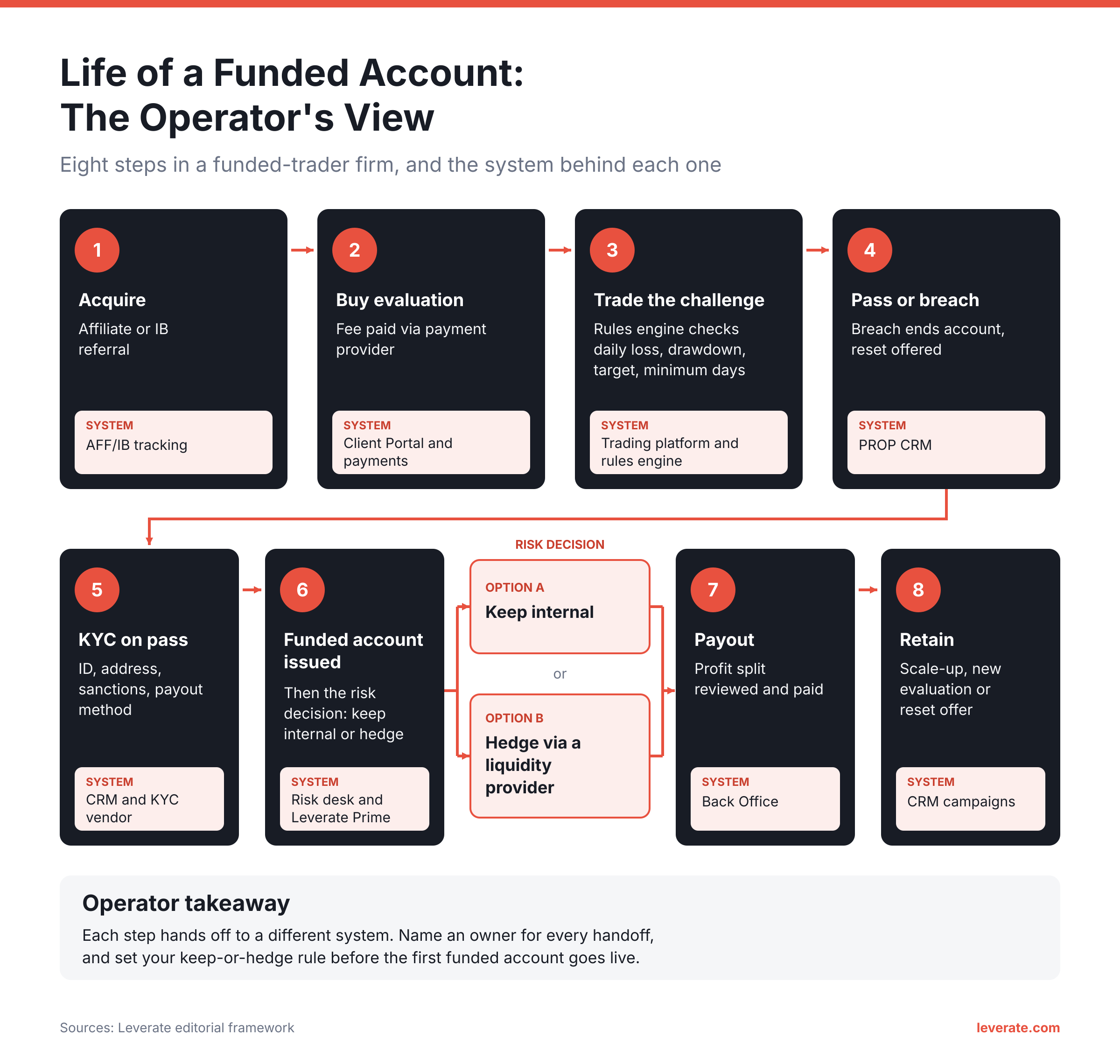
Six layers do most of the work:
- Trading platform. Traders judge a firm by the screen they trade on. Leverate's white-label trading platform runs under the firm's own brand, with xChart for charting, so the evaluation and the funded stage feel like one product.
- Rules engine and monitoring. Daily loss limits, maximum drawdown, profit targets and minimum trading days have to be checked in real time, with breaches enforced automatically and logged for disputes.
- CRM and client portal. Sign-up, evaluation purchase, KYC, account issue and payout requests run through the CRM and a branded Client Portal, which is where most support tickets start and end.
- Affiliates. Prop growth leans on partners. An affiliate and IB management system that ties every sale and reset back to its source keeps commissions accurate and fraud visible.
- Liquidity. For firms that route proven traders to market, a liquidity connection such as Leverate Prime handles the live side of the hedging decision.
- Back office. Reconciliation of fees, payouts and refunds, plus reporting for management and auditors.
Building these separately and wiring them together is where many new firms lose months. The bigger risk is the gap between systems, such as a breach flagged on the platform that never reaches the payout queue.
Should Your Brokerage Add Proprietary Trading?
A CFD broker already holds most of the parts a prop arm needs, which makes the idea tempting. Overlap is not the same as fit, though. Five gates decide whether a launch makes sense now, later or with a partner.
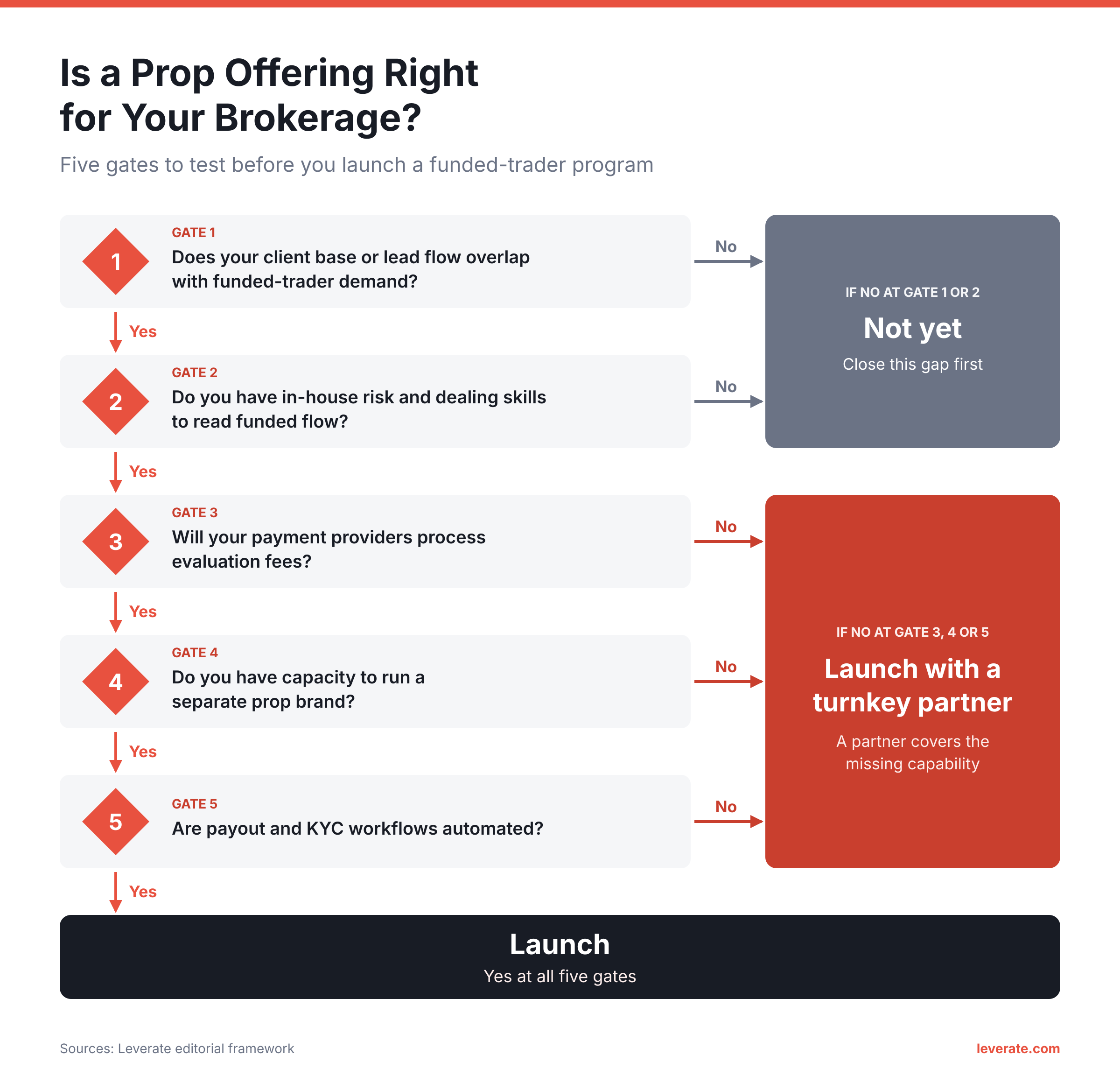
The gates are ordered by how hard they are to fix. Client fit and risk skills come first because neither can be bought quickly. A prop audience tends to be more active and more price-sensitive than a typical CFD client base, and a dealing team has to read funded flow differently: spotting coordinated accounts and deciding which traders deserve live routing.
Payments and brand come next. Some payment providers that happily process deposits will decline evaluation fees, so confirm acceptance before marketing spend starts. Many brokers also keep the prop offering at arm's length from their main brand so two different customer promises do not blur together.
Automation is the last gate and the easiest to solve with technology. If payouts and KYC still depend on manual spreadsheets, a turnkey partner closes that gap faster than an internal build. A broker that clears client fit and risk but lacks the operational tooling is the classic case for launching with a partner rather than waiting.
The Bottom Line
Proprietary trading has moved from bank balance sheets to a fee-led model that brokers are well placed to run. The economics depend less on market calls than on rule design, payout control and the choice of what to hedge. Firms that treat those as one system, with clean data flowing between platform, CRM and liquidity, are the ones that last. If your brokerage clears the five gates, explore Leverate's turnkey prop-firm solution and see how the full stack fits your launch plan.
Disclaimer: This content is based on multiple sources and is provided for educational purposes only. It does not constitute financial, legal, or investment advice.