








Forex Platform Back Office: The Operational Core of Brokerage Management
A brokerage can have a strong trading platform, a polished client area, and a CRM that keeps sales and retention moving. That still does not mean the operation is under control. The harder work happens behind the product: approving accounts, reviewing documents, processing deposits and withdrawals, managing permissions, and keeping teams aligned around the same data. That is where the forex platform back office becomes important.
A strong back-office layer helps brokers manage operational flow instead of reacting to issues one by one. That matters even more as brokerages enter their growth phase and scale beyond a startup stage.
Key Takeaways
- A forex platform back office keeps brokerage operations organized behind the scenes
- It helps brokers manage accounts, payments, reporting, and internal workflows
- Strong back-office integration can help reduce delays, duplication, and manual operational work
- The right system supports compliance, risk control, and long-term scalability
What Is a Forex Platform Back Office and Why It Is Critical for Brokers
A forex platform back office is the internal operating layer used to manage the business around trading activity. The forex trader sees charts, orders, balances, and account access. The brokerage team sees something else: account records, uploaded documents, payment requests, partnership structures, permissions, transaction history, and reporting workflows. It is an environment for managers, support staff, finance teams, and administrators who need to manage accounts, ensure compliance, and handle reporting from one place.
Back office becomes critical once a broker moves beyond a small, manual operation. A few accounts can be handled with scattered tools. A growing brokerage is much harder to control with patchwork solutions. As transaction volume, staff coordination, and regulatory expectations increase, the back office becomes the system that keeps activity reviewable, assignable, and traceable. That is why the back office dashboard is usually discussed alongside CRM, risk tools, and reporting rather than as a standalone admin panel.
Where the Forex Platform Back Office Fits in the Brokerage Stack
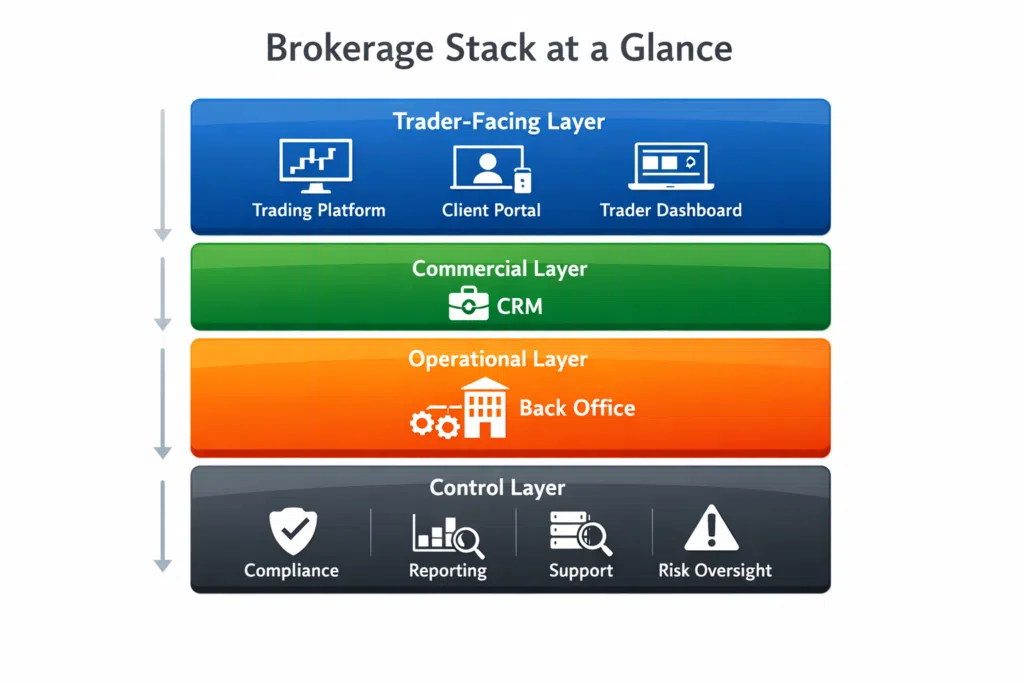
The easiest way to understand the stack is to separate the trader-facing layer from the internal operating layer. The trading platform handles execution and market access. The CRM usually supports client communication, sales flow, and broader relationship management.
The back office sits behind both, handling the operational work that turns client activity into something the brokerage can supervise properly. In practice, that includes account control, finance workflows, document review, partnership administration, and internal oversight.
The reason this line can look blurry is that many vendors now bundle CRM and back-office functions together. CRM systems in the FX space have evolved far beyond basic customer relationship tracking and increasingly function as broader business intelligence and coordination suites across departments.
That is useful, but it also means brokers need to understand what each layer is actually responsible for. A clean brokerage stack is less about labels and more about whether account, payment, compliance, and reporting work is properly controlled.
Key Functions of a Forex Platform Back Office System
Back-office systems typically cover client profile management, deposits and withdrawals, KYC and AML workflows, partner or IB management, reporting, analytics, and risk visibility. Some also include account monitoring, configurable permissions, trading-condition controls, and connections to payment processors and trading platforms. That is why the term “back office” in the forex market usually refers to a broad operating environment rather than one narrow tool.

The key point is not that the system has many tabs. It is that the work of different departments starts to flow through one place. Forex broker teams can review withdrawals, support teams can check account status, managers can monitor partner structures, and compliance staff can verify documentation without jumping between disconnected tools. When that structure is missing, small delays start appearing everywhere. With the back office in place, operations flow much smoother and without significant bottlenecks or dependencies.
How Back Office Systems Support Account Lifecycle and Payment Operations
Much of the daily pressure inside a forex brokerage appears around account lifecycle management. The workflow starts before a client trades anything: registration, identity documents, account approval, account type assignment, funding, internal review, status changes, and restrictions where needed.
A strong back office gives teams a clear way to manage that flow from start to finish instead of treating each step as a separate manual task. KYC handling, document storage, deposits, withdrawals, and transaction history are repeatedly described as core back-office functions across leading vendor materials.
Payments are especially sensitive because they combine customer experience, finance operations, and compliance checks in one workflow. If a broker is dealing with multiple payment providers, bonus structures, internal transfers, or withdrawal approvals, a weak process quickly turns into delays and avoidable errors. Some platforms now emphasize hundreds of payment integrations and finance controls precisely because payment operations are one of the first areas to strain under growth.
How Back Office Systems Integrate with Trading Platforms and CRM
A back-office system works best when it is connected to the rest of the brokerage environment. Modern providers emphasize integrations with platforms such as MT4, MT5, and proprietary systems, as well as payment processors, KYC vendors, and other infrastructure tools. The reason is simple: brokers do not want account data in one place, payment records in another, and client activity somewhere else entirely. Integration improves data flow and reduces duplicate handling across departments.
This is also where the relationship with CRM becomes more practical. A CRM may tell the commercial side of the business what the client is doing, but the back office makes sure the operational state of that client is accurate. If account approval, payment review, or document verification is lagging, the sales or support team needs that reflected in the wider system. That’s why connected tools help maintain operational continuity.
Compliance, Reporting, and Risk Control in Forex Back Office Operations
Compliance in brokerage operations is not just about having policies on paper. It depends on whether the system can collect documents, support identity verification, keep audit trails, and make actions visible to the right people. Client documentation management, identity verification, customer risk assessment, monitoring, and audit trail generation are expected capabilities in an efficient KYC environment. Those are back-office concerns because they live inside operational flow, not outside it.
Reporting matters for the same reason. A brokerage needs structured records of account activity, transactions, approvals, and staff actions to have clean and discernible reporting practices.

Risk control should also be considered as a core module because operational risk often starts with poor visibility. Unclear permissions, weak monitoring, inconsistent records, or delayed review of sensitive activity all contribute to overall brokerage risk.
Vendors in this space increasingly pair reporting with real-time risk dashboards and account monitoring because brokers need oversight. Without this concurrent analysis, it might be harder to catch abnormal events and react swiftly.
Common Operational Gaps Brokers Face Without a Strong Back Office Layer
The first gap is fragmentation. One team tracks client data in a CRM, another checks payments somewhere else, and compliance reviews documents in yet another tool. Nothing looks broken at first. The problem is that every routine task now depends on handoffs and manual confirmation. That makes the operation slower, less transparent, and harder to audit.
In the earlier state of the industry, brokers often relied on spreadsheets, manual risk handling, or third-party workarounds. That is exactly the kind of gap modern back-office systems are meant to reduce.
The second critical gap is scalability. A brokerage may survive with patchwork operations when volumes are low. Growth changes the equation. More clients, more payment routes, more partner arrangements, and more staff permissions mean more chances for operational inconsistency.
What looked manageable at a small scale starts turning into rework, delays, and internal confusion. At that stage, manual or slightly assisted oversight of operations will create significant growth blocks for the brokerage. Not considering to set up a back office solution will probably be more costly due to frequent mistakes, delays and compliance issues.
Choosing the Right Forex Platform Back Office for Scalability
The right system should match how the brokerage actually runs, not just how the vendor presents the demo. Functional fit comes first: account workflows, finance processes, compliance requirements, partner structures, reporting needs, and internal permissions. After that comes integration depth. Industry players highlight integration with the existing platform as a major selection factor because efficient data flow across systems has a direct impact on operations.
This is also where brokers should think seriously about forex back office software as long-term infrastructure rather than as a quick operational add-on. A strong choice should support reporting flexibility, secure access control, payment and KYC connectivity, and enough headroom for future growth.
Industry discussions often revolve around scalable architecture, seamless platform and payment integrations, and real-time monitoring as core qualities of a strong solution. In practice, that means the best choice is usually the one that reduces manual intervention without reducing control.
Final Thoughts
As brokerage operations become more complex, the back office has moved from a supporting function to a core part of the infrastructure. It helps brokers keep accounts, payments, reporting, and internal controls aligned as the business grows. For firms thinking beyond short-term fixes, a well-structured back office is a practical investment in stability, oversight, and scalable operations.
FAQ
- What does a forex back office system actually do in a trading platform
It manages the operational work around trading rather than trade execution itself. That usually includes client profiles, account approvals, document handling, deposits and withdrawals, reporting, partner administration, and internal monitoring. The trading platform handles orders and market access; the back office helps the brokerage run everything around that activity.
- How is a forex back office different from a CRM or trader dashboard
A trader dashboard is client-facing. A CRM often focuses on sales, retention, support, and broader client management. The back office is the internal operating layer that handles account control, finance workflows, documentation, permissions, and oversight. In many modern solutions these tools are bundled, but the functions are still different.
- Can a forex platform back office automate reporting and compliance tasks
Yes, to a meaningful extent. Providers in this space commonly offer document collection, KYC support, audit trails, reporting tools, monitoring, and workflow automation around finance and account review. Automation does not remove the need for internal control, but it does reduce manual repetition and makes review more consistent.
- Which features should brokers look for in a forex back office solution
The essentials are account management, KYC and AML support, deposit and withdrawal handling, reporting, partner or IB management, risk visibility, permissions, and strong integrations with trading platforms and payment providers. Beyond features, brokers should check whether the system fits their actual operational model and leaves room for growth.
- How does a back office system handle trader accounts, payments, and risk monitoring
It gives internal teams a centralized place to review account status, manage documents, process funding requests, monitor transaction records, apply access rules, and track operational risk indicators. In stronger setups, that also includes real-time dashboards, audit trails, payment-provider connections, and structured review workflows across finance, support, and compliance teams.
Disclaimer:
This content is based on multiple sources and is provided for educational purposes only. It does not constitute financial, legal, or investment advice.