

The trading platform is the face of a brokerage, the thing clients touch every day, so choosing a trading platform provider is one of the highest-stakes decisions a broker makes. Get it right and the platform builds the brand, engages traders, and connects cleanly to the rest of the business. Get it wrong and the broker is locked into a client experience it cannot fix and a system that fights the rest of its stack. This guide is a practical evaluation framework: the factors that matter, the questions to ask, and how to weigh them.
The stakes are heightened because switching platforms later is disruptive and risky once clients are trading on it. That makes the initial choice worth doing carefully, on evidence rather than a demo, and against a clear framework rather than a feature list.
Stability and Performance First
Everything else is secondary to a platform that stays up and executes well. Stability and performance, especially under load during volatile sessions, are the foundation, because a platform that lags or drops when the market moves loses client trust at the worst possible moment. Before weighing features, a broker should establish that the platform performs reliably when it matters, ideally with evidence of uptime and behaviour during past volatility rather than assurances.
This is the factor brokers most often underweight because it is invisible when it works. But a beautiful, feature-rich platform that stumbles during a news release is worse than a plainer one that never misses, because the stumble is what clients remember. Performance under stress belongs at the top of the framework.
Scale your brokerage today!
CRM & Client Portal, Trading Platform, MT4 & MT5 - All built for you.
Scale NowMulti-Asset Coverage and Features
Modern traders expect breadth and depth. A strong platform provider should support multi-asset trading, FX, crypto, indices, commodities, and more, so a broker can serve diverse demand from one platform, and it should offer the charting, order types, and tools active traders expect. Increasingly, social and algorithmic features are part of the baseline rather than extras, because they drive the engagement and retention that keep a book active.
The right level of features depends on the broker’s audience, but the platform should at least be capable of growing into new markets and tools without a re-platforming. A provider whose platform is a dead end, fixed in its current capabilities, caps the broker’s own growth, so evaluate not just what the platform does today but what it can be extended to do tomorrow.
Mobile Experience
Mobile is no longer a secondary surface. With most trades now placed on mobile, the mobile app is where the majority of clients live, so a platform provider’s mobile experience deserves as much scrutiny as its desktop one. A broker should judge the app on its own merits, speed, usability, feature parity, and branding, rather than treating it as a scaled-down afterthought, because for many clients it is the whole product.
A provider that treats mobile as a first-class surface gives a broker a genuine flagship app under its own brand. One that treats it as an add-on hands the broker a weak version of its own product to the very audience that matters most. In 2026, mobile quality is close to non-negotiable.
Integration, Branding and Support
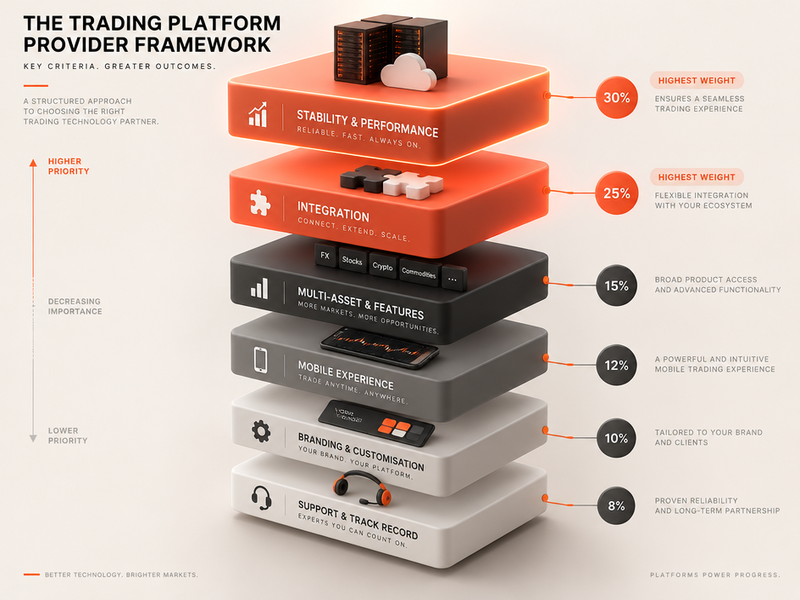
A platform does not operate alone. It must integrate cleanly with the CRM, back office, liquidity, and risk tools, sharing data in real time so the broker runs one connected business rather than reconciling silos. A platform that is excellent in isolation but hard to integrate becomes a liability, which is why integration sits near the top of the framework alongside stability. Branding matters too: a fully white-label platform builds the broker’s own identity, while a thinly branded one builds the provider’s.
Support and track record round out the evaluation. A provider that has run platforms for many brokers across market cycles has met the problems a newer vendor has not, and responsive support determines how quickly issues are resolved when they arise. Leverate’s white-label trading platform is built to score well across this whole framework, stable, multi-asset, mobile-first, deeply integrated with Leverate’s CRM, back office, and liquidity, fully brandable, and backed by a long track record, so a broker chooses a platform it can build on rather than one it will fight.
Putting the Framework to Work
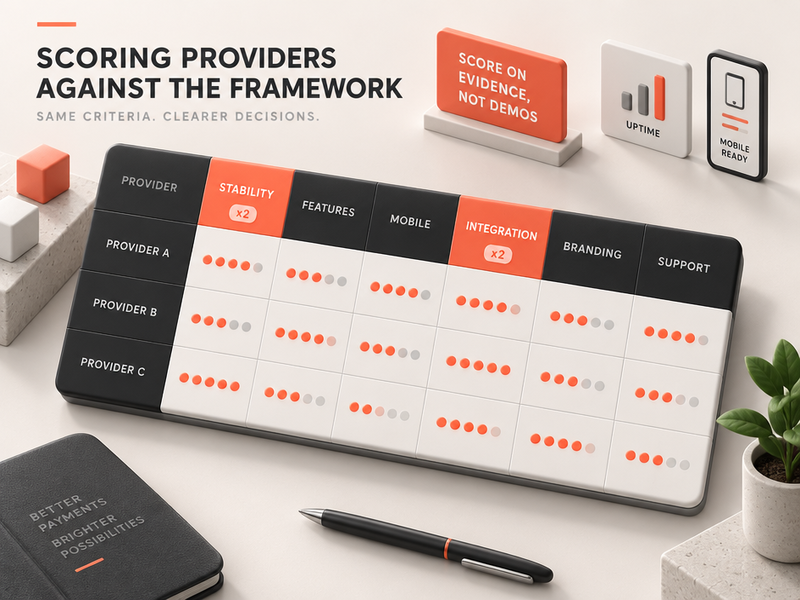
Applied in practice, the framework is a scoring exercise, not a gut call. Weight the factors by what matters most, stability and integration highest, then features, mobile, branding, and support, and score each provider on evidence: uptime data, integration depth, references from brokers of similar size, and a hands-on look at the mobile app. A provider that is strong across the framework, not just dazzling on one axis, is the safer long-term choice.
Above all, judge the platform as part of the whole business rather than in isolation. The best platform for a broker is the one that performs reliably, delights clients, and connects cleanly with everything else it runs, which is why an integrated provider so often wins over a standalone one. Choose on that basis and the platform becomes an asset the brokerage grows on for years.
Questions to Ask a Provider Before You Commit
A framework is only useful if it turns into pointed questions, and the right ones quickly separate strong providers from risky ones. On stability, ask for real historical uptime and a candid account of past incidents and how they were resolved, not a marketing figure. A provider confident in its platform will share this; reluctance is itself an answer. Because switching later is painful, this evidence is worth pressing for before any commitment.
On integration and data, ask exactly how the platform connects to a CRM, back office, liquidity, and risk tools, and whether the broker retains full, real-time access to its own client and trading data. A platform that keeps data behind a delay, or makes integration a bespoke project each time, will constrain the business. The goal is a platform that shares data openly with the rest of the stack and leaves the broker in control of it.
On mobile and roadmap, get hands on the actual app rather than a slide, and judge it as the flagship most clients will use. Then ask what the provider has shipped recently and what is coming, because a platform that is standing still will be a liability within a couple of years. A living roadmap signals a partner that will keep the broker current as AI, new assets, and new expectations arrive.
On branding and support, confirm how fully the platform can be made the broker’s own, and what support and service commitments come with it: response times, escalation, and who is accountable when something breaks at a bad moment. Branding builds the broker’s equity rather than the provider’s, and support determines the lived experience of the relationship. Vague answers on either are a reason to look harder.
Run through these questions and the right provider tends to stand out: strong on stability and integration, credible on mobile and roadmap, generous on branding and support, and backed by a track record across market cycles. Leverate’s white-label trading platform is built to answer all of them well, and to sit inside one connected stack with the CRM, back office, and liquidity, so the platform a broker chooses strengthens the whole business rather than becoming one more system to manage.
The Bottom Line
The platform is the part of a brokerage clients touch most, so choosing its provider is really choosing the daily experience the business will offer for years. That makes it worth resisting the pull of the flashiest demo and instead weighing the factors that decide long-term outcomes: reliability under stress, clean integration with the rest of the stack, a genuine mobile flagship, real branding, and a provider with the track record and roadmap to keep pace. A platform strong across all of these, rather than dazzling on one, is the one a broker will be glad it chose in three years.
It also pays to remember that the platform never works alone. Its value is realised only when it connects cleanly to the CRM, back office, liquidity, and risk tools that surround it, which is why an integrated provider so often beats a standalone one on the measures that actually matter. Evaluate the platform as part of the whole business, score providers on evidence rather than promises, and the choice becomes clear. Leverate’s white-label trading platform is built to be that dependable, integrated foundation, so the brokerage grows on it rather than around its limitations.
For a broker ready to choose, the most useful next step is to run two or three shortlisted providers through the framework and questions above, side by side, scoring each on evidence and giving extra weight to stability and integration. That disciplined comparison, rather than a reaction to a polished sales pitch, is what leads to a platform decision a broker can build on with confidence.
One last reminder ties the framework together. The platform a broker picks today will shape its client experience, its brand, and its ability to grow for years, and it is expensive to change once clients are trading on it. That permanence is a reason for rigour, not anxiety: a decision made carefully, on evidence and against clear criteria, becomes a foundation rather than a regret. Weight stability and integration, insist on a real mobile flagship and honest branding, choose a provider with a track record and a roadmap, and the platform stops being a risk and becomes one of the brokerage’s most durable assets. Chosen that way, and ideally as part of one connected stack rather than a standalone piece, the platform quietly does its job every day and lets the broker put its energy into the brand, markets, and service that actually set it apart.
**Disclaimer:
**This content is based on multiple sources and is provided for educational purposes only. It does not constitute financial, legal, or investment advice.