









Forex Trading Technology in 2026: The Trends Reshaping Brokerages
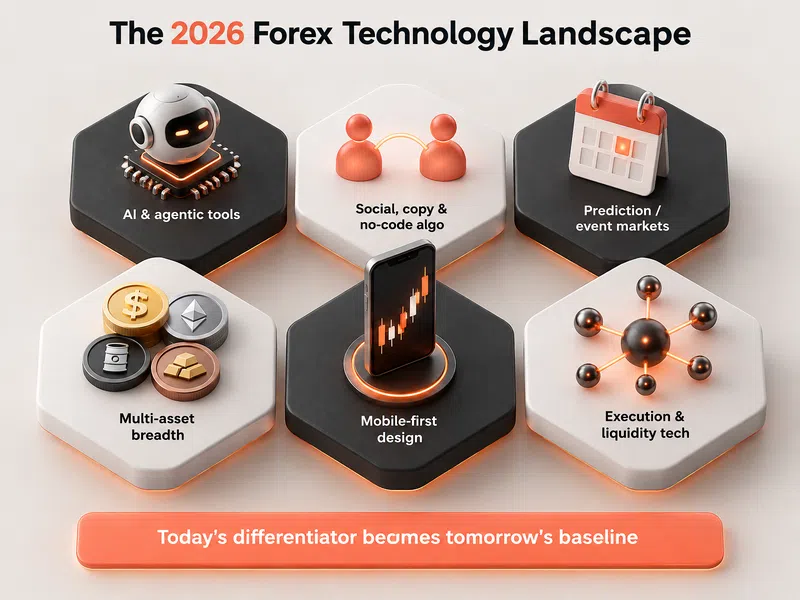
Forex trading technology has moved from a support function to the main arena of competition. Brokers no longer win primarily on price; they win on the technology that shapes retention, differentiation, and margin, and demand for brokerage technology keeps climbing, with the market on track to nearly double by 2034. This guide maps the trends reshaping brokerages in 2026, from AI and agentic tools to social and algorithmic trading, prediction markets, multi-asset breadth, mobile-first design, and the execution technology underneath, and what each means for a broker’s competitiveness.
The through-line is that technology now decides who grows and who stalls. A broker on a modern, evolving stack can offer what traders increasingly expect and adapt as the market moves, while one on ageing technology quietly loses relevance even if its pricing is keen. Reading these trends is less about chasing novelty than about understanding where the baseline is heading, because today’s differentiator is tomorrow’s table stake.
AI and Agentic Tools
Artificial intelligence has moved from analytics to action. Beyond AI-assisted insights, agentic tools now let AI act on a trader’s behalf within set rules, and brokers are being asked to support that safely through governed data access. AI is also reshaping broker operations, from client support to risk and retention, as firms apply it to their own data. The brokers pulling ahead treat AI not as a bolt-on feature but as a layer that runs across the business, enabled by making their data accessible to AI tools in a controlled, permissioned way.
The practical implication is that an AI-ready posture is becoming part of the baseline. Traders expect to connect AI tools; operations benefit from AI applied to broker data. A broker that prepares its data and access for this, rather than blocking it, positions itself for the next wave of both trader behaviour and operational efficiency. Leverate’s MCP server reflects this shift, giving brokers a governed way to connect AI to their data across the business.
Social, Copy and Algorithmic Trading
Engagement technology has become central. Social and copy trading let newer traders follow proven strategies, lowering the skill barrier and lifting activity, while algorithmic tools, increasingly no-code, let traders build and automate strategies without programming. Both drive the engagement and retention that keep a book active, and both have moved from premium extras to features traders expect, especially younger, mobile-first ones raised on social feeds and creator economies.
For brokers, the trend is toward making these capabilities native rather than bolted on, so copied flow and algorithmic activity are visible to risk and retention teams in real time. Leverate’s platform ships social and copy trading, and its Algo Studio brings no-code algorithmic trading to retail clients, so a broker meets the engagement expectation without assembling third-party tools that fragment the data.
Prediction and Event Markets
A newer category has moved from niche to commercially significant: prediction and event markets, where traders take positions on the outcomes of events. They bring a different kind of engagement, built around discrete events and continuous participation, and they open a new revenue line and audience for brokers willing to offer them. As a product category they matured faster than much of the industry expected, and they are increasingly part of how forward-looking brokers diversify beyond traditional instruments.
For a broker, the appeal is both engagement and differentiation: event markets attract participation during moments when traditional markets may be quiet, and they signal a modern, diversified venue. Offering them well requires purpose-built technology rather than a bolt-on, which is why brokers increasingly look to providers that offer a managed, branded event-markets solution alongside the core platform.
Multi-Asset Breadth and Mobile-First Design
Two client-side expectations now shape every platform decision. First, multi-asset breadth: traders want FX, crypto, commodities, indices, and more from one account, and a broker offering only one market invites clients to open a second account elsewhere. Second, mobile-first design: with most trades now placed on mobile, the app is the primary surface, not an add-on. A platform that treats mobile as a scaled-down copy of the desktop is offering a lesser product to the majority of its clients.
Together these mean a competitive platform in 2026 is broad and mobile-native by default. Brokers are designing for the phone first and ensuring one account spans the markets clients care about, because breadth and mobile quality are now baseline expectations rather than points of difference. A provider whose platform delivers both, natively and under the broker’s brand, spares the broker from stitching the experience together itself.
Execution and Liquidity Technology
Underneath the client-facing trends sits the technology that decides whether any of it works: execution and liquidity. Aggregated, multi-asset liquidity, smart order routing, and real-time risk and flow classification determine the spreads and fills clients actually receive, and connectivity and integration increasingly separate brokers who scale smoothly from those who stumble. As the visible features become baseline, execution quality is quietly becoming a key battleground, because it is felt on every trade and hard to fake.
This is why the strongest brokers treat execution and liquidity technology as strategic rather than plumbing. A modern stack ties liquidity, routing, and risk together so pricing stays competitive and the book stays safe as volumes grow. Leverate Prime and Leverate’s risk tools are built to provide exactly this foundation, so the engagement features on top rest on execution that holds up.
What It Means Competitively
Put together, the message for 2026 is that technology is the competitive strategy, not a support to it. The features that were differentiators a few years ago, AI, social and algo tools, multi-asset access, a strong mobile app, are becoming the baseline traders assume, which means a broker on ageing technology falls behind even without doing anything wrong. Staying competitive requires a stack that keeps evolving, and for most brokers that means a provider actively shipping new capability rather than a static platform.
The practical response is to choose technology as a long-term partnership. Leverate’s turnkey stack spans the platform, liquidity, CRM, back office, and risk, and it keeps pace with these trends, from AI and prediction markets to algo and multi-asset, so brokers stay current without funding the research themselves. In a market where the baseline keeps rising, the ability to keep up is itself the differentiator, and it is best bought as a partnership rather than built and maintained alone.
The Bottom Line
Forex trading technology in 2026 rewards brokers who understand that the baseline is moving. AI, social and algo tools, prediction markets, multi-asset breadth, and mobile-first design have shifted from premium features to expectations, and execution technology has become the quiet battleground beneath them. A broker that keeps pace offers what traders expect and adapts as the market changes; one that does not slips behind by standing still.
The most reliable way to keep pace is to build on a stack that evolves with the industry, delivered by a provider investing in staying current. That turns the relentless rise of the baseline from a threat into something a broker inherits automatically. Leverate is built to be that evolving foundation, so a brokerage competes on brand, service, and market focus while the technology keeps up with 2026 and whatever comes next.
There is a note of caution worth adding: not every trend deserves equal weight, and chasing all of them at once is its own mistake. A broker should read these trends against its own audience and strategy, investing first where its clients actually are, whether that is mobile, social trading, crypto, or event markets, rather than adopting every feature because it is fashionable. The value of an evolving stack is precisely that it lets a broker turn capabilities on as they become relevant, rather than forcing an all-or-nothing bet on any single trend.
Seen that way, the technology decision is really about optionality. A broker cannot know exactly which capabilities will matter most to its clients in two years, so the smartest position is to build on a foundation that already supports the major trends and can enable them as needed. That flexibility is worth more than any single feature, because it future-proofs the business against a baseline that will keep moving. Leverate’s stack is designed to give brokers that optionality, so keeping current becomes a setting to enable rather than a project to fund.
The competitive picture, finally, favours brokers who see technology as identity rather than infrastructure. In 2026 a brokerage is, to its clients, largely the experience its technology delivers, so the firms that treat their stack as central to who they are, and choose partners accordingly, are the ones that stand out. Those that treat technology as a cost to minimise tend to blend into a crowded field. The trend beneath all the others is that technology has become the brand, and brokers who internalise that compete from a position of strength.
For a broker planning its 2026 roadmap, the practical exercise is to map these trends against where its clients actually are and where it wants to grow, then prioritise. A broker leaning into a younger, mobile-first audience will weight social, algo, and mobile heavily; one targeting sophisticated traders may prioritise execution quality and AI tooling; one expanding into crypto-heavy markets will focus on multi-asset and digital-asset liquidity. The trends are a menu to choose from deliberately, not a checklist to complete blindly, and the right choices depend on the broker’s own strategy.
What does not vary is the need for a foundation that can support whichever trends prove important. Because no broker can perfectly predict which capabilities will matter most in two years, the safest position is a stack that already spans the major trends and can enable them as demand emerges. That is the difference between reacting to the market and being ready for it, and it is why the choice of technology partner is, in effect, a bet on staying relevant. Leverate is built to be a partner a broker can make that bet on with confidence.

Frequently Asked Questions
What are the biggest forex technology trends in 2026?
AI-assisted and agentic trading, social and no-code algorithmic tools, prediction and event markets, multi-asset breadth, and mobile-first design, all resting on strong execution and liquidity technology. Leverate is active across all of these.
How does trading technology affect broker competitiveness?
Technology now decides retention, differentiation, and margin more than pricing alone. Brokers on modern, evolving stacks win engagement and scale faster, while those on ageing technology fall behind even without doing anything wrong. Leverate keeps brokers current.
Why is AI important for brokers in 2026?
AI has moved from analytics to action, with agentic tools acting on traders’ behalf and AI applied across broker operations. An AI-ready, governed data posture is becoming baseline. Leverate’s MCP server gives brokers a controlled way to connect AI to their data.
Are social and algo trading now expected features?
Increasingly, yes, especially among younger, mobile-first traders. They drive engagement and retention and have moved from premium extras to expectations. Leverate ships social and copy trading and no-code algo through Algo Studio.
What are prediction and event markets?
Markets where traders take positions on event outcomes, offering a different kind of engagement and a new revenue line. They have matured into a commercially significant category, and Leverate offers a managed, branded event-markets solution.
Why does mobile-first design matter so much?
Because most trading now happens on mobile, so the app is the primary surface rather than an add-on. A platform that treats mobile as a scaled-down copy offers a lesser product to most clients.
Is execution technology really a competitive factor?
Yes, and increasingly the key one, because as visible features become baseline, the spreads and fills clients actually receive set brokers apart. Leverate Prime and Leverate’s risk tools provide that execution foundation.
How can a broker keep pace with technology trends?
By building on an evolving stack from a provider that keeps shipping new capabilities, rather than a static platform. Leverate’s turnkey stack keeps brokers current across AI, prediction markets, algo, and multi-asset without funding the research themselves.
Disclaimer:
This content is based on multiple sources and is provided for educational purposes only. It does not constitute financial, legal, or investment advice.