








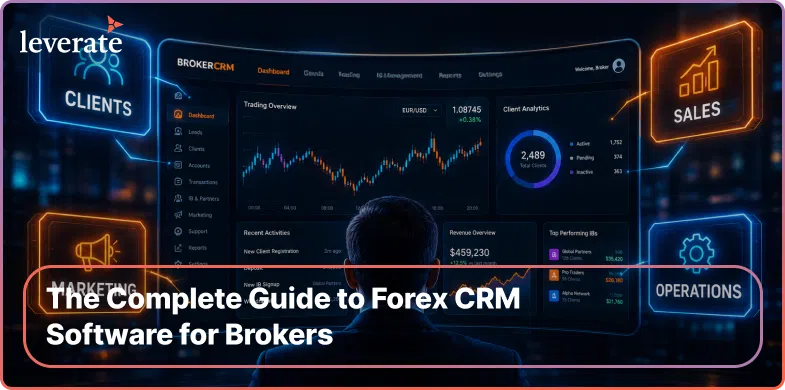
The Complete Guide to Forex CRM Software for Brokers
A brokerage can spend between 150 and 400 dollars to win a single client and still finish the month behind if that client never funds an account or quietly goes dormant. Forex CRM software is the system that decides which way that goes. It is the least visible part of a brokerage and one of the most consequential, because it governs whether leads convert, whether deposits arrive, and whether traders stay. This guide explains what a forex CRM does, how a forex crm solution differs from an ordinary CRM, and how to choose one that scales.
Most brokers give the trading platform the spotlight, yet the layer working quietly behind it, the forex CRM, is what turns marketing spend into funded, loyal clients. Treated as an afterthought, it leaks money at every step. Treated as the revenue engine it actually is, it compounds in value over the life of every client.
Why the Client Lifecycle Breaks Without the Right System
Leads reach a brokerage from many directions at once: paid campaigns, introducing brokers and affiliates, organic search, referrals, and events. Each arrives with different quality and a different likelihood of ever funding. Without a system built to capture, score, and route that flow, the leads pile up in spreadsheets and inboxes while the sales team chases the coldest names and the warmest ones cool off.
The cost of that disorder shows up in conversion. The share of leads that ever fund an account, the lead-to-first-time-deposit rate, typically sits in the low double digits even in a healthy funnel, so most leads never become paying clients. Every stalled step in between, a slow follow-up, an onboarding form that asks too much, a deposit page that fails on mobile, shaves points off that rate. Because acquisition is expensive, a small improvement in conversion often matters more than a whole new advertising channel.
The disorder is more expensive than it first appears because it compounds. Acquisition cost tends to rise every year as competition for attention intensifies, so the price of replacing a lost client keeps climbing while the value of keeping an existing one holds steady. A broker running on disconnected tools therefore pays twice: once in the leads that never convert because follow-up was slow, and again in the clients who lapse because no one noticed the warning signs in their trading. The brokerages that pull ahead are rarely the ones spending most on traffic. They are the ones converting and keeping a larger share of the traffic they already pay for.
Retention is the second leak. Roughly 74 percent of retail trading accounts lose money over time, so a broker cannot rely on trading success alone to keep clients engaged. Without structured lifecycle communication, hard-won clients drift away and the money spent to acquire them is written off. A forex CRM exists to close both leaks at once.
What Forex CRM Software Actually Does
A forex CRM is the operational backbone of a brokerage, a single system where every client relationship is captured from the first click through onboarding, funding, trading, and long-term retention. Where a general CRM tracks contacts and deals, a forex CRM adds the machinery a trading business runs on.
Lead and sales management sits at the front, capturing leads from every source, scoring them by quality, and routing them to the right agent while intent is high. Onboarding then moves a client from sign-up to approved through digital identity checks and document capture, without manual back-and-forth. Payment and provider integration lets clients deposit and withdraw inside the same environment, because a funding step that fails is a client lost.
Behind those client-facing steps sit the tools that grow the book: introducing-broker and affiliate management with multi-level hierarchies and automated commissions, segmentation and marketing automation that trigger the right message at the right moment, and reporting that shows which sources and agents produce funded, retained clients rather than vanity sign-ups. The feature that sets a forex CRM apart is its connection to live trading data, so retention and risk teams act on what clients are actually doing. Leverate’s Forex CRM ties all of this to the trading platform, and its PROP CRM extends the same core to prop firms.
The live-data connection is what makes the difference in practice. When the CRM sees account balances, trading volume, deposits, and platform activity as they happen, retention and risk teams act on what clients are actually doing rather than on a stale contact record. Adoption of this smarter, data-driven approach is accelerating across the industry, with brokers increasingly using AI-assisted CRM systems to sharpen lead scoring and timing, and digital onboarding cutting account setup to minutes rather than days. A CRM that only syncs on a delay cannot support any of this, which is why native integration is the dividing line between a system that grows a book and one that merely records it.

The Trader Lifecycle in Practice
The value is easiest to see by following one client through the system. A prospect clicks an ad and lands on a registration form. The CRM captures the lead, scores it against the source’s historical quality, and routes it to an agent within seconds. Automated onboarding then guides the client through verification quickly and on mobile, so they reach a fundable state before enthusiasm fades.
Funding is the moment everything builds toward, and with payments integrated the client deposits without leaving the environment. From there the CRM shifts into retention mode, watching trading behaviour and triggering a reactivation sequence when a once-active client goes quiet. This matters more every year as trading goes mobile, with around 78 percent of trades placed on mobile in 2025, so timely, mobile-aware communication is no longer optional. An integrated stack like Leverate’s Forex CRM connects the CRM to the platform, payments, and back office so the lifecycle runs as one flow rather than a relay between disconnected systems.
The same integration powers everyday retention work. Automated segments can greet a new depositor, nudge a client who has not traded in a fortnight, or flag an account whose behaviour signals churn, each triggered by real activity rather than a manual list a team has to remember to build. Run well, this turns retention from a monthly campaign into a continuous, largely automatic process, which is where a forex CRM quietly earns most of its return over the life of a client.

Forex CRM vs a General CRM
The distinction matters when choosing software. A general CRM is built to manage contacts, pipelines, and deals for a sales team. A forex CRM assumes the realities of a trading business: multiple payment providers, KYC and onboarding workflows, IB and affiliate hierarchies, and a constant feed of live trading data. Bolting those onto a generic tool is possible but brittle, and it usually breaks at the worst moment, during a volume surge or a payment outage. In a purpose-built forex CRM, this logic is native, which is why brokers who start on a general CRM tend to migrate within a year or two.
The gap widens as a brokerage grows. A general CRM has no concept of an introducing-broker hierarchy, a first-time-deposit event, or a dormant-then-reactivated trader, so brokers end up bolting on spreadsheets and manual processes to fill the holes. Those workarounds are fragile precisely when volume is highest, and they hide the trading-linked signals a retention team most needs. A forex CRM treats these as first-class concepts from day one, which is why the difference is felt less at launch and more as the business scales.
Choosing Forex CRM Software That Scales
A short checklist separates the contenders. Start with payment coverage for your target markets, since funding friction is the fastest way to lose a converted lead. Confirm native integration with the trading platform, so the CRM can support real-time retention rather than acting on stale data. Then look for depth in the tools that compound: multi-level IB and affiliate management, granular segmentation and automation, complete reporting, multi-language and multi-currency support, and role-based access.
The market is moving toward exactly this integrated depth. Demand for broker CRM technology is growing at roughly 6.5 percent a year, and the direction of travel is consolidation onto unified platforms rather than a patchwork of point tools. That frames the build-versus-buy question: building in-house means long timelines and permanent maintenance, while a proven, broker-specific system delivers the capability faster and keeps it current. Leverate is built to be that single accountable provider, with the CRM, trading platform, payments, and Back Office working as one connected stack.
It helps to frame the decision in return terms rather than cost. The value a CRM creates is the sum of three effects: more leads converted to deposits, faster onboarding so fewer approved clients slip away before funding, and longer active lifespans because retention is systematic rather than accidental. Against acquisition costs of several hundred dollars per client, each effect pays for the system many times over, and a broker does not need a dramatic uplift for the maths to work. A few points on conversion and a modest reduction in churn are usually enough.
Two mistakes recur when brokers choose. The first is treating the CRM as an administrative expense rather than a revenue engine, which leads to under-investing in the one system that governs conversion and retention. The second is choosing a generic CRM on price and assuming trading-specific features can be added later, when in practice those features, payments, IB hierarchies, live trading data, are exactly what break first under load. Choosing a purpose-built, broker-specific system from the start avoids a painful migration a year or two in.
Frequently Asked Questions
What is forex CRM software?
Forex CRM software is a client-management system built for brokerages. It combines lead capture, onboarding, deposits and withdrawals, IB and affiliate tracking, and retention automation in one place. Leverate’s Forex CRM ties these into the trading platform so brokers manage the full client lifecycle from a single dashboard.
How is a forex CRM different from a general CRM?
A general CRM tracks contacts and deals. A forex CRM adds trading-specific tooling: payment-provider integrations, KYC and onboarding workflows, IB and affiliate hierarchies, and real-time trading data. Leverate’s CRM is purpose-built for brokers, so this logic is native rather than bolted on.
What features should a forex CRM include?
At minimum: lead scoring and routing, digital onboarding, multi-provider payments, IB and affiliate management, segmentation and automation, reporting, and tight integration with the trading platform. Leverate delivers these as one connected suite.
How does a forex CRM improve lead conversion?
It captures every lead, scores it by quality, and routes it to the right agent while intent is high, then removes friction from onboarding and funding. Because acquisition is expensive, even a small lift in conversion has an outsized effect on profitability.
Can a forex CRM help with client retention?
Yes. By reading trading behaviour it can trigger timely education, offers, and reactivation before a client goes dormant. With most retail accounts losing money over time, structured lifecycle communication is what keeps hard-won clients engaged.
Do prop firms need a different CRM than brokers?
Prop firms share the same client-management core but need evaluation, funded-account, and payout logic on top. Leverate’s PROP CRM adds this while keeping the onboarding, payments, and automation any brokerage relies on.
How does a forex CRM integrate with the trading platform?
A strong forex CRM reads live balances, volume, deposits, and activity from the platform in real time. Leverate connects its CRM natively to the platform, payments, and back office so the whole lifecycle runs as one flow.
Is AI useful in a forex CRM?
Increasingly so. Brokers are adopting AI-assisted CRM systems to sharpen lead scoring, timing, and retention, focusing effort on the leads and clients most likely to fund and stay active.
Disclaimer:
This content is based on multiple sources and is provided for educational purposes only. It does not constitute financial, legal, or investment advice.