







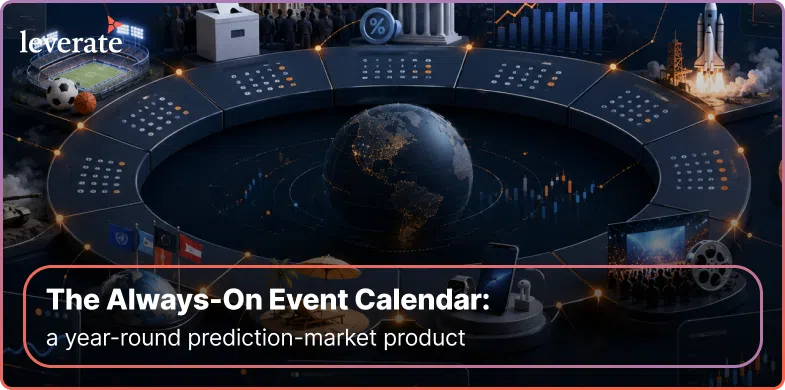
The Always-On Event Calendar: a year-round prediction-market product
A major tournament is the easiest event market in the world to launch. The audience is enormous, the interest is obvious, and traders arrive already knowing what they want to bet on. The mistake is treating that moment as the whole opportunity. When the trophy is lifted and the coverage moves on, a broker who built a one-off event around the tournament watches the traffic recede with it. The traders who signed up during the excitement drift back to whatever they were doing before, and the desk that was buzzing for three weeks goes quiet again.
There is a better way to read that spike. A tournament does not create demand for event trading; it reveals demand that was already there and will still be there next week. The growth numbers make the point plainly. Combined monthly volume on the two largest prediction-market platforms rose from under 5 billion dollars in September 2025 to about 24 billion by April 2026, according to Pew Research Center. That curve does not follow a single tournament. It reflects a steady, year-round appetite for trading outcomes, and it is the strongest argument yet for treating event markets as a permanent product rather than a seasonal campaign.
Why the tournament is the start, not the story
The instinct to stand up an event market for a headline tournament and then pack it away is understandable. The tournament is where the attention is, so that is where the effort goes. But the economics of a one-off are poor. You carry all the cost of setting up a new product, run it hard for a few weeks, and then let the acquisition, the momentum, and the trader habits you built evaporate. Every future event means starting the engine cold again, re-earning attention you already paid for once.
An always-on calendar flips that maths. The same setup that powered the tournament keeps working for the next fifty weeks, because the world keeps producing events. A rate decision lands next month. An election is scheduled for the autumn. An awards ceremony, a product launch, a box-office weekend, an inflation print, all of them arrive on predictable dates with clear, bettable outcomes. Once the product exists, adding the next event is a marketing decision, not a build. The cost you already sank into launching keeps paying back, and the traders you acquired during the tournament have somewhere to go on an ordinary Tuesday.
This is also where retention quietly compounds. A trader who came for the final and found nothing to do afterwards is a lost acquisition. A trader who came for the final and discovered a fresh, relevant market waiting every week becomes a regular. The tournament, in other words, is best understood as the top of a funnel that an always-on calendar keeps full. The event that got the most attention is the one that should feed everything that follows it.
How an event market actually works
To run events all year, it helps to be precise about what an event market is. A client is trading the outcome of a real-world event: which team wins, whether a central bank raises rates, who takes an election, whether a film clears a box-office threshold. Each outcome is expressed as a contract whose price sits between zero and one and moves as a live probability. A contract trading at 0.40 reflects a market-implied 40 percent chance of that outcome. When the event resolves, the contract settles automatically at one if it happened and zero if it did not. There is no ambiguity, no manual grading, and no lingering position to unwind. Settlement is binary and clean.
The harder part, historically, has been pricing. A blockbuster final has plenty of two-sided interest, so an order book fills naturally and spreads stay tight. A niche market, say a regional election or a minor economic print, may have willing traders on one side and thin activity on the other, and an empty order book is a dead market. Leverate’s event-market solution handles both cases with a hybrid pricing engine: it uses an order book wherever liquidity is deep enough to support one, and an automated market maker wherever it is not. That combination is what makes a full calendar viable, because the quiet events price just as reliably as the marquee ones. Without it, a broker could only realistically run the handful of events big enough to fill a book on their own, which is exactly the seasonal trap an always-on program is meant to escape.

Building a calendar that never goes quiet
An always-on program is really a content calendar with settlement attached. The job is to make sure that in any given week there is at least one market a trader wants to take a view on, and ideally several across different interests. The raw material is abundant, because almost every category of news already generates public prediction. The work is curation, not invention.
Sports is the anchor and the obvious place to start, and it is where the volume already sits: sports event contracts drove more than 80 percent of the activity in a market that quadrupled to nearly 64 billion dollars in trading volume across 2025. But leaning on sports alone still leaves gaps in the calendar and concentrates the offer in one audience. The strength of an always-on program is breadth. Economic prints are the most reliable pillar of all, because rate decisions, inflation reports, and jobs numbers are published on official calendars months in advance, each with a clean yes-or-no framing. Elections and referendums bring long build-up and intense engagement across whole regions. Entertainment and awards, from box-office openings to ceremony results, tap an audience that already predicts these outcomes for fun. Even weather thresholds and crypto price milestones give you filler markets for the weeks between the marquee moments.
Sequenced well, these categories interlock so the calendar never has a dead week. A macro print covers the mid-week lull, a weekend of sport carries the traffic, an awards season or an election cycle provides a multi-week narrative that keeps traders returning for updates. The broker’s task is to read ahead, line the events up, and promote the next one before the last one settles, so there is always a reason to log back in. For a fuller look at how the mechanics support that breadth, see Leverate’s event-market solution.
It runs on infrastructure you already operate
The reason an always-on event program is realistic rather than aspirational is that it does not require a parallel business. Leverate’s event-market solution runs on the same infrastructure a broker already operates, so the trading platform, the Client Portal, the CRM, and the reporting a broker uses for their core offering all extend to cover events. A new market is a configuration, not a construction project. That is what turns a full calendar from a burden into a routine: launching the next event is something the team schedules, not something they build.
Running on shared infrastructure also means the event program strengthens the rest of the business instead of competing with it. Traders acquired for an event are visible in the same CRM as everyone else, so the funnel from a tournament sign-up to a funded, active, multi-product client is one continuous path rather than a separate silo. The engagement an event calendar generates feeds retention across the whole platform, and the data it produces sits alongside the broker’s other data for a single view of the operation. An event market that lived on its own island would create work; one that lives on the infrastructure you already run creates leverage.

How to launch and sustain an always-on program
Getting started does not mean lining up a year of events on day one. The cleaner path is to use the next big moment you already have, a tournament or a major vote, as the launch event, and to treat it deliberately as the first entry in a calendar rather than a standalone campaign. That reframing changes how you set everything up: you configure the product to stay live, you capture the acquisition surge into your CRM with a plan to re-engage it, and you have the following month’s markets ready before the launch event even settles.
Sustaining it is a rhythm, not a heroic effort. Pick two or three categories to run consistently, for instance a weekly macro print, a rolling slate of sport, and one cultural or political market when the calendar offers it. Announce the next market as the current one resolves, so there is never a gap where a returning trader finds nothing new. Watch which categories your particular audience gravitates to and lean into them, because an event calendar is a product you tune over time rather than a fixed menu. The measure of success is not how much a single tournament traded, but whether an ordinary week still gives your traders a reason to open the app.
The brokers getting the most from this are the ones who stopped thinking about event trading as something that happens during big tournaments and started thinking about it as a standing product with a publishing schedule. The demand is clearly year-round. The infrastructure is already in place. What remains is the decision to keep the calendar full, and the traders a tournament brings you become the traders who stay.
FAQ
Q: What is an always-on event-market calendar?
A: It is a year-round program of prediction markets rather than a one-off product built around a single tournament. Instead of launching event trading for a headline moment and then shutting it down, a broker keeps the product live and adds a steady schedule of new markets every week, drawn from sports, economic prints, elections, entertainment, and other categories, so there is always something relevant for traders to engage with.
Q: Why is a one-off event market a missed opportunity?
A: A one-off carries all the cost of launching a new product but captures only a few weeks of return. The acquisition surge, the momentum, and the trader habits built during the event all fade once it ends, and every future event means starting cold again. Keeping the product always-on lets the same setup pay back across the whole year and gives newly acquired traders a reason to return.
Q: What kinds of events can become markets beyond sports?
A: Almost anything with a defined outcome and a deadline. Economic prints such as rate decisions, inflation reports, and jobs numbers are especially reliable because they are scheduled in advance. Elections and referendums bring long engagement, entertainment and awards tap audiences that already predict outcomes, and categories like weather thresholds and crypto price milestones fill the weeks between marquee moments.
Q: How does an event contract actually settle?
A: Each outcome is a contract priced between zero and one that moves as a live probability. When the event resolves, the contract settles automatically at one if the outcome happened and zero if it did not. Settlement is binary and automatic, so there is no manual grading and no position left to unwind after the result is known.
Q: How does pricing work when a market is not very liquid?
A: Leverate’s event-market solution uses a hybrid pricing engine. It runs an order book wherever there is enough two-sided interest to support one, and an automated market maker wherever activity is thin. That means quieter markets, such as a regional election or a minor economic print, still price reliably, which is what makes running a full and varied calendar practical rather than limiting a broker to only the largest events.
Q: Does launching event markets require building a separate platform?
A: No. Leverate’s event-market solution runs on the infrastructure a broker already operates. The existing trading platform, Client Portal, CRM, and reporting all extend to cover event markets, so adding a new market is a configuration the team schedules rather than a separate build project. That is what makes maintaining a year-round calendar realistic.
Q: How does an event calendar help with retention?
A: A trader acquired during a big event and then left with nothing to do afterwards is effectively a lost acquisition. When a fresh, relevant market is waiting every week, that same trader has a reason to keep returning and becomes a regular. Because the program runs on shared infrastructure, that engagement feeds retention across the broker’s whole platform, not just the event product.
Q: Which event categories should a broker start with?
A: A practical starting point is two or three categories run consistently: a weekly economic print for a dependable anchor, a rolling slate of sport for volume, and one cultural or political market when the calendar offers it. From there, a broker watches which categories their particular audience gravitates toward and leans into them, tuning the calendar over time rather than fixing a permanent menu.
Q: How is an event-market program measured for success?
A: The most useful measure is not how much a single tournament traded, but whether an ordinary week still gives traders a reason to log in. Sustained weekly engagement, repeat participation across different event categories, and the conversion of event-acquired traders into funded, active, multi-product clients are better indicators of an always-on program working than a single headline spike.
Q: How quickly can a broker turn one event into a year-round program?
A: The cleanest path is to use the next big moment already on the horizon as the launch event, but to set it up deliberately as the first entry in a calendar rather than a standalone campaign. That means configuring the product to stay live, capturing the acquisition surge into the CRM with a re-engagement plan, and having the following month’s markets ready before the launch event settles.
Disclaimer:
This content is based on multiple sources and is provided for educational purposes only. It does not constitute financial, legal, or investment advice.