

The term market maker is used constantly in trading and understood precisely by relatively few. At its simplest, the market maker meaning is this: a firm that stands ready to both buy and sell an instrument, quoting two prices at once and profiting from the difference between them. That willingness to always take the other side is what lets trades fill instantly, and it is the mechanism behind a large share of the liquidity retail traders rely on. This guide defines what a market maker is, explains how market making actually works, and shows how the model sits inside a modern brokerage, along with the risks a broker must manage to run it well.
Understanding this matters for brokers because market making is not just something other firms do. It describes one of the two ways a broker can handle client flow, and getting it right or wrong shapes both profitability and reputation.
Market Maker Meaning: A Clear Definition
A market maker is a participant that continuously quotes a bid price, at which it will buy, and an ask price, at which it will sell, for a given instrument. The gap between the two is the spread, and it is the market maker’s primary source of profit. By always being willing to trade, the market maker provides liquidity: a trader can open or close a position immediately because there is always a counterparty on the other side.
This is different from simply holding an opinion on price. A market maker is largely indifferent to direction in the short term. Its business is to capture the spread across a high volume of trades while managing the inventory, the net position, that builds up as it does so. That inventory management is the discipline that separates a profitable market maker from an exposed one.
It helps to place the role in context. Market makers exist in almost every liquid market, from equities and options to foreign exchange, because someone has to be willing to trade when a buyer and seller do not arrive at the same instant. Without them, a trader wanting to sell might have to wait for a matching buyer, and prices would gap and stall. By standing in the middle and quoting continuously, the market maker smooths that friction and is paid the spread for doing so. Seen this way, market making is less a trick and more a function markets depend on.
Scale your brokerage today!
CRM & Client Portal, Trading Platform, MT4 & MT5 - All built for you.
Scale NowHow Market Making Works
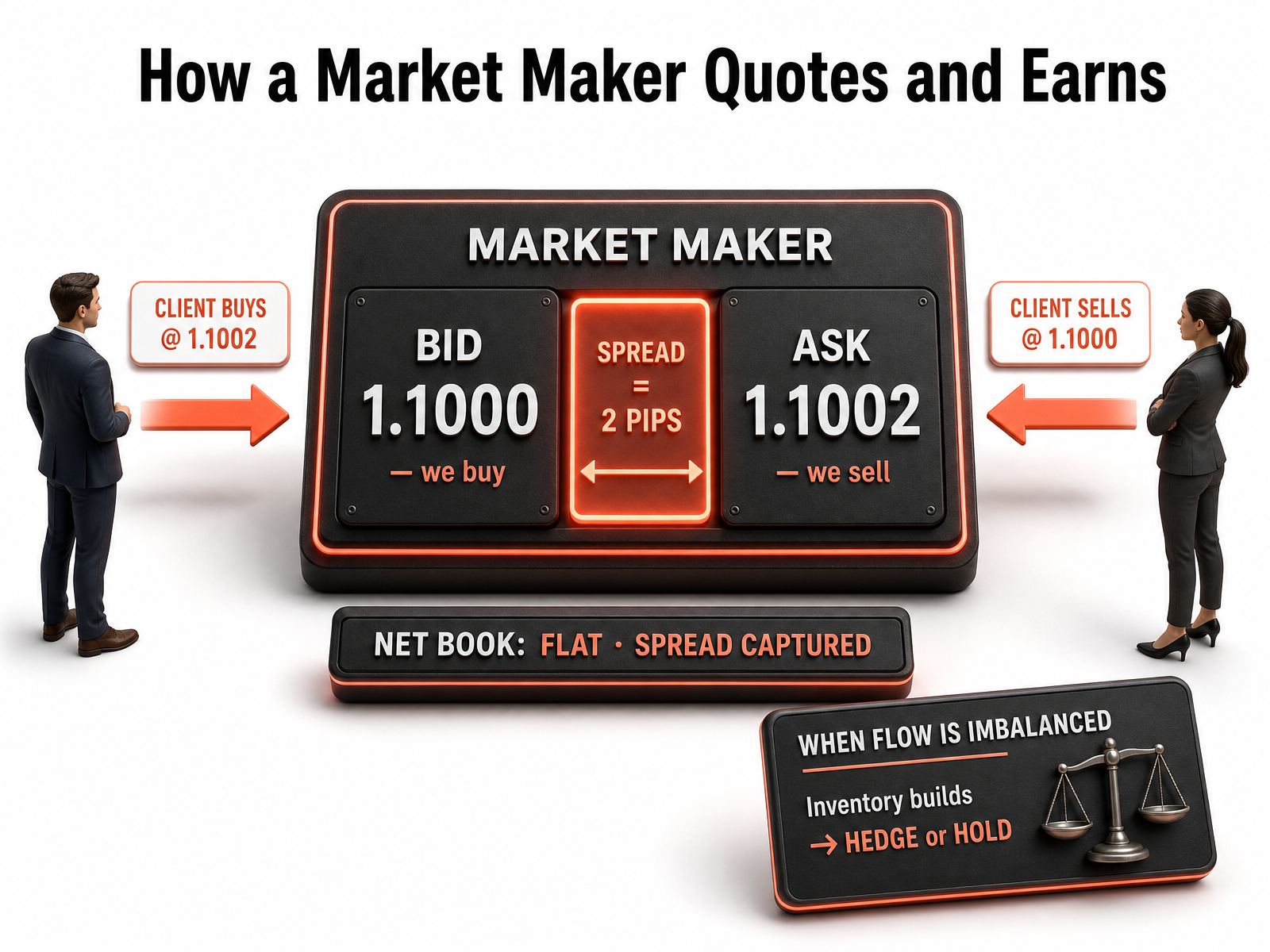
Market making works through continuous two-sided quoting. Imagine a market maker quotes a currency pair at 1.1000 to buy and 1.1002 to sell. A trader who buys pays 1.1002, and another who sells receives 1.1000, so the market maker earns the two-pip spread on the pair of trades while its net position stays flat. Repeated across thousands of trades, those small spreads add up into the market maker’s revenue.
The complication is that trades do not always net out. When more clients buy than sell, the market maker accumulates a short position and is exposed to the price rising. It then has a choice: hold the position and manage the risk, or offset it by hedging in the wider market. How well a market maker handles this imbalance, in real time and at scale, determines whether the spread income it earns is kept or given back in losses.
Two levers manage that imbalance. The first is pricing: a market maker can skew its quotes to encourage flow that offsets its position, nudging the market back toward balance. The second is hedging: when the net position grows beyond a comfortable limit, the market maker offsets it in the wider market, capping its risk at the cost of some spread. The art is knowing which lever to pull and when, because over-hedging surrenders profit while under-hedging invites a painful move. This is why market making at scale is fundamentally a technology and risk problem, not just a pricing one.
Market Maker vs Liquidity Provider vs ECN and STP
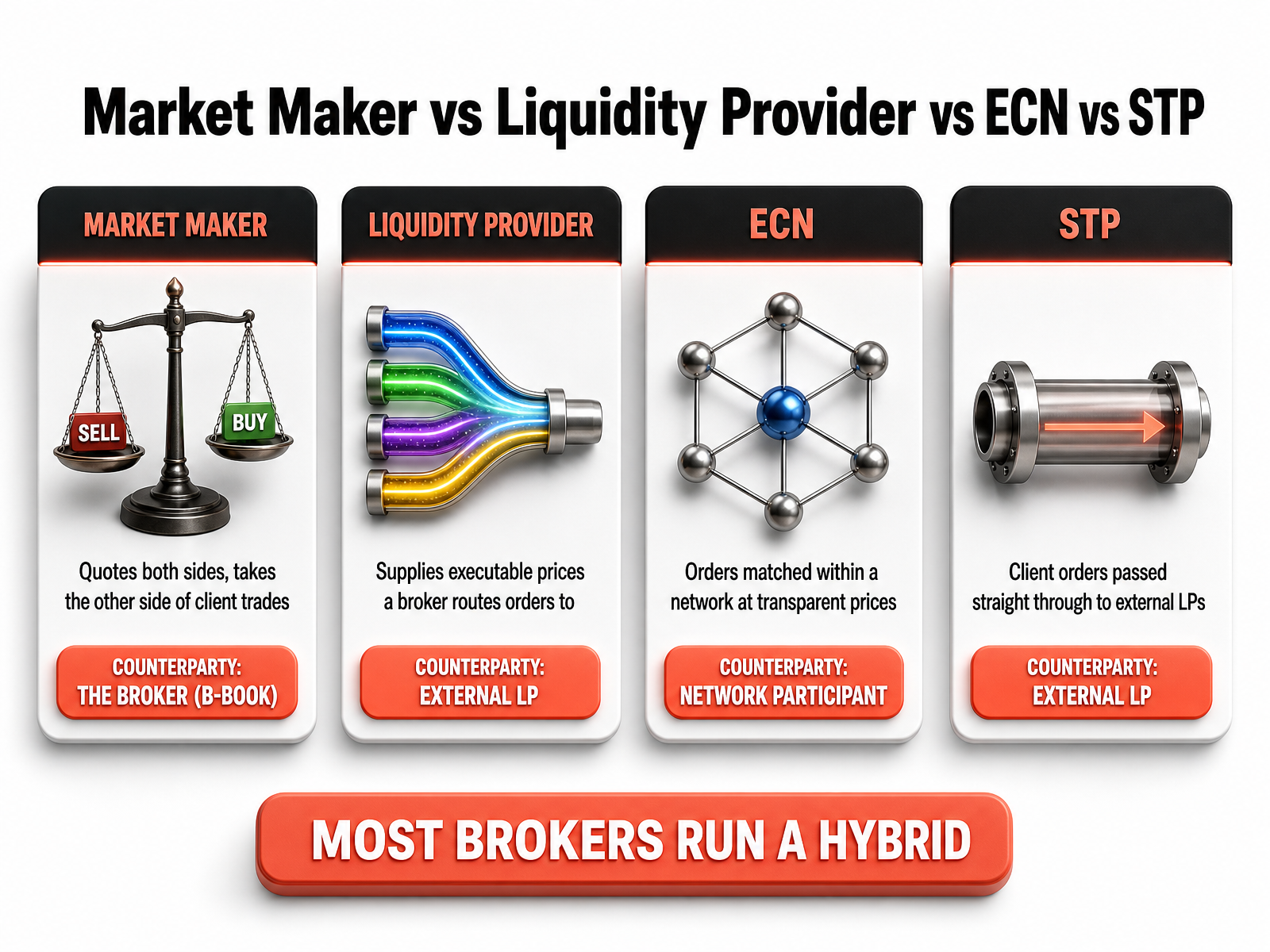
These terms are often blurred, but the distinctions are important. A liquidity provider supplies executable prices that a broker routes client orders to; it is a source a broker draws on. A market maker actively quotes and takes the other side of trades, managing its own book. The two overlap, because a large market maker can act as a liquidity provider to others, but the roles are not identical.
Execution models describe how a broker uses these. In an ECN model, orders are matched within a network of participants at transparent prices. In an STP model, the broker passes client orders straight through to external liquidity providers. In a market maker, or B-book, model, the broker itself is the counterparty to client trades. Most brokers in practice run a hybrid, routing some flow externally and internalising the rest, which is why understanding market making is essential even for a broker that does not think of itself as a market maker.
The practical upshot is that these labels describe a spectrum, not rigid boxes. A broker can internalise one client’s flow while routing another’s, and act as a market maker in one instrument and a pure pass-through in another. What matters is not the label a broker wears but whether it knows, for every stream of flow, who ultimately holds the risk and whether that is a deliberate choice. Confusion on that point, rather than the model itself, is what gets brokers into trouble, because risk a firm does not realise it is carrying is the most dangerous kind.
The B-Book Model in Brokerages
In brokerage terms, acting as a market maker is the B-book model: the broker internalises client trades and takes the other side rather than passing them to an external provider. This is not inherently predatory, and it is not inherently safe either. Its economics rest on a statistical reality: because roughly 74 percent of retail accounts lose money over time, a broker that internalises typical retail flow can profit from it, provided it can tell benign flow from the sharp, consistently profitable flow that is expensive to hold.
Run responsibly, the B-book model lets a broker offer steady pricing and capture spread on flow it understands. Run carelessly, it exposes the broker to exactly the clients it should have hedged. The difference is entirely about risk management, which is why market making and risk technology are inseparable.
The economics also explain why brokers do not simply hedge everything. Passing every trade to an external liquidity provider removes risk but also removes the spread capture that makes the B-book profitable, and it adds the cost of external execution. Internalising benign flow lets a broker keep more of the spread on trades that are, in aggregate, unlikely to move against it. The judgement call is which flow is benign, and that judgement is only as good as the data and classification behind it. A broker guessing is gambling; a broker measuring is running a business.
Managing the Risk of Market Making
A broker that acts as a market maker needs to see and control its exposure in real time. That means monitoring net position by instrument, classifying client flow, and routing risky flow out to liquidity while internalising the rest under limits, the hybrid approach most serious brokers run. Modern systems classify flow continuously and adjust routing dynamically, so a client who becomes consistently profitable is moved to A-book rather than left on the broker’s book. Leverate pairs this classification and exposure monitoring in its Back Office and Broker Portal with Leverate Prime for the hedging leg, so a broker can run internalised flow safely rather than by guesswork.
Is Market Making Good or Bad for Traders?
Because the B-book model means the broker profits when clients lose, it is sometimes viewed with suspicion. The fairer picture is that market making is a legitimate and necessary part of how markets function, and the trader experience depends on how it is run. A well-run market maker provides instant fills, steady spreads, and reliable execution, which benefits traders. Problems arise only when a broker manages the conflict poorly, for example by degrading execution on profitable clients. Sound risk technology and transparent conduct are what keep the model working for both sides, which is the standard brokers should hold themselves and their providers to.
There is a clear industry direction here worth naming. As traders become better informed and comparison is a click away, brokers that internalise flow transparently and execute fairly build lasting trust, while those that abuse the model face reputational damage that spreads quickly through trading communities. The reputable path and the profitable path have largely converged: the market maker that treats clients well and manages its book with genuine technology is the one most likely to endure. Leverate’s risk and liquidity tools are built to support exactly that approach, so brokers can run internalised flow profitably without cutting corners on the client experience.
Market Making Across Asset Classes
The mechanics of market making are consistent, but the challenge changes by asset class. In major FX pairs, spreads are thin and volume is enormous, so profitability depends on scale and speed. In less liquid instruments, wider spreads compensate for the greater difficulty of offsetting positions. Crypto adds its own twist, with 24/7 trading and sharper volatility that make inventory risk harder to manage and real-time controls even more important. A broker internalising flow across several asset classes therefore cannot apply one rule everywhere; it needs monitoring and limits tuned to each market’s behaviour.
This is another argument for treating market making as an integrated capability rather than a manual desk activity. When exposure, classification, and hedging span every asset class in one system, a broker can run a consistent B-book policy across FX, crypto, metals, and indices without blind spots. Leverate’s Back Office and Broker Portal are built to give that unified view, so internalised flow is governed by the same discipline wherever it arises.
**Disclaimer:
**This content is based on multiple sources and is provided for educational purposes only. It does not constitute financial, legal, or investment advice.