

The kind of brokerage expansion Eastern Europe now rewards is won on activation, not sign-ups. Poland and Romania already hold millions of brokerage accounts and pension savers, but only a small share trade actively. The operators that grow will be the ones that turn those dormant relationships into funded, multi-asset clients served in their own language.
Demand is also changing shape. FX and index CFDs are still the core, yet interest in local shares, global equities and ETFs is rising after two strong years on regional exchanges. This guide reads the public data for Poland and Romania, maps where demand is heading, and sets out a brokerage expansion Eastern Europe playbook built on three stages: acquire, activate and retain. It ends with a simple way to pick an entry model.
Why Central and Eastern Europe Is on Every Broker's Growth Map
Western Europe is crowded. Most large markets there have mature brokers, high acquisition costs and little room to stand out. Central and Eastern Europe (CEE) looks different. The Mordor Intelligence Europe e-brokerage market report describes Eastern Europe as underpenetrated relative to Western centres, and notes that low-cost brokers based in Germany are pushing further into Southern and Eastern Europe in 2026.
That second point matters for smaller operators. When large discount players enter a region, headline commissions fall. A mid-sized brokerage cannot win a price war against firms with far bigger balance sheets. It can win on things scale players often do poorly: local language support, faster human service, a product list that fits local habits, and partner networks that reach communities a national ad campaign misses.
The region is also not one market. Poland, Romania, Czechia and Hungary each have their own currency, language, payment habits and home exchange. That fragmentation is a barrier for giants that want one product everywhere, and an opening for brokers willing to localise country by country.
So a winning brokerage expansion Eastern Europe strategy is not about being the cheapest. It is about being the closest to the client. The Eastern Europe fintech scene has trained people to expect mobile-first banking, instant payments and quick onboarding. A brokerage that feels foreign or slow loses them at the first screen.
Scale your brokerage today!
CRM & Client Portal, Trading Platform, MT4 & MT5 - All built for you.
Scale NowWhat the Numbers Say About Demand
Two markets publish enough recent data to show the pattern clearly: Poland, the region's largest economy, and Romania, its fastest-moving equity story of the past two years.
Poland: Accounts Are Rising Faster Than Activity
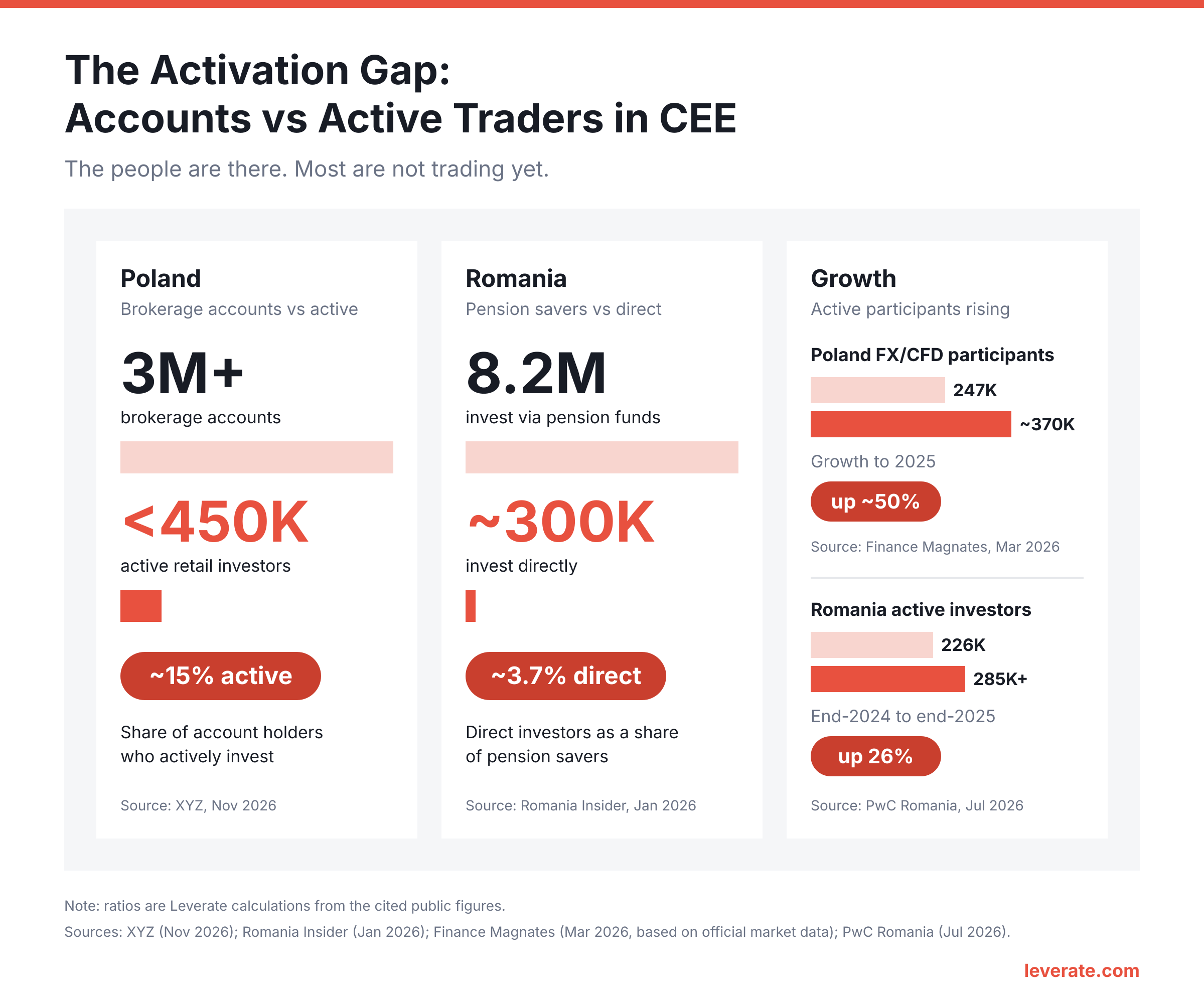
The Poland trading market has a large base and a small active core. According to XYZ's analysis of the Warsaw exchange's push for more investors, Poland has more than 3 million brokerage accounts but fewer than 450,000 active retail investors. Domestic retail investors generate just 13% of Warsaw turnover, against 73% from foreign investors. That is despite a strong market: the WIG index rose 47% in 2025 and 34% so far in 2026.
Leveraged trading is growing faster than cash equities. Official market data reported by Finance Magnates in its review of Poland's FX and CFD trader pool shows active participants rose about 50% in 2025, from 247,000 to roughly 370,000. Retail clients made up 99.9% of active clients and 94% of nominal transaction value. This is a retail market, and it is expanding.
Romania: A Rally Built a New Investor Base
Romania's story is about a rally pulling new people in. A PwC Romania review of the Bucharest Stock Exchange found active retail investors grew from 226,000 at the end of 2024 to over 285,000 at the end of 2025, a 26% rise and four times the 2020 level. Market capitalisation passed EUR 100 billion for the first time.
Yet direct investing is still rare. Romania Insider's report on the exchange's record 2025 puts direct investors at roughly 300,000, compared with 8.2 million people who invest indirectly through pension funds. The BET index closed 2025 up 46%, or 55% with dividends, its best year since 2009. Emerging Europe's look at Romanian capital markets notes that active retail investors are still only around one in a hundred Romanians.
Put the two countries side by side and a pattern appears that we call the activation gap: very large potential audiences sitting next to small active cores, while the leveraged segment grows quickly. The comparison below shows how wide that gap is.
Where Demand Is Heading Next
The data points to four shifts that should shape any product plan for the region.
Multi-Asset Over Single Product
CEE retail investors increasingly want both a long-term portfolio and a trading account. Many hold them with different providers because no single firm offers both well. That gap is where multi-asset demand comes from: one login where a client can trade EUR/USD, hold an index CFD and buy exposure to a local bank or energy stock. Each extra asset class a client uses gives them one more reason to stay.
Local Stocks Next to Global Markets
Strong home indices have made local names familiar. Stock CFD demand is no longer only about US tech. Clients want Warsaw and Bucharest blue chips next to Nasdaq names, shown in a way they understand. Brokers that list only global shares leave a gap that local exchanges are already working to fill.
First-Time Investors Arriving Through Share Sales
Large public offerings act as an on-ramp. The Hidroelectrica share sale drew nearly 52,000 retail subscription orders, according to the same Emerging Europe piece. Many of those buyers bought one stock and stopped. They know how to open an account, but they have not built a habit. Education, simple product paths and native-language guidance move them to a second and third trade.
Momentum Into 2026
Activity is catching up with valuations. In 2025, Romanian market capitalisation rose 49% but traded value fell 1%, as Romania Insider reported on the PwC findings. In the first quarter of 2026, traded value was 64% higher than a year earlier, according to the same analysis. That is the clearest signal for any brokerage expansion Eastern Europe operators plan this year: holders are starting to become traders.
The Brokerage Expansion Eastern Europe Playbook: Acquire, Activate, Retain
If the opportunity is activation, the plan should follow the client lifecycle, not launch day. The table maps each stage to the market signal, what the operator should do and where Leverate's tools fit.
| Stage | Demand signal | What the operator does | Leverate tools that help |
|---|---|---|---|
| Acquire | New accounts after big share sales and strong index years; partner-led word of mouth | Local-language landing pages and education, IB and affiliate recruitment, local payment methods at sign-up | AFF/IB, multilingual Client Portal |
| Activate | Large pools of registered but inactive accounts | Short onboarding, a guided first trade in a familiar name, fast follow-up on stalled deposits | Forex CRM, white-label trading platform, xChart |
| Retain | Clients who start with one product and drift away when markets cool | Shares, indices and FX in one account, native-language account managers, campaigns segmented by country | Leverate Prime, Back Office, Forex CRM |
The trading layer comes first. Leverate's white-label trading platform is multi-asset, so a brokerage can offer shares alongside FX and CFDs under its own brand, rather than bolting on a second system later. xChart gives clients charting for both local and global names.
Pricing depth matters just as much. Leverate Prime multi-asset liquidity spans shares, forex, indices, crypto, metals and energies from one connection, so a growing product list does not turn into a growing list of vendors.
Then comes the client layer. The multilingual Client Portal gives clients their account journey in their own language, while the Forex CRM and Back Office give sales and retention teams one place to work from.
Activation in Practice: Five Steps
- Cut the path from registration to first deposit to as few screens as possible, with the local payment method shown first.
- Offer a guided first trade in an instrument the client already knows, such as a home index or a local blue chip.
- Trigger a native-language call or message within a day when a deposit stalls.
- Suggest products the client has not tried, based on what they already hold.
- Review cohorts by country every week, not only in aggregate, so one strong market does not hide a weak one.
Choosing Your Entry Model
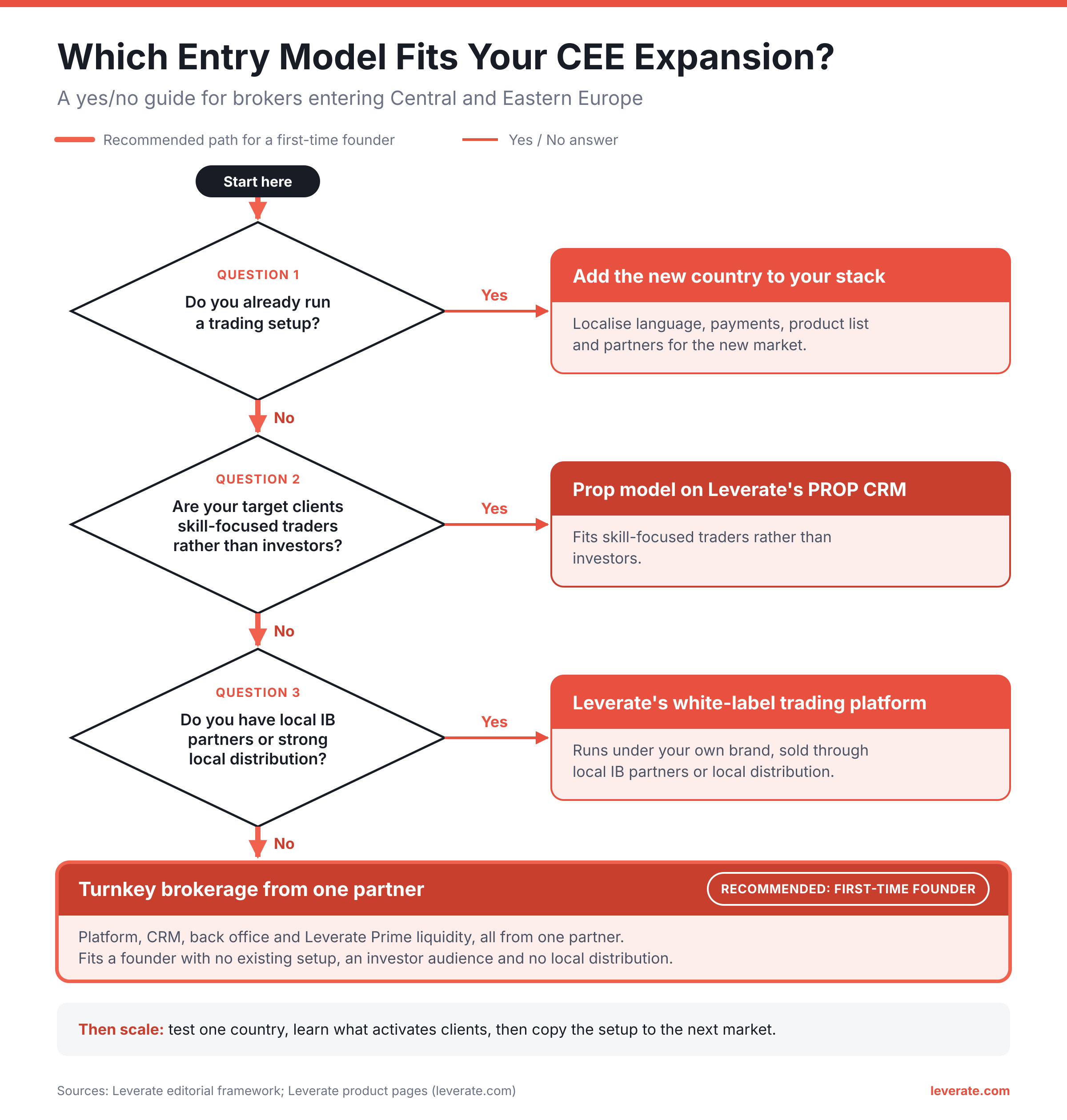
The right entry model for a brokerage expansion Eastern Europe project depends on what you already run. Four models cover most cases, and each carries a different operating load.
- Add a market to an existing setup. If you already run a brokerage, a new CEE country is mainly a localisation job: language, payment methods, product list and partners. The core stack stays the same.
- White label. A new brand on proven technology. You own marketing, sales and client relationships, and the technology partner runs the platform. This suits teams with strong local distribution and no wish to build software.
- Turnkey brokerage. A turnkey brokerage setup brings platform, CRM, back office and liquidity together, which suits founders starting from scratch who want one partner for the whole stack.
- Prop firm. If your audience is skill-focused traders rather than investors, a challenge model run on Leverate's PROP CRM may fit better than a classic brokerage.
Dealing teams should plan for one regional quirk whichever model they pick. When a local rally takes off, many new clients pile into the same few names at once. Exposure limits set by instrument and client group matter more in a young market than in a mature one.
The decision path below turns these four options into three yes-or-no questions.
The Bottom Line: Win on Activation, Not Sign-ups
Central and Eastern Europe has the accounts, the market momentum and a growing appetite for both leveraged and equity products. What it lacks is enough active clients, so a successful brokerage expansion Eastern Europe plan is a contest of onboarding, local service and product fit rather than raw sign-ups. Smaller operators can beat discount giants by being closer to the client and broader in what they offer. The technology to do that already exists. Book a demo to see how Leverate's multi-asset stack can support your next market in the region.
Disclaimer: This content is based on multiple sources and is provided for educational purposes only. It does not constitute financial, legal, or investment advice.