

An IB commission structure is the set of rules a broker uses to pay introducing brokers for the clients they refer: how much, for what activity, when, and what can be taken back. The three core models are a fixed rebate per lot, a share of the revenue referred clients generate, and a hybrid of the two, with a one-off payment per funded client (CPA) as a fourth option. The right choice keeps total partner cost below a fixed share of what each lot earns you.
Most guides stop before that point. They tell IBs what they might earn. This guide is for the operator pricing the deal. Global FX turnover averaged $9.6 trillion a day in April 2025, according to the BIS Triennial Central Bank Survey, so partners who deliver funded traders have plenty of brokers to choose from. Your terms need to compete without quietly giving away margin.
What an IB Commission Structure Actually Decides
Every partner agreement answers five questions. Settle them before you negotiate rates, because the rate is the last decision, not the first.
- Who gets paid: the direct IB only, or a chain that includes sub-IBs and a master IB above them.
- What triggers payment: volume (lots), revenue, a funded account, or a mix.
- Which activity qualifies: instruments, account types, minimum trade duration and minimum deposit.
- When money moves: the payout cycle, the hold period and the minimum payout amount.
- What can be reversed: clawback rules for chargebacks, fraud and accounts that close early.
Two brokers can both advertise a $5 rebate per lot and run very different programmes. One pays on every lot from day one. The other pays only on standard accounts, only on trades held longer than a minute, and only after a 30-day hold. The headline rate matters less than the rules around it, and a well-designed IB commission structure makes those rules explicit, both in the agreement and in the system that calculates payouts.
Scale your brokerage today!
CRM & Client Portal, Trading Platform, MT4 & MT5 - All built for you.
Scale NowThe Three Core Models (and Where CPA Fits)
Per-lot rebates
The introducing broker rebate model pays a fixed amount for every standard lot a referred client trades, usually counted per round turn. IBs like it because it is easy to understand and easy to check against their clients' statements. Brokers like it because the cost per unit of volume is predictable.
The weakness is that a lot is not a unit of profit. A rebate set for a standard account can exceed what the broker earns on a raw-spread account or a tight-spread instrument. High-frequency or rebate-farming flow can then cost more than it brings in.
Revenue share
The broker pays the IB a percentage of the net revenue its referred clients generate. Define net revenue precisely in the contract: trading revenue from spreads, markups and commissions, minus liquidity and execution costs, payment fees and any bonuses granted to those clients. Partner cost then moves in line with what the broker actually earns.
Never define revenue as client losses. In its 2018 announcement restricting CFDs for retail investors, ESMA found that 74% to 89% of retail CFD accounts typically lose money, and an IB paid on those losses has an incentive that runs against the client. Paying on spread and commission revenue avoids that conflict. The trade-off is trust: IBs cannot verify a revenue figure from their own records, so revenue share only works with transparent, line-by-line reporting.
Hybrid deals
A hybrid combines a smaller per-lot rebate with a revenue share percentage. The rebate gives the IB steady income they can check. The revenue share rewards them for clients who stay and remain profitable for the broker. To build one:
- Start from the full per-lot rate you would offer that partner.
- Cut it to roughly half or less.
- Set the revenue share so total payout on your typical account mix lands at or below your payout ceiling (explained below).
- Optionally add a small CPA on first deposit to help a new IB fund early marketing.
Where CPA fits
Cost per acquisition pays a fixed fee once per qualified funded client. The CPA vs revenue share question in forex comes down to relationship length: CPA suits partners who drive traffic but do not manage clients afterwards. Qualification rules, such as a minimum first deposit and a minimum number of trades, matter more than the fee itself.
| Model | IB is paid for | How broker cost behaves | What the IB can verify alone | Main operator risk |
|---|---|---|---|---|
| Per-lot rebate | Volume traded | Fixed per lot, rises with volume regardless of margin | Lot counts from client statements | Rebate exceeds revenue on low-margin flow |
| Revenue share | Net revenue generated | A fixed share of what the broker earns | Very little without broker reports | Disputes if reporting is not transparent |
| Hybrid | Volume plus revenue | Partly fixed, partly variable | The rebate portion only | Complex terms that are hard to reconcile |
| CPA | Each qualified funded client | Paid upfront, before any revenue | Number of funded referrals | Paying for clients who never trade |
Pricing the Deal: The Payout Ceiling
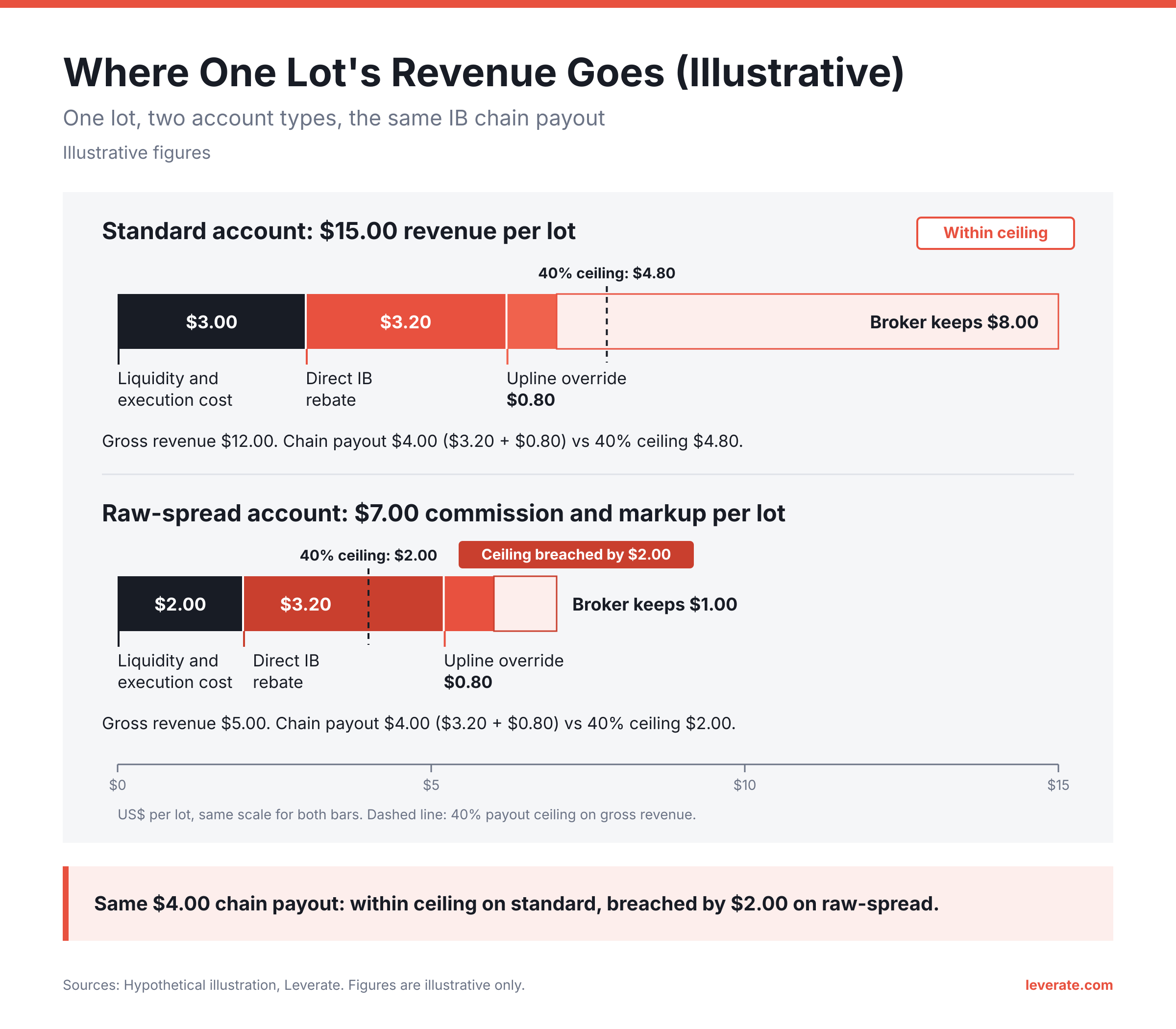
The most useful rule for pricing partner deals is a payout ceiling: the maximum share of gross revenue per lot you will pay the whole IB chain, set separately for each account type. Gross revenue per lot is what you keep after liquidity and execution costs. Set the ceiling once, as a business decision, then derive every rate from it. This keeps the IB commission structure tied to your margin rather than to whatever a rival advertised last month.
Gross revenue per lot differs sharply by account type, so one flat rebate cannot respect the same ceiling everywhere. Here is how a single per-lot rate lands on a standard account and on a raw-spread account.
Worked example: one IB, one month, three models
These figures are hypothetical, chosen to show the mechanics at portfolio level. An IB refers 50 funded clients who trade 1,000 standard lots in a month on standard accounts. The broker earns $12 gross per lot, or $12,000. After payment fees and promotions, net revenue is $10,500.
- Per-lot at $4: payout $4,000, or 33% of gross.
- Revenue share at 35%: payout $3,675, or 31% of gross.
- Hybrid at $1.50 per lot plus 20%: $1,500 plus $2,100, a payout of $3,600, or 30% of gross.
In month one the models look almost identical. Now the IB moves the same clients to raw-spread accounts, where the broker earns $5 gross per lot. Volume stays at 1,000 lots, so gross falls to $5,000 and net revenue to about $4,000.
- Per-lot at $4: payout is still $4,000, which swallows the entire month's net revenue.
- Revenue share at 35%: payout falls to $1,400.
- Hybrid: $1,500 plus $800, or $2,300.
The lesson is that per-lot pricing needs a separate rate for each account type, each set below that type's ceiling. Revenue share respects the ceiling automatically, which is why proven partners often move onto it once they trust the reporting.
Doing this by hand across dozens of partners and several account types is where errors creep in. Leverate's AFF/IB module tracks partners, their referred clients and their commission plans, which is the foundation of IB payout automation. The Back Office gives dealing and finance teams the reporting to approve and reconcile each payout run.
Multi-Tier Overrides Without Margin Leaks
A multi-tier IB program lets a master IB recruit sub-IBs and earn an override on their clients' activity. It is a strong growth channel, because a well-connected master IB can build a regional network faster than an in-house sales team. It is also the most common source of margin leaks.
The leak happens when each tier is priced on its own. The sub-IB is promised the standard rate, the master IB gets an override on top, and nobody adds the two together. The fix is simple: agree the total chain payout first, inside the ceiling, then split it. If the chain total per lot is fixed, the sub-IB might receive 80% of it while the master IB keeps 20% as the override. Recruiting more sub-IBs then grows volume, not your cost per lot.
Three more rules keep multi-tier programmes manageable:
- Cap the depth at two or three levels. Every extra level thins each partner's share and makes reports harder to explain.
- Pay overrides only on qualifying activity from sub-IB clients, under the same rules as direct business.
- Show each tier its own earnings and its direct downline, not the whole tree.
Choosing an IB Commission Structure for Each Partner Type
Partners differ in how they find clients, how long those clients stay and how much cash the partner needs up front. Good affiliate commission plans for brokers match the model to the partner instead of forcing one rate card on everyone. Before quoting any rate, gather evidence in the first partner call:
- Acquisition channel: content and education, a trading community, paid traffic or a local sales desk.
- Account preference: which account types their audience is likely to open, since this sets which ceiling applies.
- Track record: anonymised volume or retention figures from previous partnerships, where the partner can share them.
- Fixed costs: whether they carry staff or ad spend every month.
- Network plans: whether they intend to recruit sub-IBs.
Those answers feed a short set of questions that points to the right forex IB commission model.
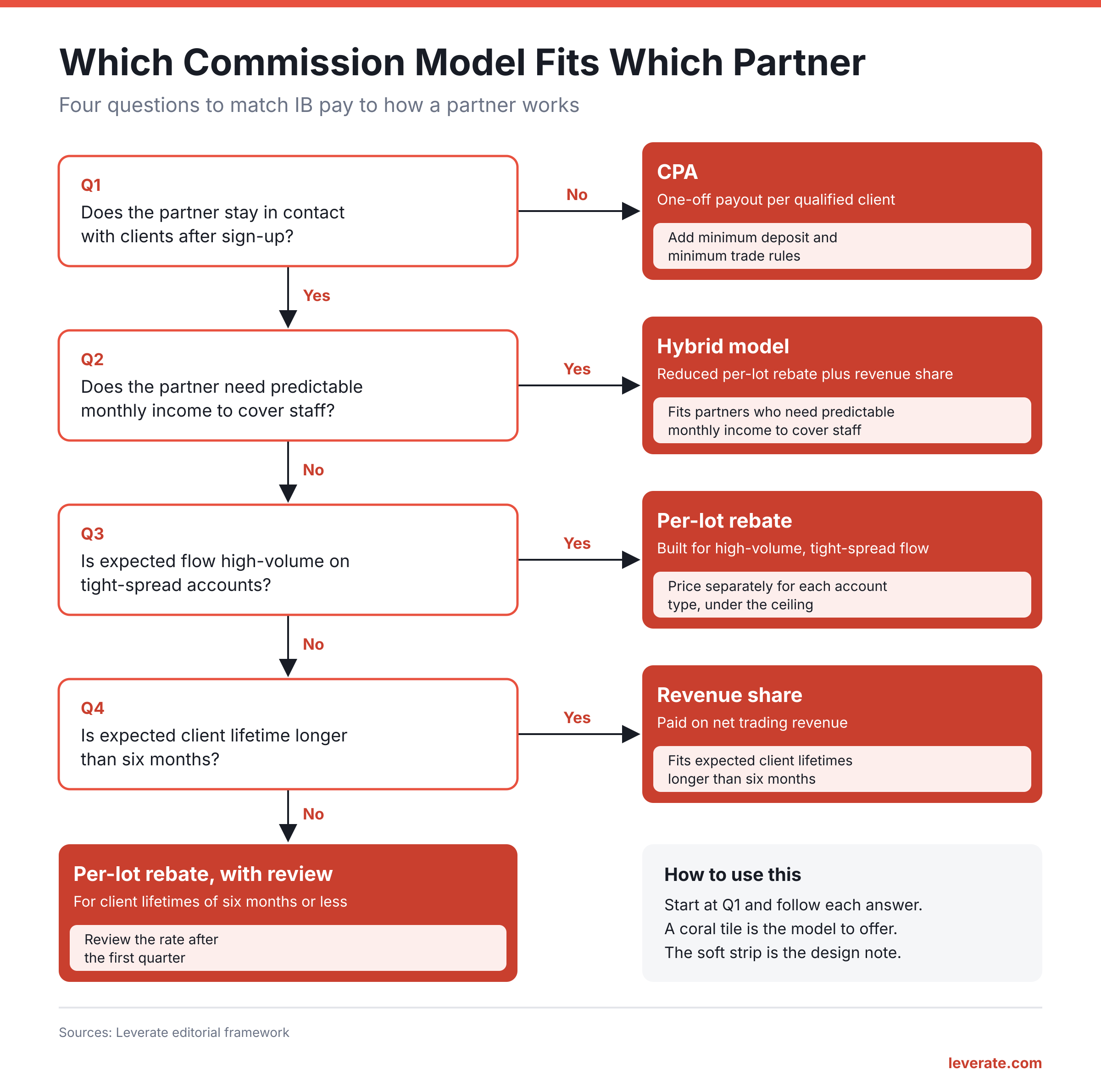
Treat the outcome as a starting offer, not a permanent label. Write a review date into every new agreement so the model can change once real account mix and retention data replace the partner's estimates.
Whatever the model, the operator needs every client mapped to the right referring partner from the first registration. A branded Client Portal gives traders a self-service area for onboarding and funding, and our complete guide to forex CRM software explains how the CRM keeps that attribution clean as clients move between accounts.
Payout Rules That Protect Both Sides
Most IB disputes are about timing and reversals, not rates. Put these rules in the agreement and enforce them in the system:
- Hold period: hold commission on new clients for a set window, so deposits that turn into chargebacks are caught before money leaves.
- Clawback: state which events reverse a payout, such as fraud, chargebacks or abusive trading, and for how long after payment.
- Minimum payout: a threshold cuts transfer fees on small balances.
- Qualifying trades: a minimum holding time stops rebate farming on positions opened and closed in seconds.
- Approval step: someone in finance signs off each payout batch before release, with an audit trail.
Clear rules make an IB commission structure easier to defend when a partner challenges a payment, and they make finance reconciliation faster at month end.
The Bottom Line
An IB commission structure is a margin decision before it is a sales decision. Brokers that tie partner cost to what each lot actually earns can say yes to more partners, because no single deal or shift in account mix can turn profitable flow into a loss. The model you choose matters less than the rules and reporting behind it, since those are what keep partners paid on time and disputes rare. To see partner tracking, commission plans and payout approval working together, book a demo with Leverate.
Disclaimer: This content is based on multiple sources and is provided for educational purposes only. It does not constitute financial, legal, or investment advice.