
MetaTrader is still the centre of gravity for most of the retail trading world. MT4 and MT5 are what the majority of traders know, trust, and expect, and for a broker that is a strong foundation to build on rather than a problem to solve. The platforms are proven, the client base is comfortable with them, and the liquidity and tooling around MetaTrader are mature. The question for a modern brokerage is not whether to keep MT4 or MT5. It is what you build around them. This is the first article in a three-part series on modernizing a MetaTrader brokerage, and it starts where most of the day-to-day business actually happens: the CRM layer.
The reason to start here is simple. Your trading platform runs the trades, but it does not run your business. Lead capture, qualification, the first call, onboarding, document collection, follow-ups, support, and the long work of keeping a client funded and active all happen outside the terminal. For many MT4 and MT5 brokers, that work is still spread across spreadsheets, a generic CRM never built for trading, email inboxes, and a few disconnected tools. The platform is modern. The business around it often is not. Closing that gap is the fastest way to grow without changing what your clients already like.
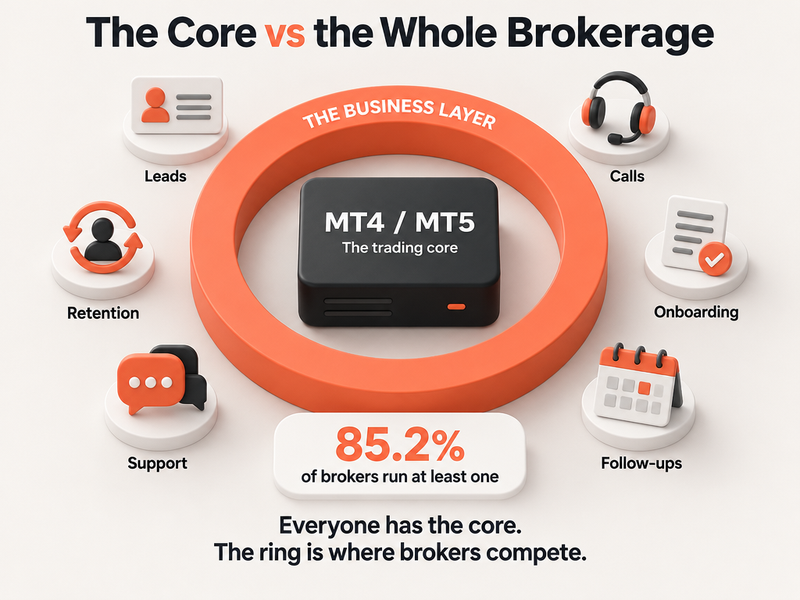
MetaTrader is the core, but the core is not the whole brokerage
MetaTrader's grip on the market is not loosening, and the recent data makes that clear. Industry tracking shows that <u>MT5 overtook MT4 in trading volume during 2025</u>, a milestone 15 years in the making that marked a generational shift from one MetaTrader platform to the next rather than away from MetaTrader altogether. By the close of the year, <u>MT5 held around 58 percent of CFD trading volume</u> on MetaQuotes platforms, with MT4 still carrying a substantial share. For brokers, the headline is continuity: the MetaTrader world is evolving, not disappearing.
Adoption at the broker level tells the same story. A 2025 review of brokerage firms found that <u>85.2 percent of brokers run at least one MetaTrader platform</u>, with a meaningful share supporting both MT4 and MT5 side by side. That near-universal footprint is exactly why MT4 and MT5 are the right core to keep. But it also explains why the trading platform cannot be the thing that sets a broker apart. If almost everyone offers the same platforms, the client experience, the speed of onboarding, the quality of follow-up, and the strength of retention are what create the difference. All of those live in the CRM layer, not the terminal.
This is the shift that defines a modern MetaTrader brokerage. The platform is a commodity in the best sense: dependable, familiar, and widely available. The business built on top of it is where the margin and the loyalty are made. A broker who runs MT4 or MT5 with a generic CRM and manual processes is competing with one hand tied behind their back, not because the trading is weak, but because everything around the trading is slow, inconsistent, and invisible. Modernizing the CRM layer is how you turn a strong core into a strong business.
Scale your brokerage today!
CRM & Client Portal, Trading Platform, MT4 & MT5 - All built for you.
Scale NowWhat a modern CRM layer adds on top of MT4 and MT5
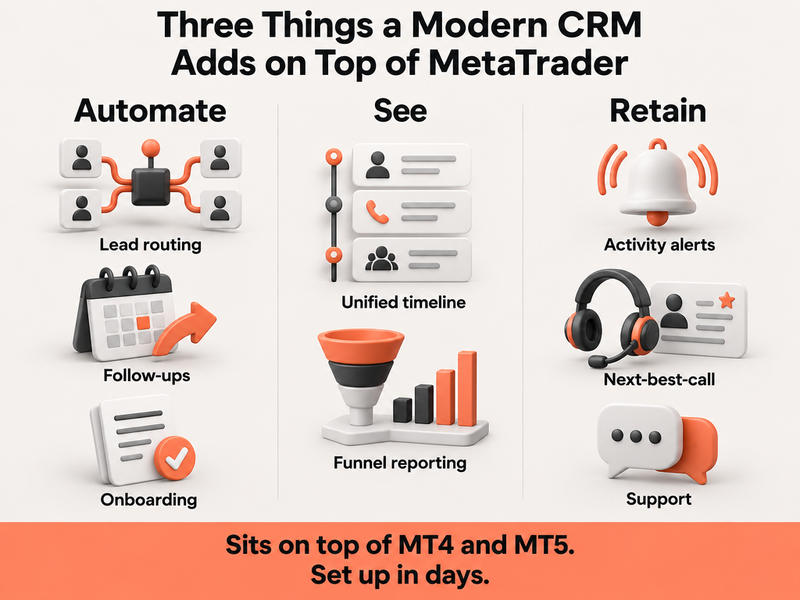
A CRM built for a trading desk does three things a generic tool cannot: it automates the repetitive work, it turns scattered activity into usable data, and it drives retention by making the next right action obvious. Take automation first. From the moment a lead lands, a modern CRM can route it with shift-aware logic, sending each lead to a desk that is actually online rather than to whoever happens to be free. It can prioritise the next best call so agents work the highest-value opportunities first, trigger automated follow-ups so no promising lead goes cold, guide onboarding step by step, and request the right documents automatically. Integrated calling and structured call outcomes mean every conversation is logged consistently, not left in someone's memory.
The second thing a modern CRM adds is data you can actually use. A unified client timeline brings every touchpoint, every call, deposit, trade signal, and support ticket, into one view, so an agent opening a client record sees the whole relationship at once instead of piecing it together from five systems. That same consolidation feeds clean reporting: where leads come from, where the funnel leaks, which desks convert, which clients are drifting. On top of MT4 and MT5, which hold the trading activity, the CRM holds the commercial picture, and the two together are what let a brokerage make decisions on evidence rather than instinct.
The third thing is retention, which is really what the first two are for. Keeping a funded client is far cheaper than acquiring a new one, and retention is won in the small, timely actions: the follow-up that happens on time, the check-in when activity dips, the support ticket that is resolved before it becomes a complaint. A CRM with live client activity alerts and next-best-call prioritisation turns those actions from things a busy desk hopes to remember into things the system surfaces automatically. Add integrated support ticketing and configurable workflows, and the whole client lifecycle, from first contact to long-term relationship, runs on one connected layer rather than in the gaps between tools.
CRM gains for an MT4/MT5 brokerage (at a glance)
Without a modern CRM layer → With a modern CRM layer
Leads assigned to whoever is free → Shift-aware lead routing to the right desk, automatically
Agents guess who to call next → Next-best-call prioritisation ranks the day for them
Follow-ups depend on memory → Automated follow-ups fire on time, every time
Onboarding is manual and inconsistent → Guided onboarding with automated document requests
Client history scattered across tools → One unified client timeline for every touchpoint
Support handled ad hoc → Integrated support ticketing inside the same system
Data exposed to scraping → Built-in data protection and configurable, permissioned workflows
Automate in days, not quarters
The usual objection to modernizing the CRM layer is time. Brokers have heard too many stories of multi-month system projects that run over and deliver late, so the instinct is to leave a working-but-tired setup alone. A modern CRM built for brokerage operations is designed to remove that objection. Because the common processes, lead routing, onboarding flows, follow-up sequences, document collection, are already built in and configurable rather than coded from scratch, a desk can turn its real workflows into automated ones in a matter of days. The work is configuration and mapping, not construction, which is what collapses the timeline from quarters to days.
That speed matters commercially, not just operationally. Every week a brokerage runs on manual processes is a week of leads cooling off, follow-ups missed, and agent time spent on admin that software should handle. Getting the automation live quickly means the gains, faster response, more consistent follow-up, cleaner onboarding, start compounding sooner. The <u>new Leverate CRM</u> is built around exactly this idea: an advanced, standalone system for large-scale brokerage operations that supports MT4, MT5, and Leverate's white-label trading platform, so a broker can modernize the business layer without touching the trading platform their clients already know.
Lower costs and an easier migration than you expect
Modernizing the CRM layer is often framed as a cost. In practice it is usually a saving. A patchwork of a generic CRM, separate calling software, a ticketing tool, spreadsheets, and manual document chasing carries a real price in licences, in duplicated effort, and in the mistakes that happen when data lives in five places. Consolidating that patchwork into one connected system removes licence overlap and, more importantly, removes the manual labour that quietly consumes a desk's hours. Automation does the repetitive work, so the same team handles more clients without growing headcount in lockstep with the book. Lower running costs are the direct result of doing less by hand and running fewer disconnected tools.
The other half of the objection is migration. Moving a CRM has a reputation for disruption, and for good reason: done badly, it means lost data, broken workflows, and a frustrated desk. A CRM designed for brokers plans for this. A modern migration moves your existing data and recreates your workflows with minimal disruption and reduced manual effort, so the business keeps running while the switch happens underneath it. For a broker on MT4 or MT5, the trading side is untouched throughout: clients keep trading on the platform they know while the engine behind the desk is upgraded. The result is a modernization measured in low risk and quick payback rather than lost weeks.
Where this series goes next
Modernizing a MetaTrader brokerage is not a single project; it is a few deliberate upgrades to the layers around a core that is already strong. This first part has focused on the CRM layer because it touches every part of the business: acquisition, onboarding, retention, and cost. The next two parts of the series will build outward from here, looking at the layers that turn a modern CRM into a modern brokerage. The throughline across all three is the same: keep the MT4 and MT5 core your clients trust, and modernize everything around it so the business runs faster, leaner, and with far more visibility. If you want to start with the layer that moves the needle first, start with the CRM. You can see how the <u>new Leverate CRM</u> is built for exactly this.