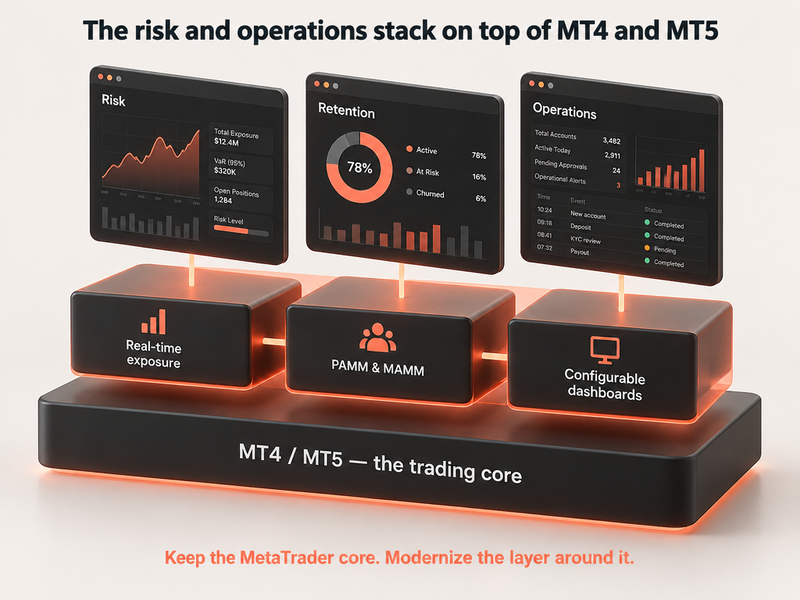
Part 1 of this series made the case for the CRM layer: keep the MT4 and MT5 core your clients trust, and modernize the business around it so acquisition, onboarding and retention run on one connected system. This second part moves up a level, to the layer where a brokerage protects and grows what the CRM brings in. Call it the risk and operations layer. It is where exposure is watched and managed, where managed-account products like PAMM and MAMM turn clients into longer, larger relationships, and where configurable dashboards give each team the real-time view it needs to run the operation. The CRM fills the top of the funnel. The risk and operations layer is what keeps the business healthy as that funnel grows.
The reason this layer deserves its own attention is that MetaTrader, for all its strength, is a trading platform, not an operating system for a brokerage. MT4 and MT5 execute trades superbly, and they remain the centre of gravity for retail trading: industry tracking shows that <u>MT5 overtook MT4 in trading volume during 2025</u>, a generational shift within the MetaTrader world rather than away from it. But the terminal does not, on its own, give a broker a consolidated view of exposure across the book, a way to offer managed accounts, or a dashboard tuned to how a risk desk actually works. Those capabilities live in the layer built on top, and that is what modernizing the risk and operations layer means.
Exposure: seeing the whole book in real time
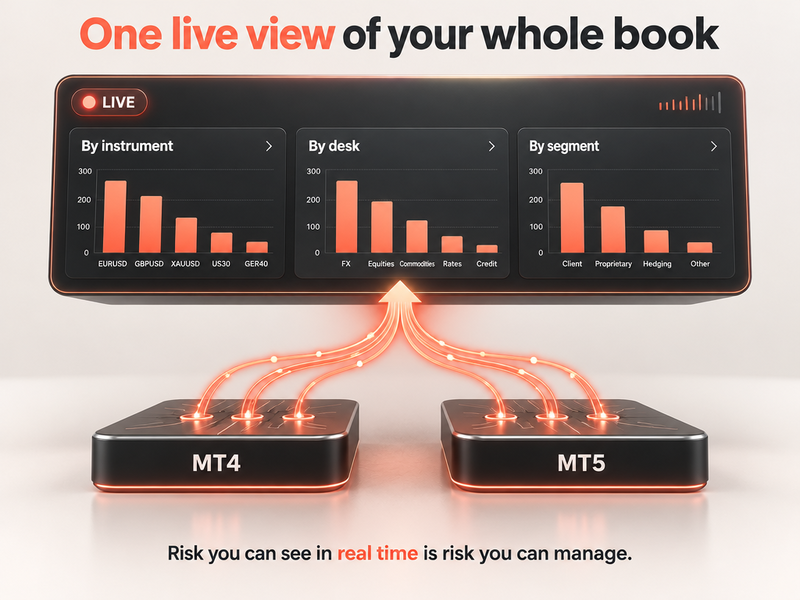
Risk management starts with visibility. A broker cannot manage what it cannot see, and exposure is exactly the kind of thing that hides in the gaps between systems. On MT4 and MT5, the trades are there, but the consolidated picture, net exposure by instrument, by desk, by client segment, in real time, is something the broker has to assemble. In too many operations that assembly is still partly manual, which means the view of risk is always slightly behind the market. In a fast move, slightly behind is the difference between a managed position and a nasty surprise.
A modern risk and operations layer closes that gap by consolidating exposure into a single live view sitting on top of the trading platforms. The desk sees net positions update as the market moves, can spot concentration before it becomes a problem, and can make hedging and A-book or B-book decisions on current information rather than a snapshot from an hour ago. This matters more as volume grows and as MetaTrader itself evolves: by the close of 2025, <u>MT5 held around 58 percent of CFD trading volume</u> on MetaQuotes platforms, with MT4 still carrying a substantial share, so many brokers now run meaningful activity across both. A risk layer that unifies exposure across MT4 and MT5 at once, rather than forcing the desk to watch two separate views, is what turns a multi-platform setup from a complication into a managed whole.
The operational point is that real-time exposure is not a luxury for large brokers alone. It is the foundation of a controlled operation at any size, because it turns risk from something reacted to into something managed. A desk that sees its book clearly makes calmer, faster decisions, and spends less time assembling the picture and more time acting on it.
Scale your brokerage today!
CRM & Client Portal, Trading Platform, MT4 & MT5 - All built for you.
Scale NowPAMM and MAMM: managed accounts as an operations and retention tool
The second pillar of this layer is managed accounts, and specifically PAMM and MAMM. These are not just products for traders; they are operational structures that change the shape of a broker's book. PAMM, the percentage allocation management model, pools investor capital into one managed account where a money manager trades, and returns profit and loss to each investor in proportion to their contribution. MAMM, the multi-account manager model, keeps each investor in their own account while the manager places trades that are allocated across all of them at once. In both, the investor keeps ownership of their funds and chooses the manager, while the manager handles the trading.
From an operations standpoint, managed accounts do two things that strengthen the business. First, they give the broker a credible offering for the large segment of clients who want market exposure but do not want to trade actively, which turns prospects who would otherwise churn into funded, longer-term relationships. Second, they tend to lift assets under management and lengthen the client lifecycle, because a client following a manager they trust has a reason to stay funded through the quiet periods that would otherwise prompt a withdrawal. The broader market shows how powerful trusted managed structures can be at scale: managed account assets <u>grew close to 20 percent to reach 13.7 trillion dollars in 2024</u>, a reminder that when clients trust a managed structure, capital concentrates in it.
Because PAMM and MAMM run on the same stack as the trading platform and the CRM, offering them is an operational decision rather than a technical project. They sit alongside, and are distinct from, copy trading, where a client follows and mirrors an individual trader. Together, copy trading, PAMM and MAMM give a broker a full menu for different kinds of clients, from the hands-on trader to the investor who prefers to delegate entirely. For the operations and risk layer, that menu is not just a retention lever; it is also a way to channel client activity into structures the broker can oversee cleanly, with the manager's allocations handled automatically rather than by hand.
Configurable dashboards: the operations layer each team can shape
The third pillar is the one that ties the other two together: configurable dashboards. A risk and operations layer is only as useful as the view each team has into it, and no two desks need the same view. A risk manager wants exposure, concentration and alerts front and centre. A retention lead wants client activity and the managed-account book. An operations head wants funnel health, desk performance and the state of the day across the whole brokerage. A single fixed layout forces most of these people to work around a view built for someone else, which slows everyone down and buries the signal that matters to each role.
Configurable dashboards solve this directly. In the Leverate CRM, each team can now shape the dashboard to how it actually works: rearrange the layout, hide the elements it does not use, and pin what matters to the top. The same system presents a purpose-built face to the risk desk, the retention team and the operations lead, so each one opens straight to the information that drives its decisions. Accounts can be configured to match how the desks are organised, so the workspace mirrors the real structure of the business. When the operation changes, the view changes with it, which keeps the dashboard aligned with how the brokerage runs rather than how it ran on setup day. You can see how the <u>new Leverate CRM</u> brings this configurable operations view together on top of MT4 and MT5.
The deeper value is that configurable dashboards turn the risk and operations layer from a set of tools into a workspace. Exposure, managed accounts, funnel health and client activity stop being separate screens and become arrangeable elements in one view each team tunes to its job. That is what makes the layer usable day to day, and why customization is a core part of how a modern operations layer earns its keep.
Why this layer is the one to modernize next
Part 1 argued for starting with the CRM because it touches acquisition, onboarding and retention at once. The risk and operations layer is the natural next step because it governs what happens to everything the CRM brings in. A brokerage can win clients efficiently and still struggle if its exposure view lags the market, if it has nothing for the client who wants to delegate, or if every team squints at a dashboard built for someone else. Modernizing this layer converts a healthy top of funnel into a healthy, controlled, growing book.
The throughline with Part 1 is deliberate. None of this requires leaving MetaTrader. Exposure management, PAMM and MAMM, and configurable dashboards all sit on top of MT4 and MT5, which stay exactly as they are. The modernization is additive: keep the trading core your clients trust, and build the risk and operations layer that the terminal was never meant to provide. A broker that does this runs a tighter operation on the same familiar platforms, with risk it can see, products that deepen relationships, and a workspace each team can shape to its own job.
Where this series goes next
Part 1 covered the CRM layer. Part 2 has covered the risk and operations layer: real-time exposure, managed accounts with PAMM and MAMM, and configurable dashboards that let each team shape its own view. Part 3 will complete the series by building outward once more, to the layer that turns a modern, well-run brokerage into one that keeps growing. The principle holds across all three parts: keep the MT4 and MT5 core your clients trust, and modernize the layers around it so the business runs faster, safer and with far more visibility. If Part 1 was about bringing the business onto one connected system, Part 2 is about running that business with its eyes open. You can see how the <u>new Leverate CRM</u> brings the risk and operations layer together on top of MetaTrader.