Building a forex brokerage Southeast Asia traders trust comes down to three choices: which market you enter first, how clients move money, and which local partners bring them in. You do not need to be live in every country on day one. You need one strong hub market, a mobile-first platform in the local language, and payment and partner networks that work before your first campaign runs.
This playbook is written for broker owners and leadership teams planning regional expansion. It gives you a four-test framework for choosing your first market, an operating matrix for five countries, and a 90-day plan that takes a new brand from stack to first funded clients.
Why Southeast Asia Is Drawing Brokers Now
Demand in the region is young, digital and growing. According to Finance Magnates' analysis of the Southeast Asian broker boom, Indonesia's retail investor base has topped 20 million, and retail participation from the wider Asia Pacific region in CME Group markets has grown 16% over the last five years.
The Indonesia trading market shows how fast this has moved. A regional client acquisition analysis estimates the country added over 16 million retail investors since 2020. Most of these clients opened their first account on a phone, learned from a community or educator, and expect to fund in minutes.
The region also sits close to deep FX liquidity. The BIS Triennial Central Bank Survey for 2025 put global FX turnover at $9.6 trillion a day in April 2025, and Singapore remains one of the world's largest FX trading centres. That helps with pricing and hosting, but it also brings competition. Thailand brokerage growth, for example, has pulled global and local brands into the same app stores and the same social feeds. That is why a forex brokerage Southeast Asia plan has to run country by country, with cost control built in from the start.
Scale your brokerage today!
CRM & Client Portal, Trading Platform, MT4 & MT5 - All built for you.
Scale NowHow to Sequence a Forex Brokerage Southeast Asia Rollout
Southeast Asia is not one market. Indonesia, Thailand, Vietnam, the Philippines and Malaysia differ in language, payment habits and how traders find brokers. Launching in all five at once spreads budget, support and partner effort too thin. A hub-and-spoke model works better: pick one hub market, prove the model there, then add spoke markets that reuse as much of the setup as possible.
The four entry tests
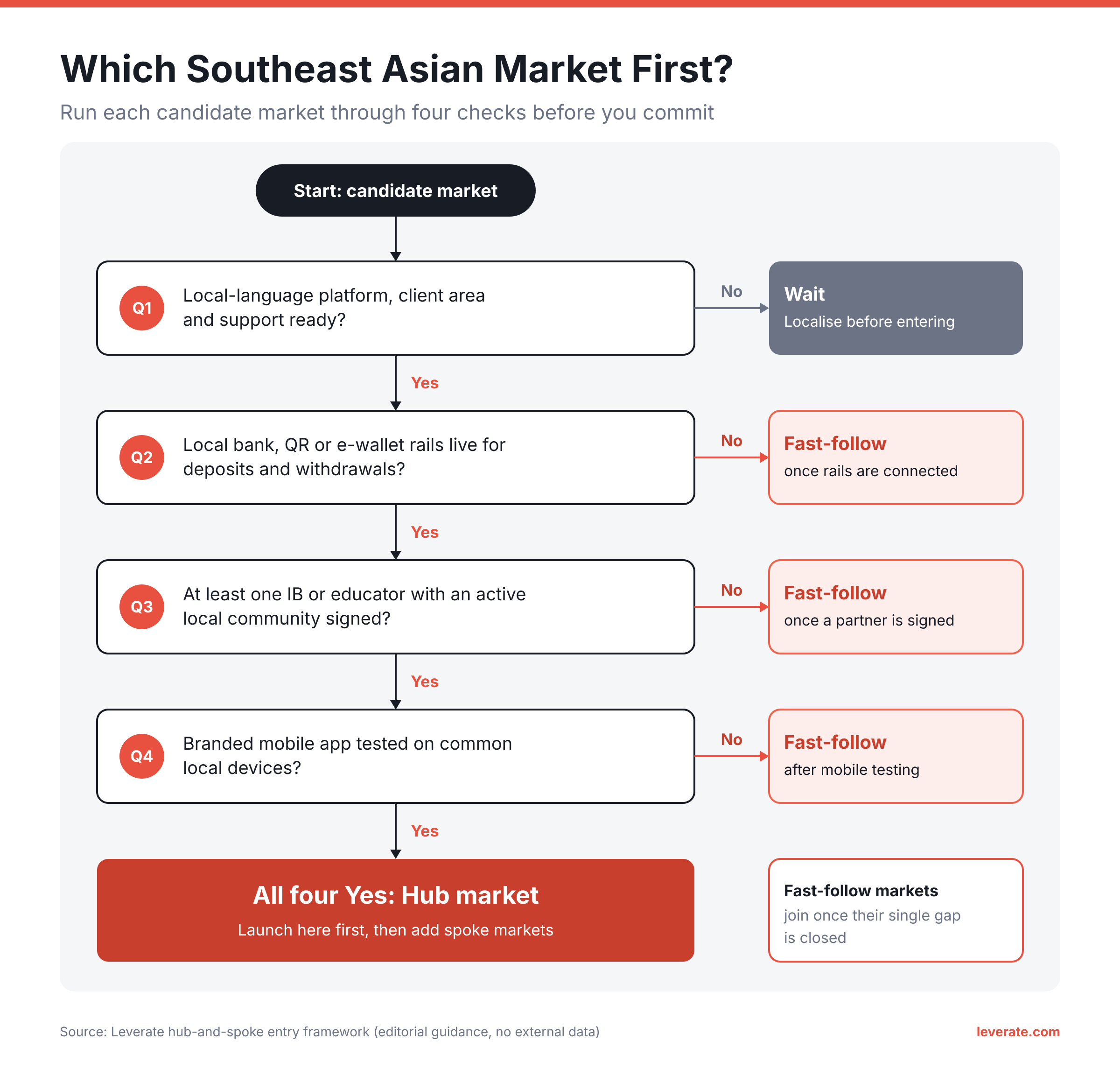
Score each candidate market from 0 to 2 on four tests you can control. The market with the highest total becomes your hub. Markets that score well on two or three tests become fast-follow spokes.
- Payment rails: can clients deposit and withdraw through the local methods they already use, in local currency?
- Language coverage: can you offer the platform, client area, emails and support in the main local language?
- IB density: do you have, or can you sign, introducing brokers and educators with active trading communities there?
- Mobile readiness: is your branded app ready for the devices and network speeds common in that market?
The tests are practical on purpose. None depends on market size alone. A large market where you have no partners and no local rails will cost more to crack than a smaller one where an IB is ready and payments already work. The decision path below shows how to route each market quickly.
Market-by-market operating matrix
The matrix gives a forex brokerage Southeast Asia team a starting view of each country's operating basics. Use it to fill in your four-test scores, then check every cell with your own partners before you commit budget.
| Market | Main client languages | Common local payment rails | Main discovery channels | Strong product interest |
|---|---|---|---|---|
| Indonesia | Bahasa Indonesia | Bank virtual accounts, QRIS, e-wallets | Educators, trading communities, IB referrals | Gold, FX majors, indices |
| Thailand | Thai | PromptPay, local bank transfer | Social video, educators, community groups | Gold, indices, crypto |
| Vietnam | Vietnamese | VietQR bank transfers, e-wallets | IB networks, community groups | Gold, FX majors, crypto |
| Philippines | English, Filipino | GCash, Maya, InstaPay transfers | Social media, educators, IB referrals | FX majors, crypto, indices |
| Malaysia | Malay, English, Chinese | DuitNow, FPX online banking | IB referrals, educators, community groups | Gold, FX majors, crypto |
Two patterns stand out. First, real-time bank transfer and QR systems are now the default in most of these markets, so card-only funding is a weak start. Second, discovery runs through people. Vietnam traders, like many across the region, often follow a trusted educator or community leader to a broker, which makes partner recruitment as important as paid media.
Build a Mobile-First Trading Stack for Asia
Mobile-first trading in Asia is not a design preference. It is how most new clients will meet your brand. The same broker-boom analysis found that 49% of Thai investors use trading apps. If the app is slow, hard to read in Thai or Vietnamese, or hides the deposit button, the client leaves before the first trade.
On a phone, your stack should deliver:
- fast order entry and clear position views on small screens
- touch-friendly charting that loads quickly on mobile networks
- one-tap access to funding and withdrawal requests
- alerts for price levels, margin and payment status
Leverate's white-label trading platform gives you a branded trading environment across web and mobile, with xChart for charting, so you can launch under your own name without building trading technology.
Asian language localisation beyond translation
Translation is the minimum. Real localisation covers number and date formats, local time on positions and statements, instrument names traders recognise, and support scripts written by native speakers. Traders notice when timestamps on the platform, statements and emails do not match their local time, and that small gap erodes trust.
Leverate's multilingual Client Portal lets clients register, fund and manage their accounts in their own language, so the journey from sign-up to first deposit stays local from end to end.
Make Deposits and Withdrawals Local
In most of the region, trust is earned at the withdrawal, not the deposit. A client who requests a payout on Monday and sees it in a local bank account or e-wallet the same day tells their community. A client who waits a week tells them too.
Local payment methods in Asia fall into three groups: real-time bank transfers and QR payments, popular e-wallets, and stablecoins for clients who already hold crypto. Card funding still has a place, but it should not be the only route. Brokers that offer familiar rails and quick payouts tend to see more clients complete a first deposit. The e-Conomy SEA research from Google, Temasek and Bain and the World Bank Global Findex database both track how digital payments and account ownership are spreading, and they are useful inputs when you score markets on the payment test.
Operationally, connect payments to the rest of the stack. Deposits and withdrawals requested in the Client Portal should flow into the Back Office for approval and reconciliation, with a status the client can see. When a payment is held or delayed, a standard reason shown to the client cuts support tickets and keeps confidence intact.
Grow Through IBs, Educators and Community
Many traders in the region find brokers through local communities, educators and messaging groups rather than search ads. Partners with real local standing bring clients who already trust the recommendation, and those clients usually stay longer than ones bought through paid campaigns.
The strongest partners are often educators who run courses, live sessions or analysis groups in the local language. Their clients arrive knowing how the platform works and with a reason to keep trading. Recruiting a handful of these partners in your hub market often matters more than your first media budget.
To recruit and keep partners, give them:
- a clear multi-tier structure so master IBs can build their own sub-networks
- real-time reporting on referrals, deposits and volume, in their language
- tracking links and marketing material localised for each market
- predictable, on-time commission payments
Leverate's AFF/IB module for affiliate and partner networks manages multi-level IB structures, tracking and commissions in the same system as your CRM, so partner data and client data stay aligned.
Retain Clients and Widen the Product Mix
In a community-driven market, every lost client is a story told to others. Retention starts with the product shelf. Gold and major indices are widely traded across the region, and crypto interest is strong among younger clients: Finance Magnates also reported that almost a quarter of Gen Z and millennials in Malaysia hold cryptocurrency.
A multi-asset brokerage can meet that demand from a single account. Leverate Prime liquidity covers forex, indices, metals, energies, shares and crypto through one connection, so you can add products as each market matures without new integrations.
Then use your Forex CRM to act on behaviour. A client who deposited but has not traded in seven days, a client whose IB has gone quiet, a client whose withdrawal just cleared: each is a trigger for a local-language call, message or offer from the retention team. Segment by market, language and source, so a Thai IB-referred client and a Philippine paid-media client get different journeys.
Your 90-Day Launch Plan
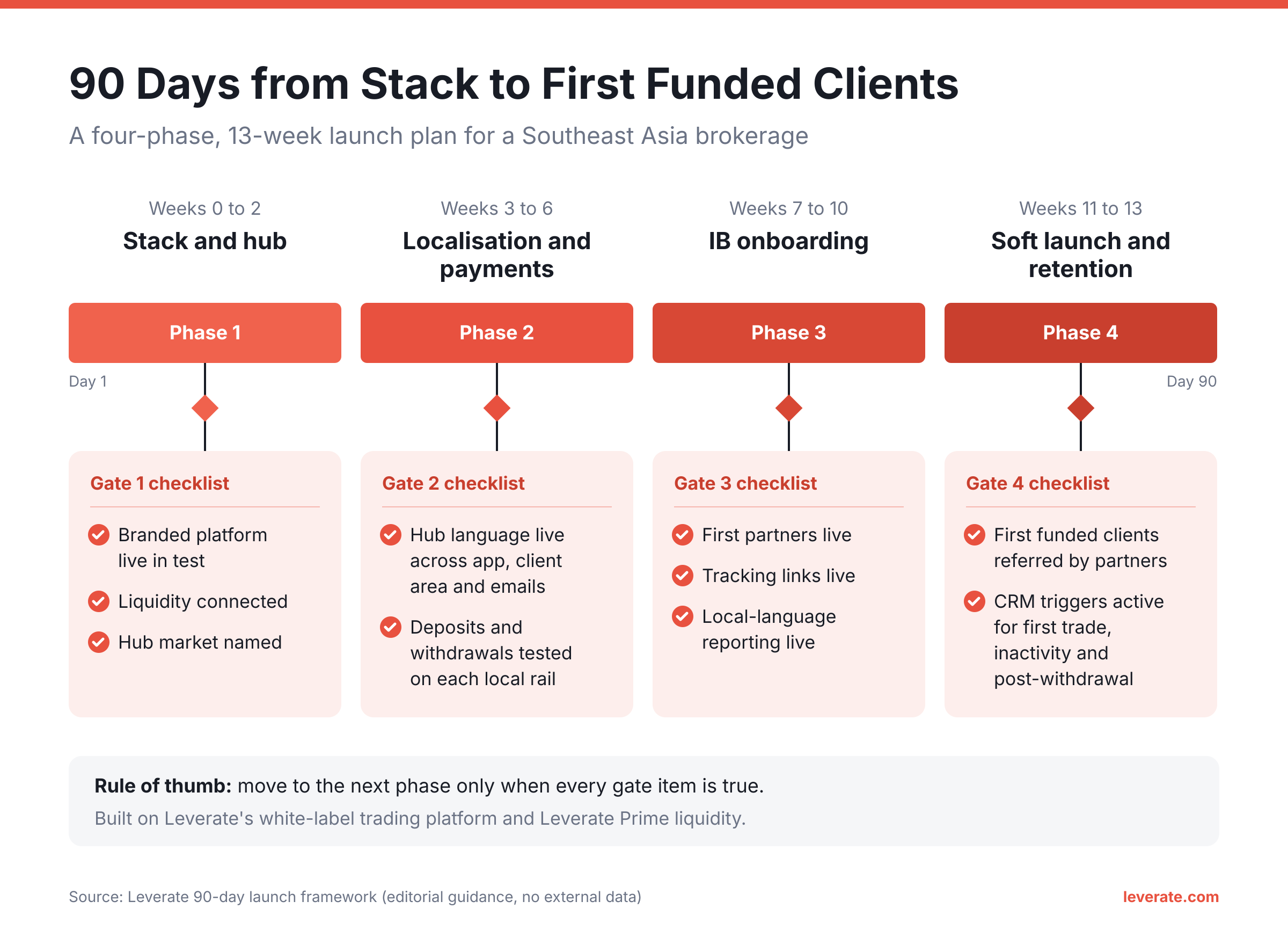
A forex brokerage Southeast Asia launch moves fastest when the order of work is fixed. These steps take you from stack to first funded clients:
- Score and choose. Run the four tests on each candidate market and name one hub plus one fast-follow spoke.
- Stand up the core stack. Brand the trading platform, connect liquidity, and configure the CRM and back office for the hub market.
- Localise the client journey. Adapt the app, client area, emails and support scripts to the hub language.
- Go live on local rails. Connect the hub's main bank transfer, QR and e-wallet routes, then test deposits and withdrawals with real accounts.
- Sign launch partners. Onboard a small group of IBs and educators with tracking links, localised material and reporting access.
- Soft launch. Open to partner-referred clients first, fix friction, then switch on paid campaigns.
- Turn on retention triggers. Build CRM journeys for first trade, inactivity and post-withdrawal follow-up before volume grows.
The timeline below maps these steps to weeks and shows the milestone that should be true before each next phase begins.
If you would rather receive the whole stack as one package, a turnkey forex brokerage solution brings platform, CRM, back office, client portal and liquidity together, so your team can focus on markets and partners.
The Bottom Line
Southeast Asia rewards brokers who go deep before they go wide. The operators who win treat each country as its own launch but build the stack once, so every new spoke costs less time and money than the one before. A winning forex brokerage Southeast Asia model is a repeatable playbook, not a single regional bet. Leverate's white-label trading platform, Client Portal, Forex CRM, AFF/IB and Leverate Prime give you that repeatable base under your own brand. Book a demo to plan your Southeast Asia launch with our team.
Disclaimer: This content is based on multiple sources and is provided for educational purposes only. It does not constitute financial, legal, or investment advice.