Modular brokerage technology means sourcing each layer of your stack, from the trading platform and CRM to the back office, liquidity and partner tools, from whichever provider suits that layer best. A single-vendor stack buys most of those layers from one supplier. Neither model is right for every broker: the answer depends on your stage, your team and how well data moves between your systems.
Most pages on this topic are written by vendors arguing for their own model. This guide looks instead at the handoffs between systems, where the real cost hides. It then matches each model to a business stage and gives you a simple swap test to run before you sign any contract.
What modular brokerage technology means in practice
In a modular setup, each function runs as its own component and talks to the others through APIs. A typical broker stack has seven layers:
- Trading platform: order entry, pricing display and account types.
- Liquidity: pricing and execution from one or more providers.
- CRM: leads, sales, retention and client history.
- Client portal: sign-up, documents, deposits and withdrawals.
- Back office: risk, reporting, payments and reconciliation.
- IB and affiliate system: partner tracking and commission.
- Charting and analysis: the tools traders use to read the market.
The opposite is a single-vendor stack, where one supplier delivers most or all of these layers on a shared data model. Many brokers sit somewhere in between.
The modular approach has grown alongside the wider API economy. In Postman's 2024 State of the API report, 74% of respondents described their organisation as API-first, up from 66% the year before. For a broker, an API-first brokerage stack means every layer exposes documented endpoints, so you can connect, extend or replace it without waiting on one vendor's roadmap.
An API alone does not make a stack work, though. What matters is what flows across it, and who looks after that flow.
Scale your brokerage today!
CRM & Client Portal, Trading Platform, MT4 & MT5 - All built for you.
Scale NowThe real cost sits in the seams between systems
Vendor comparisons usually count contracts. Operators should count handoffs instead. Every time a client record, deposit or trade moves from one system to another, there is a seam. Each seam needs a field mapping, a sync schedule and a person who fixes it when it breaks.
Follow one client from sign-up to their introducing broker's commission payout and you cross at least six handoffs. In a single-vendor stack, the vendor owns most of them. In a fully modular brokerage technology setup, you own them yourself or pay an integrator to.
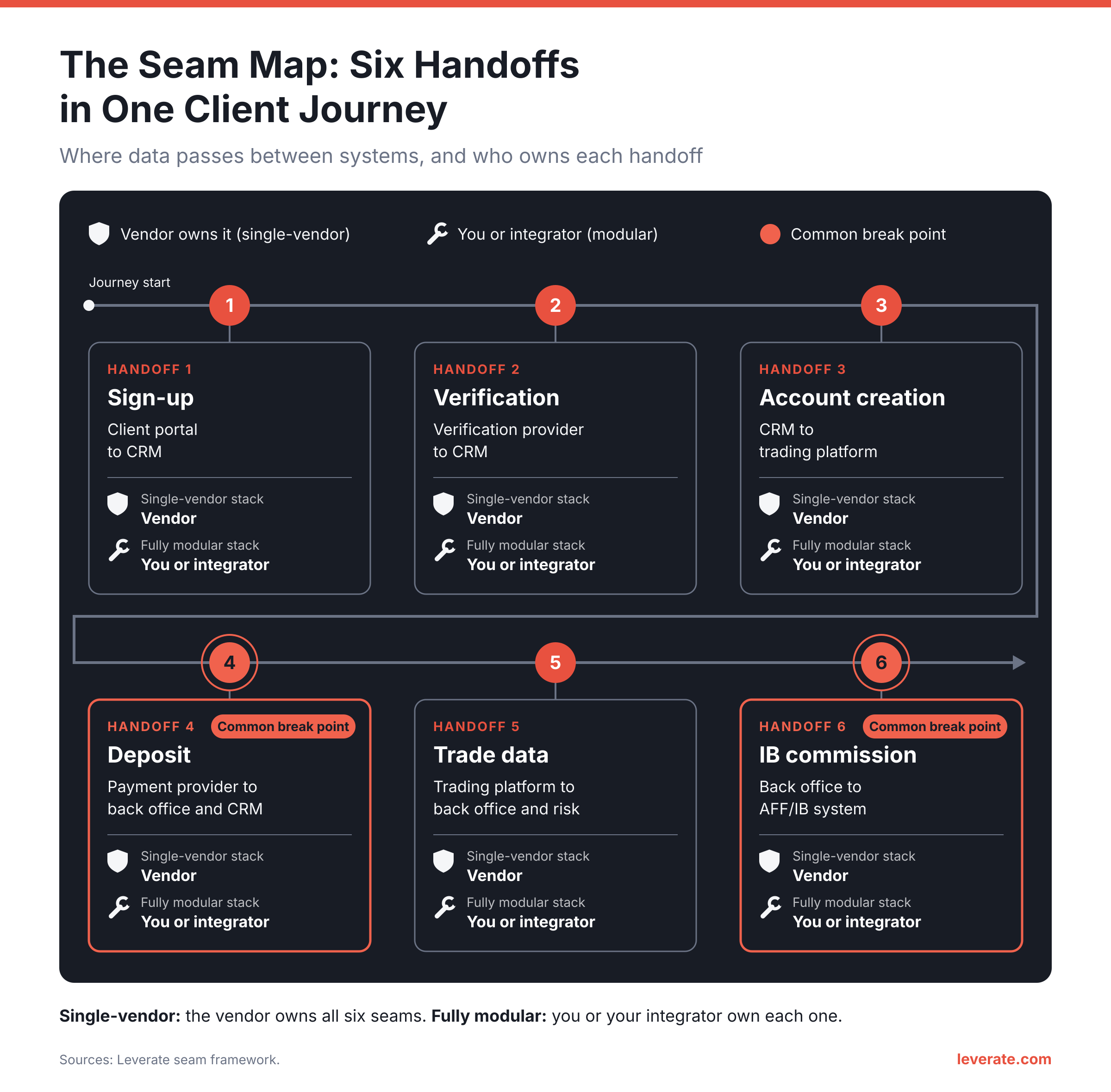
Seams are where data consistency breaks down. A deposit lands in the payment system but not the CRM, so a retention agent calls a client who has already funded. An IB's commission is calculated on trade data that synced late. A risk report shows one balance while the client portal shows another. None of these is a disaster on its own. Together they eat hours from dealing, support and finance every week.
This is not just a broker problem. The MuleSoft 2025 Connectivity Benchmark found that organisations run about 897 applications on average, yet only 29% of them are integrated. A brokerage runs far fewer systems than a large enterprise, but the pattern holds: tools get added faster than they get connected.
The lesson is practical. Before you choose a model, list your handoffs and write down who will own each one. If the honest answer is that you will work it out later, that seam will cost you later.
What a single-vendor stack gives you, and what it takes
A single-vendor stack removes most seams by design. One supplier means one data model, one support line and one service agreement. When a deposit fails to appear in the CRM, there is one party to call and no debate about whose system is at fault.
- Speed to market: the layers are already connected, so launch work is configuration rather than integration.
- One client ID: the same record follows a client from sign-up to every trade and payment.
- A leaner team: you need operations staff, not an integration engineering team.
- Simpler vendor management: one contract, one renewal and one roadmap conversation.
The trade-off is concentration. If the vendor has an outage, several layers can fail at once. The July 2024 faulty security update showed how far one supplier's error can reach: Microsoft reported that 8.5 million Windows devices were affected, under 1% of all Windows machines, yet airlines, banks and hospitals felt the impact for days. Downtime is costly too. In the Uptime Institute's 2024 outage analysis, 54% of operators said their latest significant outage cost more than $100,000, and 16% said it cost more than $1 million.
The second risk is vendor lock-in. If the supplier's roadmap stalls or its pricing changes, leaving means migrating every layer at once: accounts, trade history, IB trees and payment records together. That is a heavy project for a brokerage in full growth.
If speed matters most, a turnkey forex brokerage gives new operators a connected stack from day one, so the team can focus on winning clients rather than wiring systems together.
What a modular stack gives you, and what it takes
The best of breed vs single vendor debate is really about control. A modular stack lets you pick the strongest tool for each job and replace it when something better comes along. If your CRM falls behind, you swap the CRM. If you enter a region with different payment habits, you plug in a provider that serves it.
- Roadmap control: no single vendor decides what your brokerage can offer next year.
- Negotiating leverage: each supplier knows it can be replaced.
- Lower exit cost per layer: you migrate one system, not the whole business.
- Room for niche needs: specialist tools for one market, asset class or client segment.
The cost is ownership. Each new vendor brings another contract, another release schedule and another security perimeter. The Verizon 2025 Data Breach Investigations Report found that third-party involvement in breaches doubled to 30%. Every system that holds client data, or connects to one that does, adds to that exposure.
Integration work also moves onto your team. When one vendor ships an update that renames a field, your connector breaks, not theirs. A broker that goes fully modular needs at least one engineer who understands the whole data flow, plus monitoring on every sync. Done well, modular brokerage technology gives a growing firm real freedom. Done badly, it turns the operations team into full-time reconcilers.
Modular vs single-vendor stacks side by side
The table adds a third column, because most operators end up with a mix rather than a pure model.
| Factor | Single vendor | Fully modular | Integrated core, open edges |
|---|---|---|---|
| Launch time | Fastest, configuration only | Slowest, every integration built and tested | Fast for the core, edges added later |
| Contracts | One main contract | One per layer | A few |
| Data model | Shared, one client ID | Several, mapped through APIs | Shared core, APIs at the edges |
| Outage impact | Wide, can hit every layer | Narrow per layer, more failure points | Core concentrated, edges isolated |
| Exit cost | High, whole-stack migration | Low per layer | Medium |
| Roadmap control | Vendor-led | Fully yours | Shared |
| Team needed | Small, operations-led | In-house integration engineers | Operations team plus light technical support |
Which model fits your stage
Broker tech stack integration needs change as the business grows. The right answer at launch is rarely the right answer three years later.
Launching a brokerage
At launch, speed and cash matter most. You have little data history and a small team. A single-vendor or turnkey stack is usually the better fit, because every seam you avoid is one less problem to debug while you chase your first funded clients. Choose a provider you could grow with, and avoid custom work that only one supplier can maintain.
Scaling volume and asset classes
Once flow is steady, needs get more specific. You may want deeper multi-asset liquidity, a second platform for one client segment, or a regional payment provider. The market rewards that kind of focus: the BIS Triennial Survey puts global FX turnover at $9.6 trillion a day in April 2025, up 28% from April 2022. This is the stage where modular brokerage technology starts to pay for itself, provided the core data model stays shared.
Adding prop trading or prediction markets
A prop firm or prediction markets offering is a new business line on top of the old one. Challenges, evaluations and payouts follow their own logic, and the easy move is to add a new vendor with its own client database. Avoid splitting your client records. A trader who buys a challenge today may open a CFD account next month, and you want one view of that person. Leverate's PROP CRM is built for challenge-based prop operations, so the new line can run alongside your brokerage rather than in a separate silo.
Running several brands or entities
At group level, the risk turns into duplication. Brands that grew on their own often bring separate CRMs, back offices and reporting. The goal is consolidation: shared core data and group-wide reporting, with brand-level front ends and settings on top. Every duplicate system you retire removes a set of seams.
Run the swap test before you sign
Whichever model you lean towards, test it against one question: can you replace any single layer without breaking the others? A stack that passes is resilient, whether it comes from one vendor or six. A stack that fails will hurt at the worst moment, usually mid-growth.
Score your current or proposed stack below. Give a point only for a clear yes backed by a document, a contract clause or a live demo, not a sales promise.
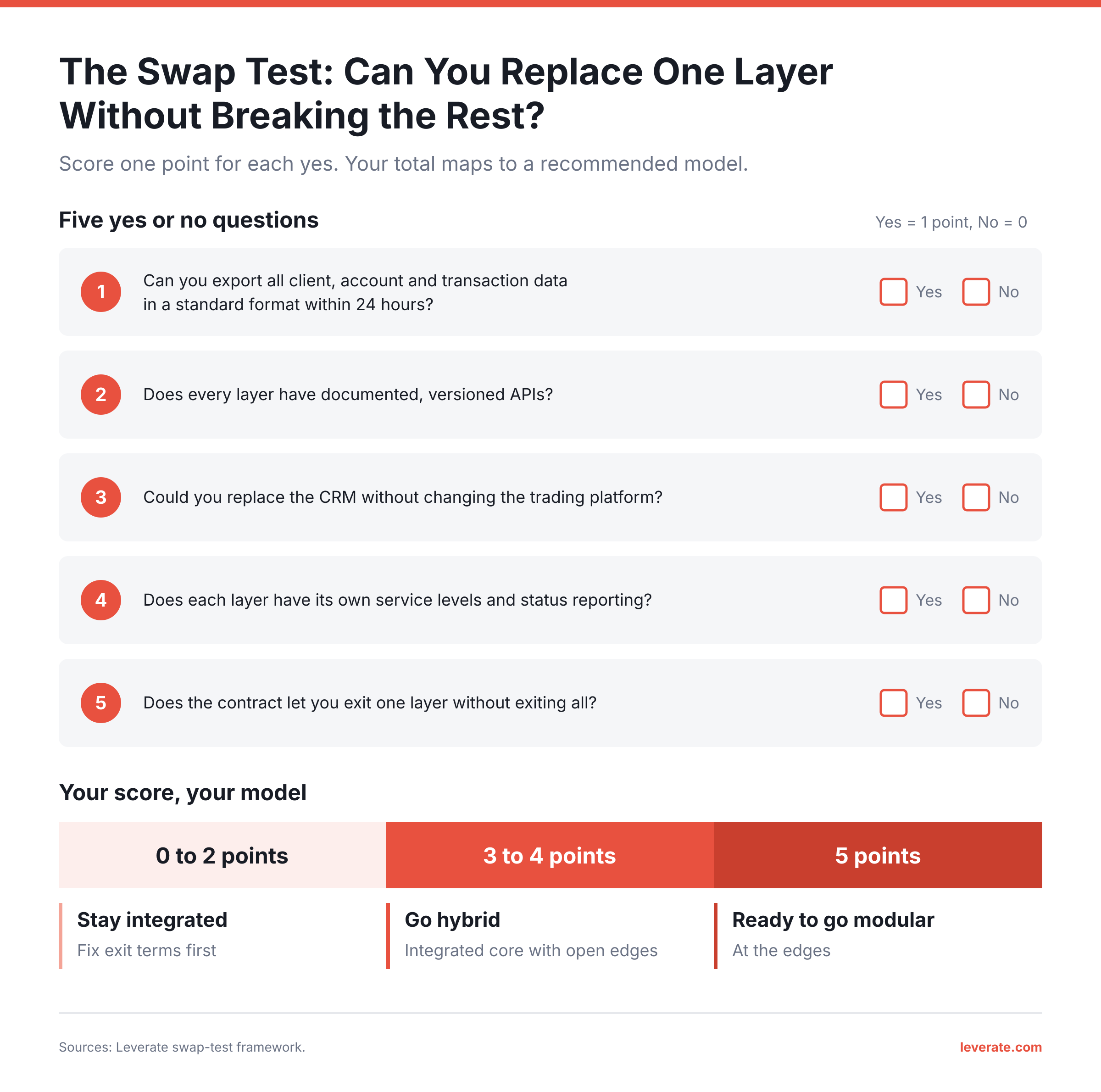
Run the test on the stack you have today and on each shortlisted option. A low score does not rule a vendor out, but it tells you exactly which terms to negotiate before signing.
The hybrid path: an integrated core with open edges
For many operators the best answer sits between the extremes. A sound brokerage platform architecture keeps the layers that share the most data (trading platform, CRM, client portal and back office) on one data model. Open edges then let you connect specialist tools through APIs wherever you want choice.
This is the thinking behind Leverate's platform architecture. Leverate's white-label trading platform, Forex CRM, Client Portal, Back Office and AFF/IB system work as connected parts of one stack, so a deposit, trade or IB commission is recorded once and seen everywhere it is needed. Leverate Prime adds multi-asset liquidity across forex, shares, indices, metals, energies and crypto, and xChart extends the trader-facing side of the stack.
At the open edge, Leverate's MCP server opens the stack to AI assistants through a standard protocol rather than a custom build for each tool. The result is modular brokerage technology where it adds choice, and tight integration where data consistency matters most.
The Bottom Line
The choice between one vendor and many is really a choice about who owns the seams. A single-vendor stack wins on speed and consistency, while modular brokerage technology wins on control, provided someone owns every handoff. Most brokers do best with an integrated core and open edges, adding specialist tools as their stage demands. To see how a connected core handles your handoffs in practice, talk to the Leverate team.
Disclaimer: This content is based on multiple sources and is provided for educational purposes only. It does not constitute financial, legal, or investment advice.