








What a Trading Software Development Company Actually Delivers
When a broker signs with a trading software development company, they are rarely buying a single product. They are buying the entire technical foundation their business will run on, and the accountability for keeping it running. The term sounds narrow, as if it meant a team that writes a trading screen, but in practice a serious brokerage technology provider delivers the platform, the systems around it, and the integrations that make them behave as one. This article explains what that actually includes, the different ways to source it, and how to tell a capable partner from a risky one.
It matters because the choice shapes everything downstream: how fast a broker launches, how reliably it executes, and how easily it scales into new markets. Trading platform development is the visible part, but the value of a strong provider lies in everything that surrounds and connects it.
What a Trading Software Development Company Does
At its simplest, a trading software development company designs, builds, and maintains the technology brokers and prop firms operate on. That spans the client-facing trading platform, the back-end systems that run the business, the connectivity to markets and liquidity, and the risk controls that keep the book safe. Crucially, it also owns the integrations between these pieces, which is where most home-grown setups fall down.
The word development undersells the scope. A capable provider does not just write software and hand it over; it hosts it, keeps it available around the clock, patches and secures it, and ships new capability as markets and client expectations change. In practice a broker is buying an ongoing relationship, not a one-off build, which is why the provider’s stability and roadmap matter as much as the code itself. This is the difference between a vendor that delivers a product and a partner that carries the technology alongside the broker.
The market backdrop explains why this has become a specialised discipline. The brokerage trading platform software market was valued at roughly 6.3 billion dollars in 2025 and is on track to nearly double by 2034, and the technology has grown too complex and too fast-moving for most brokers to build and maintain alone. A dedicated provider absorbs that complexity so the broker can focus on clients and growth.
The Core Systems It Builds
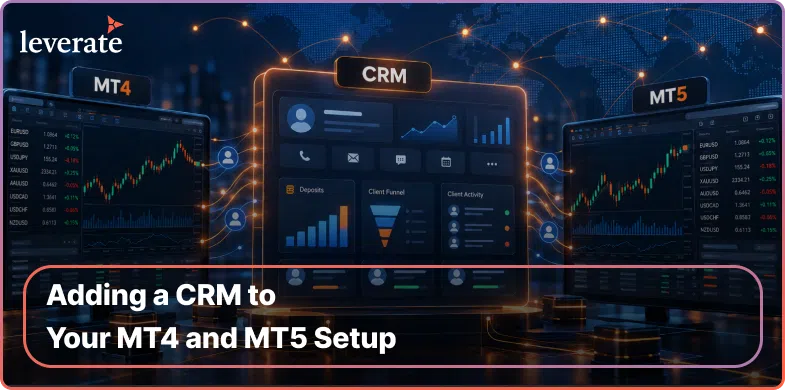
A complete brokerage technology provider delivers five connected systems. The trading platform is where clients trade, across web and mobile, with charting, order types, and increasingly social and algorithmic tools. The CRM manages the client lifecycle, from lead capture and onboarding through payments, retention, and introducing-broker relationships. The back office runs operations, reporting, and administration. Liquidity connectivity links the platform to pricing and execution through APIs and aggregation. And risk management gives the broker real-time control over exposure.
Individually these are useful. Together, and properly integrated, they become a business. The integration layer is the quiet differentiator: when the platform, CRM, back office, liquidity, and risk share data in real time, a broker can act on what is actually happening rather than reconciling separate systems after the fact. Leverate develops and maintains this full stack, so brokers get one accountable technology partner instead of a patchwork of vendors that each point at the others when something breaks.
A concrete example shows why integration is the real product. When a client funds an account, that single event should update the CRM, unlock trading on the platform, register with the payment and back-office systems, and feed the risk engine, all at once and without manual intervention. In a well-integrated stack this happens invisibly. In a stitched-together one, each step is a hand-off that can lag or fail, and the gaps are exactly where clients get frustrated and risk goes unseen. A development company earns its value less in any single system than in making all of them behave as one.
Global Footprint and Localisation
A trading software development company that operates globally delivers more than translated screens. Serving brokers across regions such as LATAM, MENA, and APAC means multi-language platforms and client portals, local payment methods and providers, regional hosting for performance, and support that works across time zones. These are not cosmetic details. A deposit method a local audience trusts, or a platform that loads quickly in-region, can decide whether a broker converts clients in that market at all.
This global reach is also a mark of a provider’s maturity. Building and maintaining technology that performs across many jurisdictions and market structures is hard, and a provider that already does it has solved problems a single-market vendor has never faced. For a broker with international ambitions, choosing a provider with a genuine global footprint means the technology can follow the business into new markets rather than holding it back.
A global footprint is also a form of proof. A provider trusted by brokers across multiple regions has been tested against a wide range of market conditions, client behaviours, and operational demands, and has survived them. Awards and years in the market matter for the same reason: they signal a track record that a broker is, in effect, borrowing when it signs on. For a firm choosing who will build and run its most critical systems, that accumulated credibility is not marketing gloss, it is a genuine reduction in the risk of the decision.

Build In-House, Buy Off the Shelf, or Use a Development Partner
Brokers have three broad routes, and the right one depends on scale, budget, and appetite for maintenance. Building fully in-house offers maximum control but demands large budgets, long timelines, and a permanent engineering team to keep pace with markets and platform changes. Buying rigid off-the-shelf tools is cheaper to start but often traps a broker in systems that cannot adapt or integrate. A development partner sits between the two, delivering proven technology that is still configurable, and taking on the maintenance and upkeep so the broker does not have to.
For most brokerages, the partner model wins because it converts a large, unpredictable build into a managed, scalable service. The broker gets current technology quickly and a roadmap that keeps it current, without carrying the cost and risk of a full engineering department.
The hidden costs of building usually decide it. Beyond the initial development sit the ongoing burdens that never appear in the first budget: maintaining connectivity as venues and providers change, patching security, keeping pace with new asset classes and client expectations, and staffing a team capable of all of it indefinitely. Timelines slip too, and a build that takes a year is a year the business is not trading. A development partner absorbs those recurring costs and compresses the timeline, which is why the partner model tends to win on both speed and total cost even when the in-house option looks cheaper on paper at the outset.

What Separates a Strong Brokerage Technology Provider
Not every provider that can write trading software can carry a brokerage. A few qualities separate the strong from the risky. Track record matters most: a provider that has run broker infrastructure across many firms and market cycles has already met the failure modes a newer vendor has yet to encounter. Depth of integration matters next, because a provider offering the full stack as one connected system spares the broker the fragile job of wiring vendors together.
Support and reliability decide the day-to-day experience, from onboarding speed to how quickly issues are resolved when markets are moving. And a clear product roadmap signals whether the provider will keep the broker current as AI, new asset classes, and new client expectations arrive. A provider that is still shipping meaningful capability is one a broker can grow with, rather than one they will outgrow.
Security and reliability belong on that list too, even though they rarely headline a sales demo. A brokerage runs on client data and continuous uptime, so the provider’s approach to encryption, access control, redundancy, and recovery is part of what a broker is really buying. A provider that treats these as core, and can show how it protects data and keeps systems available under load, offers something a cheaper vendor on thin infrastructure cannot. It is also the kind of quality a broker only notices the value of when it is suddenly missing, which is the worst possible moment to discover the gap.
Why One Accountable Partner Beats a Patchwork
The strongest argument for a single provider is accountability. When one partner delivers and maintains the platform, CRM, back office, liquidity, and risk together, there is no finger-pointing when something needs fixing and no integration gap where problems hide. Leverate is a multi-award-winning technology provider with brokerage clients worldwide, and it delivers this full stack as one turnkey solution, so a broker launches on proven technology and scales without re-plumbing the business every year. That combination of build capability, integration, and accountability is what a trading software development company should ultimately be judged on.
It is also the honest way to think about cost. The headline price of a build or a licence is only part of the picture; the fuller measure is total cost of ownership over several years, including maintenance, integration, security, upgrades, and the people to manage them all. A single accountable provider folds most of that into one predictable relationship, which is usually cheaper and far less risky than it first appears once a broker adds up what a self-assembled stack genuinely demands. The cheapest quote and the lowest cost are rarely the same thing.
Frequently Asked Questions
What does a trading software development company do?
It designs and builds the technology brokers run on: trading platforms, CRM, back office, liquidity connectivity, and risk systems, plus the integrations that tie them together. Leverate develops and maintains this full stack, so brokers get one accountable technology partner instead of many vendors.
Should a broker build in-house or use a development company?
Building in-house means long timelines, ongoing maintenance, and a permanent engineering team. A specialised provider delivers proven technology far faster and keeps it current. Leverate’s turnkey stack lets brokers launch quickly and adapt as the market evolves.
What systems does a brokerage technology provider deliver?
Typically five connected systems: the trading platform, CRM, back office, liquidity connectivity, and risk management, plus the integration layer that lets them share data in real time. Leverate delivers all five as one stack.
What is the difference between off-the-shelf software and a development partner?
Off-the-shelf tools are cheaper to start but often rigid and hard to integrate. A development partner delivers proven technology that is still configurable and takes on maintenance, which suits most growing brokerages better.
How do I evaluate a trading software development company?
Weigh track record across market cycles, depth of integration across the stack, support and reliability, and a clear product roadmap. A provider willing to evidence all four is a safer long-term choice.
Why does integration matter so much?
When the platform, CRM, back office, liquidity, and risk share data in real time, a broker acts on live reality rather than reconciling separate systems. Poor integration is where delays, errors, and risk hide.
Can one provider really cover the whole stack?
Yes, and doing so removes integration risk and vendor management. Leverate is built to be that single accountable provider for CFD brokers and prop firms.
How fast can a broker launch with a development partner?
Because the technology already exists and is maintained by the provider, launch is measured in days or weeks rather than the quarters a full in-house build requires. Leverate’s turnkey stack is designed for fast time to market.
Disclaimer:
This content is based on multiple sources and is provided for educational purposes only. It does not constitute financial, legal, or investment advice.