What Does a White-Label Forex Setup Actually Cost?
The white-label forex broker cost is one of the first questions any new operator asks, and it is also one of the hardest to get a straight answer to. The honest answer is that cost depends on scope, but the drivers are consistent and knowable: platform licensing, liquidity, CRM and back office, hosting and infrastructure, and one-off setup. Forex remains the largest financial market on earth, with the Bank for International Settlements reporting global daily turnover of around 9.5 trillion dollars in April 2025, so the commercial opportunity is real, but so is the need to understand where the money goes before you launch. This guide breaks the cost into its parts and explains why a managed white-label usually beats building in-house.
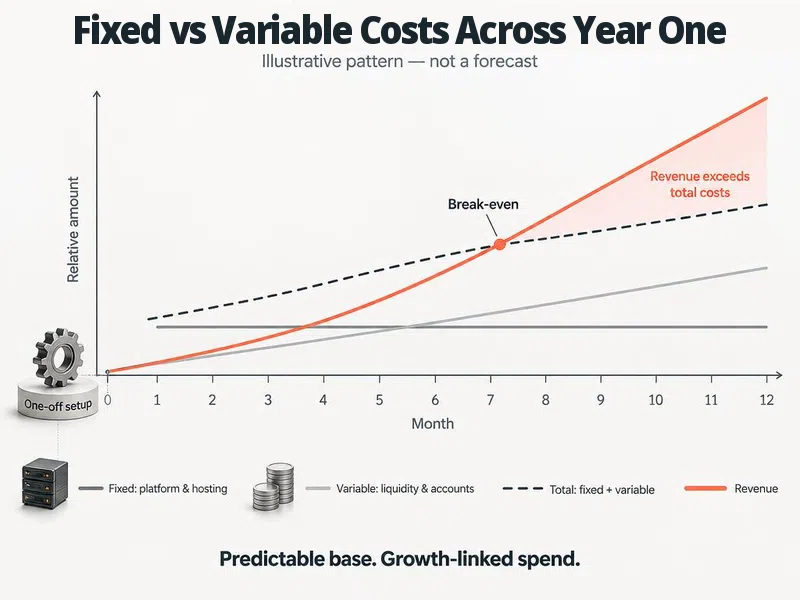
Rather than quoting a single headline figure that would be misleading, the useful way to think about cost is as a structure. Some elements are fixed monthly, some scale with your trading volume and client numbers, and some are one-time. Once you can see the structure, you can decide where to start lean and where to invest, and you can compare providers on a like-for-like basis instead of being dazzled by a low sticker price that hides expensive extras. That clarity is the goal here.
The Main Cost Drivers of a White-Label Brokerage
The trading platform is the most visible cost. A white-label platform licence gives you branded access to proven trading technology without building it, and the price varies with the platform, the number of accounts and the features you enable. Liquidity is the next major driver: your clients need tight spreads and fast execution, and that comes from a liquidity provider whose pricing typically scales with volume. Then there is the CRM and back office, the system that runs onboarding, payments, retention and reporting, followed by hosting and infrastructure to keep everything fast and available, and finally the one-off setup and configuration to get you live.
The important point is that these are not optional add-ons; they are the minimum viable stack for a real brokerage. Where operators get caught out is treating one line, usually the platform licence, as the whole cost and then discovering that liquidity, CRM, payments and hosting are billed separately and add up fast. A managed turnkey model folds most of these into a predictable package, which is why Leverate structures its turnkey brokerage solution to bundle the platform, CRM, back office and liquidity so a broker starts lean and scales spend with volume rather than paying for everything up front.

MT4 and MT5 White-Label Costs
Brokers launching on MetaTrader often ask specifically about MT4 white-label cost and MT5 white-label cost, because MetaTrader is a distinct route with its own economics. A MetaTrader white-label gives you branded access to the MT4 or MT5 terminal running on a provider’s server infrastructure, which avoids the far larger expense of a full MetaTrader licence and the technical burden of hosting and maintaining the servers yourself. The cost typically reflects the number of accounts, the hosting and support included, and any additional modules such as bridges, reporting and the CRM layer that MetaTrader itself does not provide.
Between the two platforms, the cost difference is usually less about the licence and more about scope. MT5 is the newer, multi-asset platform and can support a broader instrument range, which may matter if you plan to offer more than forex. MT4 remains popular for its familiarity and its large ecosystem of expert advisors. A managed MetaTrader white-label from a single provider keeps both options open and rolls hosting, support and the surrounding stack into one predictable cost, so the platform decision is driven by your audience rather than by hidden infrastructure bills.
Build In-House vs Managed White-Label
The alternative to a white-label is building your own technology, and for almost every new or mid-sized broker the numbers favour the white-label decisively. Building means large upfront development cost, a permanent engineering team to maintain and secure the platform, and a long delay before you can take a single client. A white-label delivers proven technology as a service, so you launch in weeks rather than quarters and you convert a big, uncertain capital project into a predictable operating cost. The trade-off is less low-level control, which most brokers happily accept in exchange for speed and reliability.
There is also an opportunity-cost argument that rarely appears on a spreadsheet. Every month spent building is a month not spent acquiring and retaining clients, which is where a broker actually makes money. A managed white-label lets you put your capital and attention into marketing, sales and retention from day one, while the provider carries the technology risk. For operators whose competitive edge is their brand, their market knowledge and their client relationships rather than their software, the white-label route is not just cheaper; it is strategically sounder.
How to Budget for Launch and Growth
A sensible budget separates the cost of getting live from the cost of growing. To launch, you need the platform, liquidity, CRM and back office, hosting, and setup, plus working capital for marketing and a reserve. To grow, your variable costs, chiefly liquidity and any per-account platform fees, rise with volume, but so does revenue, which is the point. The online trading platform market itself continues to expand, with market research projecting steady growth through the decade, so a cost structure that scales with success rather than punishing it is exactly what you want.
The practical way to control cost is to start with a lean but complete stack and let a managed provider absorb the complexity, then invest in the areas that grow the business as revenue arrives. Beginning lean does not mean launching with gaps; a broker still needs the full minimum stack to operate credibly. It means choosing a provider whose pricing scales with your volume so you are not paying enterprise costs on day one. That is the model a well-structured turnkey solution is designed to deliver, and it is why the managed route tends to win on both cost and time to market.
So what does a white-label forex setup actually cost? It costs the sum of platform, liquidity, CRM and back office, hosting and setup, arranged so that fixed elements stay predictable and variable elements scale with volume. Quoted honestly, that is a far more useful answer than a single number, because it lets you compare providers, plan your budget and avoid the hidden extras that catch out under-prepared operators. Leverate structures its turnkey offering around exactly this logic, so a broker can start lean, launch fast and grow spend in step with revenue.
Hidden Costs to Watch For
The costs that catch operators out are rarely the headline ones; they are the extras that appear after launch. Watch for per-account platform fees that climb faster than expected as you grow, liquidity arrangements with wide markups that quietly eat your margin, payment processing charges that vary by method and region, and support or maintenance tiers that turn out to be paid add-ons. Individually these look small, but together they can turn an attractive sticker price into an expensive setup. The way to protect yourself is to ask every provider for a full, itemised cost across a realistic first year of volume, not a launch-day snapshot.
Integration and maintenance are the other hidden cost, and they are the one operators forget entirely. Every time two systems have to be wired together by hand, someone has to build and maintain that connection, and those hours are real money. A stack assembled from separate best-of-breed pieces can look cheaper line by line while costing far more once you account for the engineering time to keep it running. A managed, pre-integrated turnkey avoids most of this, which is a genuine cost saving even though it does not appear as a discount on any invoice.
Getting the Most Value from Your Spend
Controlling cost is not the same as spending the least; it is spending where it moves the business. The highest-return spend for most new brokers is not more platform features but marketing, retention and the people who run them, because that is what turns technology into revenue. A cost structure that keeps the technology predictable frees budget and attention for those growth levers. This is the real argument for a managed white-label: it makes the largest and most complex cost, the technology, behave like a utility, so the operator can invest the rest where returns are highest.
It also helps to choose a provider whose commercial model is aligned with your growth rather than against it. Liquidity that scales with volume, a platform that grows with your client base, and a back office that does not charge you more for succeeding all mean your costs rise only as revenue does. Leverate structures its turnkey solution around this principle, bundling the core stack so a broker starts lean and pays more only as volume and revenue grow, which keeps the cost of running the brokerage tied to its success rather than fixed against it.
One more factor shapes the true cost: the speed at which you can start earning. A build that takes two or three quarters before it can accept a single client is not just an engineering cost; it is months of revenue you never collect, while your fixed costs run the whole time. A managed white-label compresses that gap to weeks, so the business begins generating income far sooner and the payback period shortens accordingly. When you compare options, weigh time to first revenue alongside the line-item prices, because for a new brokerage the calendar is often the most expensive variable of all.
Frequently Asked Questions
How much does a white-label forex broker cost?
Cost varies with scope, but the main drivers are platform licensing, liquidity, CRM and back office, hosting, and setup. A managed white-label turns most of this into a predictable monthly cost. Leverate structures it so brokers start lean and scale spend with volume.
Is a white-label cheaper than building in-house?
For almost all brokers, yes. Building means large upfront cost and permanent maintenance, while a white-label delivers proven technology as a scalable service. Leverate lets firms launch fast without carrying an engineering team.
What does MT4 white-label cost depend on?
MT4 white-label cost usually reflects the number of accounts, the hosting and support included, and added modules such as bridges, reporting and a CRM. A managed MetaTrader white-label bundles these into one predictable cost.
Is MT5 white-label more expensive than MT4?
The licence difference is usually small; cost is driven more by scope. MT5 supports a broader multi-asset range, which may matter if you plan beyond forex. A managed provider keeps both options open under one predictable cost.
What ongoing costs should a broker expect?
Expect fixed elements such as platform and hosting, and variable elements such as liquidity and per-account fees that scale with volume. Budgeting separately for launch and growth keeps spend under control as revenue rises.
Can I start small and scale later?
Yes. A well-structured turnkey lets you launch with a lean but complete stack and grow spend as volume and revenue increase. Leverate’s pricing is built to scale with the broker rather than charging enterprise costs on day one.
What is included in a turnkey forex solution?
A turnkey solution bundles the trading platform, CRM and back office, liquidity and hosting into one managed package, plus the setup to get you live. Leverate provides these as connected parts of a single stack.
How long does it take to launch a white-label brokerage?
With a managed white-label, most brokers launch in weeks rather than the many months a full in-house build takes, because the technology is already proven and only needs branding and configuration.
Disclaimer:
This content is based on multiple sources and is provided for educational purposes only. It does not constitute financial, legal, or investment advice.