A forex brokerage in Africa grows by being mobile-first and payments-led. The operators that succeed pick one market, build around the way clients there already move money, and recruit local introducing brokers (IBs) before they spend on scale. This guide shows how to size African markets when public trader counts disagree, how the main growth markets differ, and how to get from setup to first trades in 90 days.
It is written for broker owners, COOs and growth teams planning an entry or expansion, not for traders choosing an account.
Why Brokers Are Looking at Africa Now
The global currency market keeps expanding. The BIS Triennial Central Bank Survey for April 2025 put average daily FX turnover at $9.6 trillion, up from $7.5 trillion in 2022. Retail demand from Africa is a small slice of that total, but it has been growing from a low base.
A 2021 survey of brokers active on the continent reported median growth of 21.5% across the firms it covered during 2020, and estimated Africa at roughly 5.5% of global retail forex. The data is dated and survey-based, so read it as a direction rather than a forecast. The direction is clear, though: young, mobile-connected populations are discovering online trading, and local currency swings push many savers toward dollar-linked products.
Macro conditions vary widely by country, so check them before you commit budget. The IMF's Regional Economic Outlook for sub-Saharan Africa is the most useful single source for current growth, inflation and currency pressure, market by market.
It also matters who is capturing demand. Finance Magnates' review of where Africa stands in online retail forex found that growth has been led by foreign brokerage firms, mostly from Europe. International operators are not too late. Clients expect them, as long as they localise.
Scale your brokerage today!
CRM & Client Portal, Trading Platform, MT4 & MT5 - All built for you.
Scale NowSizing a Market When the Trader Counts Don't Add Up
Search for the number of active Nigeria traders and you will find estimates that differ several times over. None of the pages publishing them shows a method or a source. Building a forex brokerage in Africa on numbers like these is guesswork, and it usually leads to budgets spread too thin across too many countries.
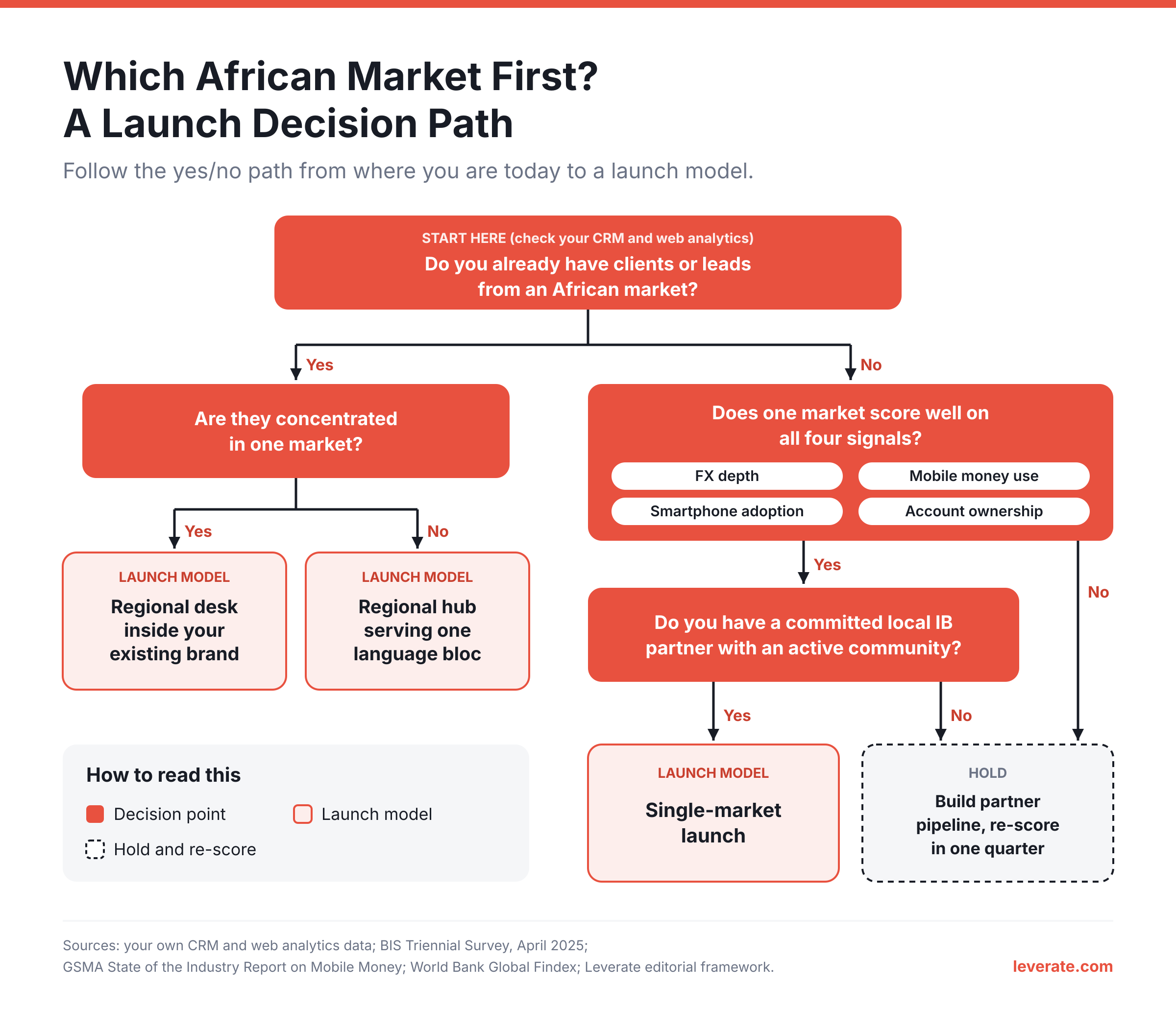
A better approach is to score each candidate market on four signals you can check in public data:
- FX market depth. How actively the local currency trades, and how much interest there is in dollar exposure. The BIS survey breaks global turnover down by currency, which shows where local FX markets are deep enough to support clients trading their home pairs.
- Mobile money use. GSMA's State of the Industry Report on Mobile Money consistently ranks sub-Saharan Africa as the largest mobile money region by accounts and transaction value. High usage means clients will expect mobile money deposits and withdrawals.
- Smartphone adoption. The share of mobile connections running on smartphones tells you whether clients can use a full trading app or need a lighter web flow first.
- Account ownership. The World Bank's Global Findex database tracks how many adults hold a bank or mobile money account. Markets where ownership is rising fast, often through mobile wallets, have a growing pool of clients who can fund digitally.
Then add a fifth signal only you can see: your own data. Where do your current leads, website visits and partner enquiries already come from? A market that scores well on public signals and already sends you traffic is the strongest first candidate.
Choosing the First Market for a Forex Brokerage in Africa
Africa is not one market. Payment habits, languages and client profiles change sharply across borders, so the go-to-market plan has to change too. The table below compares five common entry points on the factors that shape launch costs.
| Market | Main deposit methods | Main acquisition channel | Typical client |
|---|---|---|---|
| Nigeria | Local bank transfer, stablecoins | IB networks, Telegram and WhatsApp communities, creators | Young, mobile-only, small first deposits, strong interest in gold and indices |
| South Africa | Instant bank transfer, cards | Search, social media and IBs | More experienced, mixed desktop and mobile, price-sensitive, trades rand pairs |
| Kenya | M-Pesa and other mobile money | IBs, education groups, social media | Mobile-first, small and frequent deposits, expects fast withdrawals |
| Ghana | Mobile money, bank transfer | IBs and WhatsApp groups | Small accounts, seeks dollar exposure against cedi swings |
| French-speaking West Africa | Orange Money, Wave and other mobile wallets | French-language communities and IBs | Mobile-only, small accounts, needs French support and content |
A few patterns stand out. The South Africa forex market is the most mature on the continent, with bank-linked funding and clients who compare pricing closely. Nigeria has deep demand but harder funding rails, so payment design comes first. Kenya forex brokers compete on how fast a withdrawal reaches an M-Pesa wallet, and Ghana and French-speaking West Africa follow a similar mobile money pattern.
The table describes the markets. Choosing between them depends on where your business stands today: whether you already have African clients, how concentrated they are, and whether you have a committed local partner. The decision path below turns those questions into a launch model.
Payments: Build Around How Clients Actually Move Money
Payments decide more African launches than marketing does. A client who can fund in two taps from a mobile wallet will try your platform. A client told to use an international card, which many local banks limit for foreign transactions, will usually leave.
Plan funding methods in this order:
- Mobile money deposits first in Kenya, Ghana and French-speaking West Africa, through payment providers that aggregate local wallets.
- Local bank transfer where it is the default, as in Nigeria and South Africa.
- Stablecoins as a backup rail in markets where clients already hold them.
- Cards last, and never as the only option.
Withdrawals matter as much as deposits. Many traders in the region have dealt with offshore firms that were slow to pay, so a withdrawal that lands in a mobile wallet the same day is your best advertisement. Set withdrawal service levels before launch and show them clearly in the client area.
For a forex brokerage in Africa, the funding flow should sit inside the client's own area rather than on a separate site. Leverate's Client Portal gives clients one place to register, verify, fund and withdraw, while the Back Office records every transaction so finance teams can reconcile by payment method and by market.
Acquisition: Local IB Networks, Communities and Mobile Funnels
In most African markets, trust travels through people. Traders open accounts because a mentor, a trading group or a local educator they follow recommends a platform. Paid search and social ads still play a part, especially in South Africa, but local IB networks usually bring in the first wave of funded clients.
What tends to work:
- Recruit a small number of IBs who already run active communities on Telegram, WhatsApp or YouTube, rather than signing hundreds of inactive partners.
- Give each partner their own tracking links, a branded landing page and a view of their clients' activity, so they can see what they earn.
- Lead with education: live sessions, beginner courses and market recaps in local languages, scheduled for local evenings.
- Keep the mobile funnel short: sign-up, document capture by phone camera, first deposit, first trade.
- Let sales and retention teams reach clients on the messaging apps they already use, not only by email.
Leverate's AFF/IB solution lets you run multi-level partner structures with tracking and commission reporting, and the Forex CRM links every lead to its source, so retention teams know which partner brought which client and how that group trades over time.
The Tech Stack for an Africa-First Brokerage
An Africa trading platform strategy starts with the phone. The product has to work on a mid-range Android device over a patchy connection, which rules out desktop-only setups as the core offer. A forex brokerage in Africa rarely fails on feature count. It fails when platform, payments, CRM and liquidity do not talk to each other and every client issue becomes a manual task.
The core components:
- Trading platform. Leverate's white-label trading platform gives you branded web and mobile trading under your own name, with xChart for charting, so clients see a consistent experience on every device.
- Client layer. Client Portal, Forex CRM, AFF/IB and Back Office run as connected parts of one stack, so onboarding, partner tracking and payments share the same client record.
- Liquidity. Leverate Prime provides multi-asset liquidity across forex, metals, indices, energies, shares and crypto from one connection. A broad instrument list matters from day one, because it lets partners run education sessions on whatever their community wants to trade.
- Speed to market. If you are starting from zero, a turnkey brokerage package bundles platform, CRM, back office and liquidity, so the team can focus on payments and partners instead of integration work.
A 90-Day Go-to-Market Plan
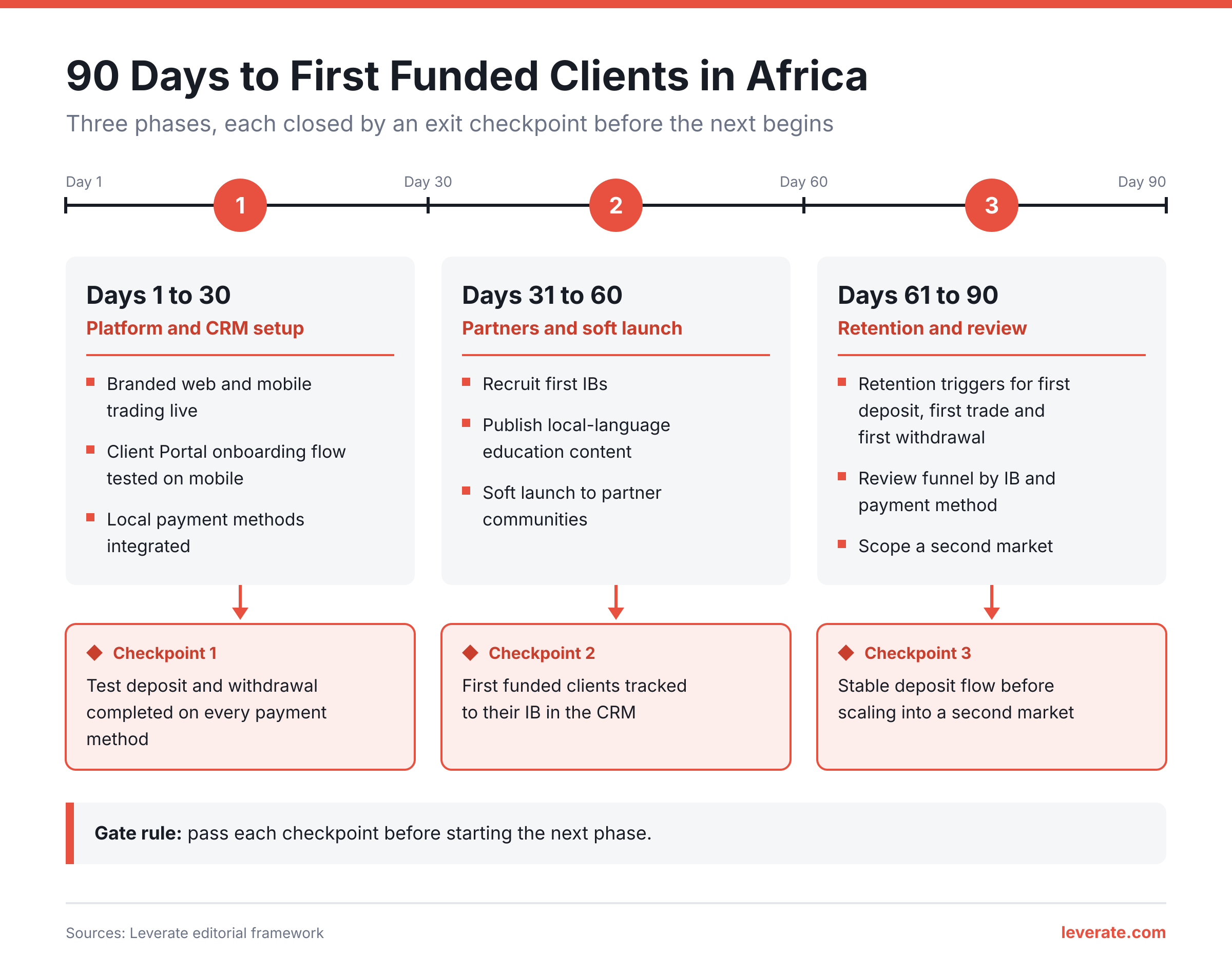
A focused first market can move from signed contract to first funded clients within a quarter, if platform setup, payment integration and partner recruitment run in parallel rather than one after another. The timeline below sets out the three phases and what each one has to deliver before the next begins.
The Bottom Line
Africa rewards operators who treat it as a set of distinct markets rather than one region. A forex brokerage in Africa that sizes markets with checkable signals, funds clients through the rails they already use and grows through trusted local partners has a clear route to scale. Start narrow, prove the funnel in one market, then expand. To see how Leverate's connected stack supports an Africa-first launch, book a demo with our team.
Disclaimer: This content is based on multiple sources and is provided for educational purposes only. It does not constitute financial, legal, or investment advice.