











Leverage in CFD Trading: How Brokers Scale Risk Management and Automated Execution
Most brokers understand leverage as a client-facing tool. Fewer treat it as what it actually is: a structural variable that shapes everything from margin requirements and hedging strategies to the speed at which positions need to be executed. When leverage ratios shift, the downstream effects ripple through the entire operation, and manual workflows are rarely fast enough to keep pace.
Leverage in CFD trading sits at the centre of the broker-risk model, and the brokers managing it well in 2025 are the ones who have built automated execution around it rather than reacting to it after the fact.
What Leverage Means in CFD Brokerage
Leverage in CFD trading allows traders to open positions that exceed their deposited capital, typically expressed as a ratio such as 30:1 or 100:1, depending on the asset class and jurisdiction. For the broker, this creates an asymmetry: the client controls a large notional position while the broker absorbs the remaining market exposure.
That exposure is not inherently problematic. It becomes a risk management challenge when positions accumulate across many clients simultaneously, when volatility sharpens the margin requirements, or when the broker’s hedging infrastructure cannot respond quickly enough to changing conditions.
Regulators across major jurisdictions have tightened leverage caps over recent years. The European Securities and Markets Authority set limits as low as 2:1 on cryptocurrencies and 30:1 on major forex pairs for retail clients. Brokers operating across multiple regions must manage differing caps across the same product catalogue, which adds a layer of operational complexity that is difficult to handle without automated rule enforcement.
Understanding what leverage in CFD trading means operationally, rather than simply as a client acquisition feature, is the starting point for building a sustainable brokerage model. Brokers who treat leverage purely as a marketing variable tend to discover its operational implications only when a market event forces the issue.

How Leverage Impacts Broker Exposure and Risk
When a client opens a leveraged CFD position, the broker’s exposure is determined by the notional value of that trade, not the margin posted. A 30:1 leveraged position on a major forex pair means the broker is effectively exposed to the full value of the contract if that client’s margin is depleted before the position is closed.
Aggregate exposure management, sometimes called book management, is the process by which brokers monitor the net position across all client trades and decide how much of that exposure to offset in the market. An A-book model internalises no risk and passes all orders to a liquidity provider. A B-book model retains some or all of the exposure internally. Most brokers operate a hybrid, which means their risk desk must evaluate both the size of individual positions and the concentration of directional bets across the client base.
Leverage in CFD trading makes this assessment more complex. A heavily leveraged client base with correlated positions can create a scenario where a single market event triggers simultaneous margin calls across hundreds of accounts. If the broker’s systems cannot process those closures quickly, slippage becomes costly and the exposure grows rather than shrinks.
| Book Model | Exposure Retained | Automation Priority | Primary Risk |
| A-Book | None | Fast order routing | LP latency |
| B-Book | Full notional | Exposure monitoring | Concentrated positions |
| Hybrid | Selective | Routing and monitoring | Routing logic errors |
How Automation Changes CFD Trading Execution
The case for automated execution in leveraged CFD environments is straightforward: manual intervention at scale is too slow and too prone to error. When markets move sharply, the window between a triggered margin level and a completed position closure may be measured in milliseconds. Automated execution systems handle that window without human delay.
CFD automated trading systems can be configured to monitor margin levels in real time, trigger stop-outs at defined thresholds, route hedge trades to liquidity providers without manual approval, and adjust leverage tiers for specific client segments based on account parameters. These are not speculative capabilities; they are operational requirements for brokerages running significant volumes.
According to Finance Magnates, algorithmic and automated trading now accounts for a substantial share of CFD order flow across major platforms, with brokers citing execution consistency and reduced operational overhead as primary drivers of adoption.
Source: Finance Magnates, 2025
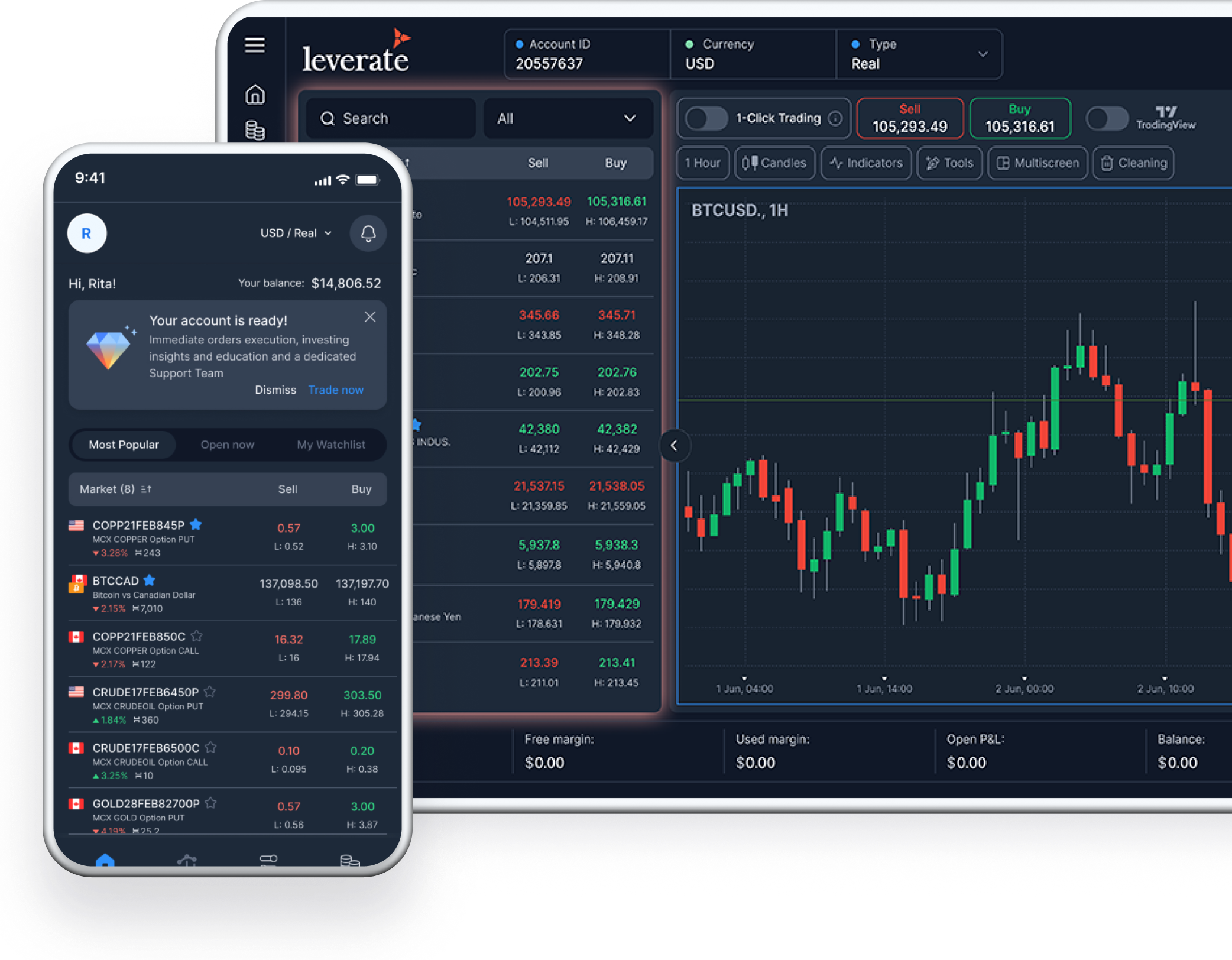
Brokers adopting Leverate’s premium trading platform gain access to automated execution tools built into the infrastructure rather than integrated through disconnected as third-party add-ons. This means leverage rules, margin monitoring, and order routing can be managed through a single administrative environment, reducing the complexity of maintaining multiple systems that need to stay synchronised.

The Relationship Between Leverage and Automated Trading
Leverage in CFD trading and automated execution are not separate conversations. The leverage parameters a broker sets determine the volume of positions that may need automated intervention, the speed at which margin events must be handled, and the complexity of the hedging logic required.
A broker offering 100:1 leverage on forex to offshore clients has a fundamentally different automation requirement than one offering 10:1 on indices to EU retail clients. The former needs faster stop-out processing, tighter real-time monitoring, and potentially more sophisticated liquidity provider routing to absorb the size of positions being opened. The latter may focus more on compliance automation, ensuring that leverage limits are enforced at the point of order entry and that client onboarding captures the correct regulatory category.
When leverage rules are enforced manually, errors accumulate. A client placed in the wrong leverage tier, a margin call sent a few seconds too late, a hedge trade routed to the wrong liquidity pool, each of these creates small financial leakages that compound at scale. Automated systems reduce these leakages by removing the human decision point from time-critical processes.
Balancing Risk and Execution in Scaled CFD Operations
Scaling a CFD brokerage without also scaling the risk infrastructure is a well-documented path to operational problems. As client numbers grow, so does the range of trading behaviours, leverage preferences, and account sizes that the broker must manage simultaneously. A system designed for 500 active traders behaves differently under the same configuration with 5,000.
Brokers looking to scale leverage in CFD operations sustainably typically invest in three areas in parallel: risk management tooling that can handle larger books without adding headcount, execution infrastructure that maintains consistent performance under high-order volume, and compliance automation that enforces leverage rules across client segments without manual oversight.
Leverate’s Back Office Solutions are designed to support this kind of scaled operation, connecting the client-facing trading environment with the broker’s risk and administrative infrastructure. The goal is to make leverage management a background process rather than a daily operational burden. For brokers building or expanding their CFD offering, the leverage model is only as strong as the execution and risk infrastructure behind it.
Visit leverate.com/cfd-broker/ to explore how Leverate’s premium trading platform provides the technical foundation to manage that infrastructure without building it from scratch.
Frequently Asked Questions
What is leverage in CFD trading?
Leverage in CFD trading is a mechanism that allows traders to open positions with a notional value greater than their deposited margin. A 30:1 leverage ratio means a trader can control a position worth 30 times their deposited amount. For brokers, this creates exposure to the full notional value of client trades, which must be managed through hedging, book management, and automated execution systems.
How does leverage affect risk in CFDs?
Leverage can amplify the speed at which a client’s margin is depleted during adverse market movements. For brokers, the primary risk is that leveraged positions move against clients faster than stop-out systems can respond, particularly during high-volatility events. Every mention of leverage should be accompanied by an acknowledgement that it also involves significant risk of loss, and brokers must ensure client communications reflect this clearly.
What is automated CFD trading?
Automated CFD trading refers to the use of algorithmic systems to execute, manage, and monitor trades without requiring manual input for each decision. At the broker level, this includes automated margin monitoring, stop-out execution, order routing to liquidity providers, and rule enforcement for leverage tiers. Automated systems are designed to reduce human error and improve execution consistency at scale.
How do automated systems impact CFD trading for brokers?
Automated systems allow brokers to manage larger client books without proportionally increasing operational headcount. They handle time-sensitive processes such as margin calls and hedge execution faster than manual workflows, which can reduce slippage and improve overall cost efficiency. The main operational benefit is consistency: automated rules apply the same logic to every account regardless of volume, whereas manual processes introduce variability.
How do brokers manage leverage and automation together?
Brokers typically configure leverage rules within their trading platform infrastructure, so that automation enforces those rules at the point of order entry and during position lifecycle events such as margin breaches. In a hybrid book model, automated routing logic determines whether a given trade is managed internally or passed to a liquidity provider, based on exposure thresholds and client risk profiles. Keeping leverage configuration and execution automation within a single system reduces the risk of rule inconsistencies.
What leverage caps apply to CFD brokers in regulated markets?
Leverage caps vary by jurisdiction and asset class. Under ESMA rules in the EU, retail clients are limited to 30:1 on major forex pairs, 20:1 on minor forex pairs and gold, 10:1 on commodities excluding gold and non-major indices, 5:1 on individual equities, and 2:1 on cryptocurrencies. Other regulators such as ASIC in Australia and the FCA in the UK apply similar or adjusted frameworks. Brokers serving multiple regions must configure their platforms to enforce the correct limits per client segment.
What is the difference between A-book and B-book in CFD brokerage?
An A-book model passes all client orders directly to a liquidity provider, so the broker retains no market exposure. A B-book model sees the broker take the opposing side of client trades internally, retaining the exposure. Most brokers operate a hybrid model, routing certain traders to the A-book and managing other segments internally. Automated routing logic determines which book a given trade flows to, based on account parameters, trade size, and exposure levels.
Can smaller brokers implement automated execution for leveraged CFD trading?
The practical barriers have reduced considerably with the availability of white-label and fully managed trading infrastructure. Brokers using Leverate’s premium trading platform gain access to automated execution capabilities without building the underlying systems themselves. The key consideration is configuring those systems correctly for the broker’s book model, leverage policy, and client base, which typically requires an onboarding and integration phase with the platform provider.
Disclaimer:
This content is based on multiple sources and is provided for educational purposes only. It does not constitute financial, legal, or investment advice.