









Prediction Markets for Brokers: The 2027 Opportunity
Prediction markets have gone from a fringe curiosity to one of the fastest-growing products in trading, and for brokers the question is no longer whether they matter but how to offer them. Prediction markets for brokers means giving clients a way to trade the outcomes of real-world events, elections, sports, economic releases, entertainment, alongside the FX, CFD, and crypto they already trade. The category has scaled at a pace few products ever match: global prediction market volume quadrupled from 2024 to 2025 and kept climbing through 2026, and the trend is carrying that momentum into 2027, drawing both retail traders and institutional attention. This guide explains what prediction markets are, why they matter for brokers heading into 2027, and how a brokerage launches a branded offering without building an exchange.
The reason to treat this as a strategic opportunity rather than a novelty is that prediction markets bring a different kind of engagement than traditional instruments. They are event-driven, easy to understand, and inherently social, which makes them powerful for attracting new audiences and keeping existing traders active during quiet spells in other markets. For a broker looking to differentiate and grow, prediction markets are one of the clearest new revenue and retention levers available heading into 2027.
What Prediction Markets Are
A prediction market lets people trade on the outcome of a future event. Instead of buying an asset, a participant takes a position on whether something will happen, will a particular team win, will an economic figure come in above a threshold, will an event occur by a certain date, and the price of that position reflects the market’s collective estimate of the probability. When the event resolves, positions settle based on the outcome. In effect, prediction markets turn opinions about the future into tradable, priced contracts.
This makes them intuitive in a way traditional instruments are not. A newcomer who finds forex pairs or CFD mechanics intimidating can immediately grasp a market on a question they already have a view on, which lowers the barrier to entry dramatically. That accessibility, combined with the constant supply of events to trade, is a large part of why the category has grown so quickly and why it reaches audiences beyond the traditional trading base.
Event-Based Trading vs Traditional Instruments
Prediction markets are the best-known form of event-based trading, where the tradable question is tied to a discrete event rather than a continuously priced asset. That distinction shapes the experience. Traditional trading is open-ended: a position can be held indefinitely and its value drifts with the market. An event contract has a defined resolution, a known moment when it settles to a clear outcome, which gives it a natural rhythm of anticipation, participation, and resolution that keeps traders engaged around each event.
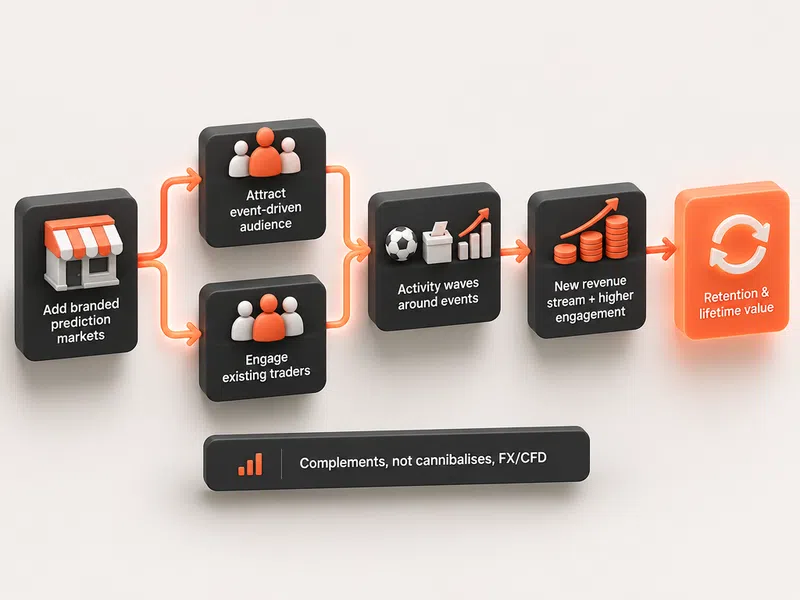
For a broker, this rhythm is commercially useful. Event contracts create waves of activity around scheduled moments, a major match, an election, a data release, that can drive participation even when FX or CFD markets are quiet. They also complement, rather than cannibalise, existing products, because they appeal to a different mindset and a partly different audience. A broker offering both gives clients more reasons to stay engaged across more of the week.

Why Prediction Markets Matter for Brokers Now
The timing is what makes this urgent. Prediction market activity has soared into the mainstream through 2025 and 2026, with monthly notional volume climbing into the tens of billions and unique participants multiplying, and that trajectory sets up 2027 as the year the category consolidates its place in the mainstream. Analysts now project it could scale toward roughly a trillion dollars in annual volume by 2030, and Wall Street is treating it as a genuine new trading frontier rather than a passing trend. Sports events alone account for the large majority of activity, and major tournaments have driven record volumes.
For brokers, a fast-growing category with a large, partly new audience is exactly the kind of opportunity worth moving on early. The brokers who add prediction markets while the product is still establishing itself capture demand and build a reputation as a modern, diversified venue, while those who wait cede ground to competitors and to specialist platforms. As with any emerging product, first-mover advantage is real, and the window to establish a position is open now rather than indefinitely.
There is also a defensive dimension. Traders drawn to event contracts will find them somewhere, and if a broker cannot offer them, its clients may open accounts elsewhere to participate, splitting their attention and deposits. Offering prediction markets keeps that activity, and the engagement and revenue it brings, within the broker’s own platform rather than sending clients to a rival or a specialist venue.
How Brokers Offer Prediction Markets
The good news for brokers is that offering prediction markets does not mean becoming an exchange or building the product from scratch. Through a white-label prediction markets solution, a broker can launch a fully branded event-trading offering on infrastructure a provider builds and maintains, in much the same way it runs a white-label trading platform. The broker focuses on its clients, markets, and brand, while the provider handles the pricing engine, settlement, and the technology that makes event trading work.
Leverate’s white-label prediction markets solution is built for exactly this: a branded, fully managed prediction markets platform a broker can launch and operate without building the underlying technology. That turns what would be a major infrastructure undertaking into a product a broker can switch on, add to its existing offering, and scale, which is what makes prediction markets accessible to brokers rather than only to specialist venues.
Structuring Markets and Categories for Volume
Once a broker can offer prediction markets, the commercial art is in how they are structured. The categories a broker opens, sports, politics, economics, crypto, entertainment, and how those categories are organised, directly shape how much volume they generate. Sports contracts dominate activity industry-wide, but a thoughtful mix that matches a broker’s audience and regions keeps a steady flow of events to trade rather than a few spikes and long lulls. The goal is a calendar of markets that always gives clients something relevant to take a view on.
This is a discipline in its own right, and getting it right materially affects revenue. For a deeper treatment, our guide to structuring prediction market categories for maximum volume goes into how category design drives participation. The principle for brokers is that prediction markets reward active curation: aligning the events on offer with what the audience cares about, and keeping the calendar full, is what turns the product from a novelty into a consistent contributor.
The Revenue and Retention Case
Prediction markets earn their place on two fronts: new revenue and stronger retention. On revenue, event contracts open a stream that is partly independent of FX and CFD trading conditions, so a broker is less exposed to quiet spells in traditional markets. Because events happen constantly, and spike around major moments, they generate participation and associated revenue on a rhythm that does not depend on market volatility in the usual sense. For a broker whose income rises and falls with trading volume, that diversification smooths the business.
Retention is the other half, and it may be the stronger case. Event contracts are inherently engaging: they give traders a reason to return around each event, and their social, opinion-driven nature fits how modern audiences behave. Prediction markets are unusually good at building repeat engagement, because each event is a fresh reason to participate. Our guide to retention loops in prediction markets explores the mechanics, but the headline for brokers is that a well-run prediction markets offering keeps traders active and coming back, which lifts lifetime value across the whole account.
Seasonal and event-driven peaks add to this. A major tournament or election can bring a wave of new and returning participants, and a broker positioned to capture that wave turns a one-off moment into lasting engagement if it converts those participants into ongoing clients. Handled well, prediction markets are both an acquisition channel around big events and a retention engine between them.
Pricing, Liquidity and Running the Book
Behind the client-facing simplicity sits real operational substance, and a broker should understand it before launching. Prediction market contracts have to be priced so that they reflect probabilities fairly and leave the broker a sustainable margin, and that pricing has to update as new information arrives and as participants take positions. A capable white-label solution handles this pricing engine, so the broker offers fair, responsive markets without building the quantitative machinery itself.
Liquidity and risk matter here as they do in any trading product. Markets need enough liquidity that participants can enter and exit cleanly, and the broker needs to manage its exposure across open contracts so a single event outcome does not create outsized risk. This is analogous to managing a trading book, and it benefits from the same discipline of monitoring and controls. For the mechanics of how event-based pricing translates into broker revenue, our guide to pricing models in event-based trading goes deeper; the essential point is that prediction markets are a managed product, not a set-and-forget one, and the technology behind them is what makes them sound.
This is also where a broker’s wider stack helps. The same instincts and, in part, the same infrastructure a broker uses to manage exposure and liquidity in its core business apply to running a prediction markets book responsibly. A provider that offers prediction markets alongside the platform, liquidity, and risk tools a broker already uses keeps the whole operation coherent rather than bolted together, which matters as the offering scales.
Launching Prediction Markets Without Building an Exchange
The practical path for most brokers is clear: launch prediction markets through a branded, managed solution rather than attempting to build the product in-house. Building an event-trading platform means constructing a pricing engine, settlement, market creation and curation tools, and the risk and liquidity apparatus to run it, a substantial undertaking that is not most brokers’ core competence. A white-label solution delivers all of this as a managed product, so a broker can be live with a credible offering in a fraction of the time and cost.
This is the route Leverate provides. Its prediction markets white-label solution gives brokers a fully branded, managed event-trading platform that sits alongside the rest of the Leverate ecosystem, the trading platform, CRM, Leverate Prime for liquidity, and risk tools, so prediction markets become part of one coherent offering rather than a separate silo. For a broker, that means adding a fast-growing product to its lineup as a configuration decision rather than a multi-quarter build, and scaling it as demand grows. Brokers already capturing event-driven demand around major moments, such as a global sporting tournament, show how quickly the product can contribute when it is launched on the right foundation.
The Bottom Line
Prediction markets are one of the clearest growth opportunities available to brokers as they plan for 2027. The category is scaling at a pace few products ever match, it reaches a large and partly new audience, and it brings a kind of event-driven engagement that both diversifies revenue and strengthens retention. For a broker weighing whether to add them, the demand and the trajectory make the case, and the risk of waiting is ceding the audience to competitors and specialist venues.
The route in is not to build an exchange but to launch a branded, managed offering that sits within the broker’s existing stack. Structured thoughtfully, priced and risk-managed properly, and integrated with the rest of the business, prediction markets become a durable contributor rather than a passing experiment. Leverate’s white-label prediction markets solution is built to let brokers do exactly that, so a brokerage can meet a fast-moving opportunity with a credible, branded product rather than watching the trend from the sidelines.
Frequently Asked Questions
What are prediction markets?
Prediction markets let people trade on the outcomes of future events, such as sports, elections, or economic releases. Instead of buying an asset, a participant takes a position on whether something will happen, and the price reflects the market’s estimate of the probability, settling when the event resolves.
What does prediction markets for brokers mean?
It means a brokerage offering its clients event-based trading, positions on real-world outcomes, alongside FX, CFD, and crypto. Brokers typically do this through a white-label solution such as Leverate’s, which provides a branded, managed prediction markets platform.
Why are prediction markets growing so fast?
They are intuitive, event-driven, and social, which attracts audiences beyond traditional trading. Volume has climbed sharply, quadrupling from 2024 to 2025 and carrying that momentum into 2027, with analysts projecting the category could approach a trillion dollars in annual volume by 2030.
How do brokers offer prediction markets?
Through a white-label prediction markets solution, a broker launches a fully branded event-trading offering on infrastructure a provider builds and maintains. Leverate provides a managed prediction markets platform so brokers do not have to build the technology themselves.
Do brokers need to build an exchange to offer prediction markets?
No. A white-label, managed solution provides the pricing engine, settlement, market curation, and risk tools, so a broker adds prediction markets as a configuration rather than a multi-quarter build. Leverate’s solution works this way.
How do prediction markets make money for a broker?
They open a revenue stream from event-contract activity that is partly independent of FX and CFD conditions, spiking around major events. Priced with a sustainable margin and run as a managed book, they diversify a broker’s income.
Do prediction markets help with retention?
Yes. Event contracts give traders a reason to return around each event and suit a social, opinion-driven audience, so a well-run offering builds repeat engagement and lifts lifetime value across the account.
What can clients trade on prediction markets?
Outcomes across categories such as sports, politics, economics, crypto, and entertainment. Sports contracts account for the majority of activity, but a broker can curate a mix of categories to match its audience and keep a full calendar of events.
How are prediction markets priced and risk-managed?
Contracts are priced to reflect probabilities and update as information and positions change, and the broker manages exposure across open contracts so a single outcome does not create outsized risk. A capable white-label solution handles the pricing engine and supports this risk management.
How can a broker launch prediction markets quickly?
By using a branded, managed white-label solution that integrates with the broker’s existing stack. Leverate’s prediction markets white-label sits alongside its platform, CRM, Leverate Prime for liquidity, and risk tools, so a broker can go live fast and scale as demand grows.
Disclaimer:
This content is based on multiple sources and is provided for educational purposes only. It does not constitute financial, legal, or investment advice.