







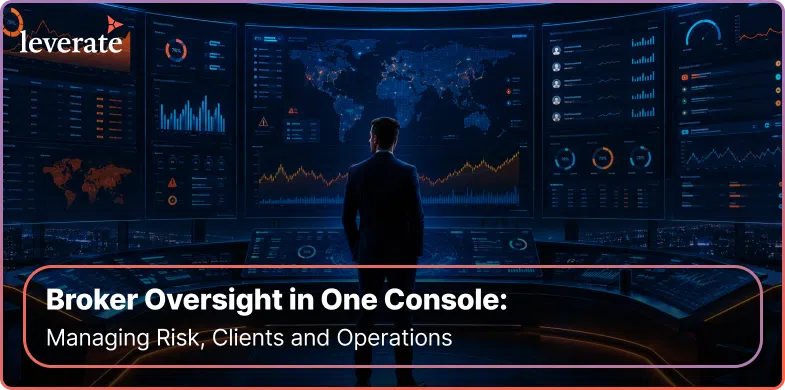
Broker Oversight in One Console: Managing Risk, Clients and Operations
The best-run brokerages are not the ones with the most tools, but the ones that can see and control the whole business from a single console. As a brokerage grows, risk oversight, client management, and daily operations pull in different directions, and running them from separate systems creates exactly the blind spots that cost money. This article looks at why leading brokers are consolidating oversight into one management console, and what that console needs to do: monitor exposure in real time, integrate the CRM, segment traders, and run operations efficiently.
The theme throughout is control. A broker that can act on what is happening across risk, clients, and operations from one place makes faster, better decisions than one stitching a view together from disconnected screens.
From Trading Screen to Command Center
A trading platform shows what clients are doing. A broker management console shows what the business is doing, and lets the operator act on it. That distinction matters because a brokerage is not run from the client-facing platform; it is run from the back end, where exposure, client data, payments, and performance come together. Consolidating these into one console turns a collection of tools into a command center, where a lean team can supervise a large book by exception rather than by constant manual checking.
The shift is cultural as much as technical. A broker running from one console stops thinking in terms of separate tools and starts thinking in terms of the business as a whole, which is precisely the mindset that scales as volumes and client numbers grow.
Leverate’s Broker Portal is built to be that command center, giving operators a single, configurable place to run risk, clients, and operations rather than switching between systems that do not share data.
Real-Time Exposure and Risk Oversight
Oversight starts with risk. A capable console shows net exposure by symbol, asset class, and client in real time, flags concentration as it builds, and lets the desk set automated limits that warn or act before a position becomes dangerous. The value is speed: seeing exposure form during a volatile window, rather than reading about it in the next day’s report, is the difference between containing risk and absorbing it.
This is where consolidation pays off directly. When exposure data lives in the same console as client and operational data, the desk can connect a spike in risk to the specific clients driving it and respond precisely, rather than reacting blindly to an aggregate number.

CRM Integration and Trader Segmentation
Oversight is incomplete without the client dimension. When the CRM is integrated into the same console, the broker sees not just exposure but the clients behind it, their value, history, and behaviour. That enables genuine trader segmentation: grouping clients by profitability, activity, risk profile, or lifecycle stage, and treating each group appropriately, from retention outreach to how their flow is handled.
Segmentation is where risk and commercial strategy meet. Knowing which clients are valuable and which flow is risky lets a broker protect revenue and manage exposure at the same time, decisions that are only possible when client and risk data sit together. Leverate’s CRM and Broker Portal share this data so segmentation drives both retention and risk decisions.
Operational Efficiency and Self-Configuration
Finally, a strong console makes the business cheaper and faster to run. Consolidating payments, reporting, and administration alongside risk and CRM removes duplicated work and the errors that creep in when data is copied between systems. Just as important is self-configuration: the ability for a broker to adjust risk parameters, payout rules, and workflows itself, without waiting on external developers, so the business can adapt at its own pace.
That independence is a real competitive edge over setups that lock a broker into rigid back ends. Leverate’s Back Office Solutions bring risk, CRM, payments, and reporting into one configurable environment, so operators run more of the business themselves and spend less time firefighting across disconnected tools.

Frequently Asked Questions
What is a broker management console?
It is the back-end environment a brokerage is actually run from, unifying risk oversight, client management, and operations in one place. Leverate’s Broker Portal is built to be this single command center.
Why consolidate oversight into one console?
Running risk, clients, and operations from separate systems creates blind spots and slow reactions. One console with shared data lets a lean team see the whole business and act by exception rather than constant manual checking.
How does real-time exposure oversight work?
The console shows net exposure by symbol, asset class, and client as it changes, flags concentration, and enforces automated limits. Seeing risk form in real time lets the desk contain it rather than absorb it after the fact.
What is trader segmentation and why does it matter?
Segmentation groups clients by value, activity, risk, or lifecycle stage so each is handled appropriately. When CRM and risk data share a console, segmentation drives both retention and risk decisions at once.
How does CRM integration improve oversight?
It connects exposure to the specific clients driving it, so the broker sees not just how much risk exists but who is creating it, and can respond precisely. Leverate’s CRM and Broker Portal share this data.
What operational efficiencies does a single console create?
It removes duplicated work and copy-between-systems errors, and lets a broker self-configure risk parameters, payouts, and workflows without waiting on external developers, so the business adapts faster.
Why does self-configuration matter?
It gives a broker independence to adjust the business itself rather than being locked into a rigid back end and reliant on a vendor for every change. Leverate’s Back Office is built to be configured by the broker.
How does consolidated oversight support growth?
By letting a small team supervise a large, complex book safely and adapt quickly, it removes the operational drag that otherwise grows with volume. Leverate’s Broker Portal and Back Office are designed to scale this way.
Disclaimer: This content is based on multiple sources and is provided for educational purposes only. It does not constitute financial, legal, or investment advice.