









CFD-on-Crypto vs Crypto-Native Trading: What Brokers Should Offer
Crypto is no longer a question of whether a broker offers it but how. The two routes, CFD-on-crypto and crypto-native, look similar to a client but are worlds apart for the broker, in custody, risk, technology, and the liquidity behind them. As digital-asset rails become part of mainstream financial infrastructure, getting that decision right matters more each year. This guide explains the difference between CFD-on-crypto and crypto-native trading, what each demands of a broker, and why most brokers reach for CFDs backed by strong crypto liquidity providers rather than building an exchange.
The Core Difference
CFD-on-crypto lets a client speculate on the price of a digital asset without ever owning it, with the position settled in cash. Crypto-native trading means the client buys, holds, and can move the actual token, which the broker or exchange must custody. The dividing line is ownership, and from it flows every operational and risk difference between the two models. A CFD is a contract on price; crypto-native is the asset itself.
For the trader, the experience can feel similar: a price goes up or down and they profit or lose. For the broker, the two models require entirely different infrastructure, which is why the choice is strategic rather than cosmetic.
The distinction has become sharper as crypto has matured. Early on, offering crypto often meant simply listing a few coins; today clients expect depth, tight pricing, and the ability to trade crypto the way they trade everything else. That expectation pushes the decision to the front of a broker’s strategy, because the route chosen now shapes the cost base, the risk profile, and the speed at which the broker can respond as new tokens and demand emerge. Getting it wrong is expensive to unwind once clients and balances are involved.
What Each Model Requires of a Broker
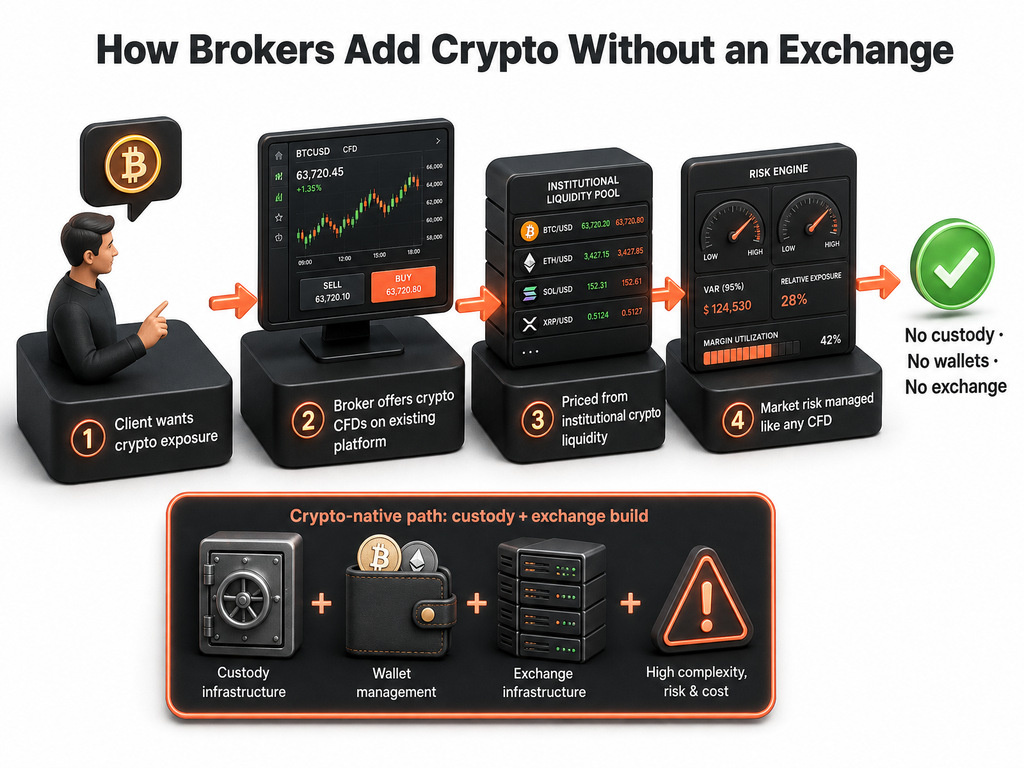
CFD-on-crypto fits naturally into an existing brokerage. The broker offers crypto CFDs on the same platform as FX and other markets, prices them from crypto liquidity, and manages the market risk exactly as it does for any other CFD, hedging or internalising under controls. There is no wallet, no custody, and no exchange infrastructure to run.
Crypto-native trading is a different business. It requires secure custody of client assets, wallet infrastructure, blockchain integration, and the operational and security burden of holding real tokens. That is a substantial undertaking, closer to running an exchange than a brokerage, and it introduces risks, custody, security, and settlement, that a CFD broker does not carry. The two models are not two versions of the same thing; they are two different businesses.
Time to market reflects that gap. A broker can switch on crypto CFDs in the time it takes to connect liquidity and enable the instruments, because the platform, risk tools, and client systems already exist. Standing up a crypto-native offering means building or integrating custody, wallets, and blockchain connectivity, then securing and maintaining them, which is a project measured in quarters and carries ongoing operational weight. For a firm whose goal is to meet client demand for crypto quickly, that difference alone often settles the decision.

Custody, Risk and Complexity
The custody question is where the models diverge most sharply. Holding client crypto means securing private keys, defending against theft, and carrying responsibility for assets that, once lost, are often unrecoverable. That is a serious security and operational commitment. CFD-on-crypto sidesteps it entirely, because the broker never holds the underlying asset; it manages price exposure using the same risk tools it already runs for other markets.
Risk management also differs. In a crypto-native model, the broker’s risk includes custody and operational security on top of market movement. In a CFD model, the risk is market exposure, which a broker already knows how to classify, hedge, and internalise. For a firm whose core competence is brokerage rather than custody, the CFD route keeps the risk within familiar, manageable bounds.
None of this is an argument that crypto-native is wrong; for a firm whose strategy is to be an exchange, owning custody and the token economy is the whole point. The argument is about fit. A brokerage that wants to add crypto to a multi-asset offering is choosing a feature, and CFDs deliver that feature within its existing model. A firm that wants to be in the business of custodying and moving crypto is choosing a different company, with a different risk and cost structure. Being honest about which of those a firm actually is prevents an expensive detour into infrastructure it never really needed.
Liquidity is the deciding factor that ties the CFD route together. Because a CFD broker never holds the token, its entire crypto offering rests on the quality of the pricing and depth it can access. Thin crypto liquidity shows up as wide spreads and slippage during exactly the volatile moments crypto is known for, which erodes trust fast. Deep, institutional crypto liquidity, by contrast, lets a broker price competitively and fill reliably, so crypto CFDs feel as solid as the rest of the book rather than a bolt-on that wobbles under stress.
This is why the provider choice matters as much as the model choice. A broker can decide correctly to offer crypto CFDs and still disappoint clients if the liquidity behind them is weak. Sourcing crypto liquidity from the same provider that supplies the rest of the multi-asset book keeps pricing consistent and operations simple, and it means the broker adds crypto as a strength rather than a liability. Leverate Prime is built to deliver exactly that depth alongside FX, metals, and indices through one connection.
Why Most Brokers Choose CFD-on-Crypto
Put together, the practical conclusion for most brokers is that CFD-on-crypto captures the demand without the burden. Clients get long and short exposure to major digital assets, with leverage, alongside the rest of their multi-asset account, and the broker avoids custody, wallets, and exchange operations. The audience for trading crypto price, rather than owning crypto, is large and overlaps heavily with existing CFD and FX clients.
The one requirement is reliable crypto liquidity, which is where a provider matters. Leverate’s institutional crypto liquidity lets brokers offer crypto CFDs with the depth and pricing to compete, and it plugs into the same multi-asset platform and risk tools a broker already uses. For a brokerage weighing the crypto decision, that is usually the pragmatic answer: meet the demand through CFDs, backed by strong liquidity, rather than becoming an exchange.
The Multi-Asset Context
Crypto rarely stands alone in a client’s account. Traders increasingly expect FX, crypto, commodities, and indices in one place, and adding crypto CFDs is most powerful when it broadens an already multi-asset offering rather than creating a separate silo. Sourcing crypto liquidity from the same provider that supplies the rest of the book keeps operations simple and the client experience coherent. Leverate Prime delivers crypto alongside other assets through one connection, so crypto becomes part of the platform rather than a bolt-on.
Making the Decision
For a broker weighing the two routes, a short set of questions settles most cases. Is the goal to let clients trade crypto price, or to own and move crypto? Does the firm want to add a feature to a multi-asset offering, or enter the custody business? How quickly does it need to be live, and how much operational and security burden can it carry? Answering honestly usually points clearly to one model.
Crypto-native makes sense for firms whose strategy is genuinely to be a crypto venue, with the appetite and resources to custody assets and run exchange-grade security. For them the burden is the business. But that is a minority, and it is a fundamentally different company from a brokerage adding a market.
For the majority, the pragmatic default is CFD-on-crypto backed by strong liquidity: it captures the demand, fits the existing platform and risk model, and can be live quickly without custody. It also leaves the door open, since a broker can always add more as the market evolves. Meeting clients where they are, wanting exposure rather than ownership, is usually both the simpler and the smarter path, and Leverate’s crypto liquidity is built to support exactly that.
A final point on future-proofing. The crypto market moves quickly, with new tokens, shifting demand, and evolving client expectations, so a broker wants a route that lets it adapt without re-architecting. CFD-on-crypto offers that flexibility: adding a new instrument is a configuration and liquidity question, not a custody and wallet project, so the broker can follow demand as it emerges. A crypto-native operation, by contrast, must extend its custody and security stack for each new asset, which slows the response and raises the cost of keeping up.
That adaptability is the quiet advantage of the CFD route. It lets a brokerage treat crypto as one more market it can expand and refine alongside the rest of the book, rather than a separate business with its own operational gravity. For the great majority of brokers, that is exactly what they want from crypto: a way to meet strong and changing client demand quickly, competitively, and within a risk model they already understand. Backed by institutional crypto liquidity from a provider like Leverate, it becomes a durable part of the offering rather than a one-off bet.
In short, the crypto question is less about the asset and more about the kind of business a broker wants to run. Choose the model that fits the strategy, back it with liquidity strong enough to compete, and crypto stops being a dilemma and becomes simply another market the brokerage serves well. For most, that means CFDs on a multi-asset platform, powered by institutional crypto liquidity, and the freedom to expand as the market keeps moving.
Frequently Asked Questions
What is the difference between CFD-on-crypto and crypto-native trading?
CFD-on-crypto lets clients speculate on crypto prices without holding the asset, settled in cash. Crypto-native trading involves the underlying tokens, which must be custodied. Leverate Prime supplies the crypto liquidity that powers the CFD approach.
Do brokers need a crypto exchange to offer crypto trading?
No. With CFDs on crypto, brokers offer exposure through their existing platform and liquidity, avoiding custody and exchange complexity. Leverate Prime supplies institutional crypto liquidity for exactly this.
Why do most brokers choose crypto CFDs over crypto-native?
Because CFDs capture the demand without the custody, wallet, and exchange burden, and the risk stays market exposure a broker already manages. Leverate makes this practical with institutional crypto liquidity.
What are the custody risks of crypto-native trading?
Holding client crypto means securing private keys, defending against theft, and carrying responsibility for assets that are often unrecoverable if lost. CFD-on-crypto avoids this entirely.
Can clients go short and use leverage on crypto CFDs?
Yes. CFDs allow both long and short positions and leverage, unlike simply owning crypto. Sound brokers apply margin controls to manage the added risk, using tools like Leverate’s.
What liquidity do crypto CFDs require?
Deep, reliable crypto liquidity so pricing stays competitive and fills hold up during volatility. Leverate’s institutional crypto liquidity delivers this alongside other asset classes.
How does crypto fit into a multi-asset offering?
Best as part of a broader account spanning FX, crypto, commodities, and indices, sourced from one provider to keep operations simple. Leverate Prime delivers crypto alongside other assets through one connection.
Is CFD-on-crypto suitable for a broker new to crypto?
Yes. It lets a broker enter crypto using the platform and risk tools it already runs, with liquidity from a provider, rather than building exchange and custody infrastructure. Leverate supports this route.
Disclaimer:
This content is based on multiple sources and is provided for educational purposes only. It does not constitute financial, legal, or investment advice.