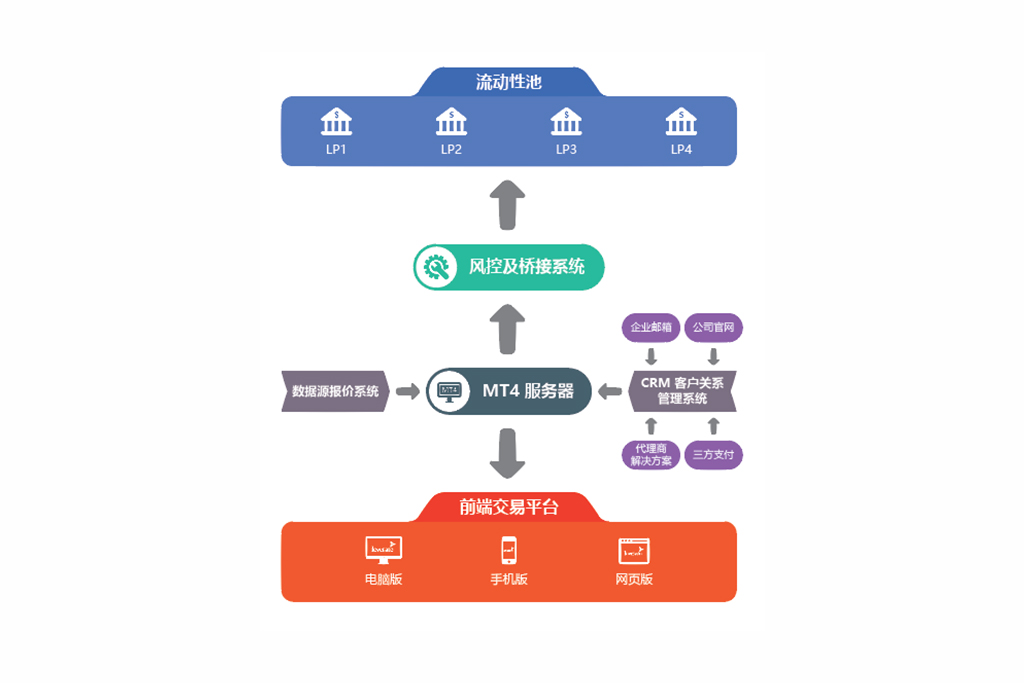
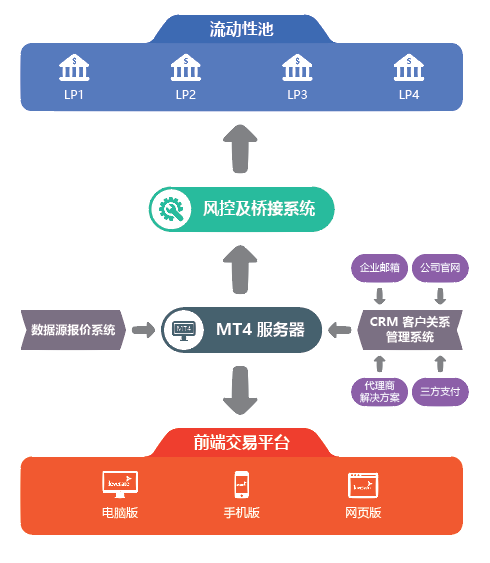
In the image above, you can see how the entire foreign exchange system operates, both front-end and back-end. To help you better understand, we’ll briefly introduce the six key elements of our core trading system.
1. Trading Software
The front-end interface through which clients and traders execute trades, such as desktop, web, mobile, and tablet trading interfaces.A user-friendly interface enhances the trading experience and includes many features designed to improve the client’s experience. A good front-end interface is easy to navigate, simple to use, and offers comprehensive functionality. Notable examples include MetaQuotes’ MT4 software and Leverate’s Sirix social trading software.
Scale your brokerage today!
CRM & Client Portal, Trading Platform, MT4 & MT5 - All built for you.
Scale Now2. Data Source Quotation System
A quote system for trading instruments should offer a comprehensive range of products, typically including CFDs on forex currency pairs, spot precious metals, U.K. and U.S. futures, stocks, and commodities. Leverate’s data sources and quote system provide a comprehensive range of trading instruments with zero-latency quotes.
3. Risk Management System
A risk management system allows you to independently configure and integrate your hedging strategies to control risk. Leverate’s powerful risk management system monitors real-time exposure at all times and enables you to customize order execution terms, effectively reducing your risk and delivering steady profits for your platform.
4. Liquidity and Bridge Systems
Once connected to liquidity providers (LPs), the providers quote prices to buyers and sellers and match trades at the best available price for both parties (ECN). Through its BBO bidding mechanism, Leverate partners with multiple top-tier liquidity providers, offering tight spreads, deep liquidity, and fast execution.
5. Customer Relationship Management System
CRM is a tool for managing customer and agent networks. A good customer relationship management system can organize customer information, seamlessly integrate with third-party payment providers and corporate email systems, and monitor and track the performance of traders and agents.
6. Network and Hardware Solutions
All software requires hardware to run, as data on the platform is backed up to servers in real time. Leverate uses data hosting services provided by Quinix (the world’s second-largest data center operator). With dedicated network solutions, top-tier caching and acceleration, and network security services, brokers can operate with peace of mind and focus on their business.