






How to Launch an Equities (Stock) Brokerage
Starting a stock brokerage firm means assembling a specific stack: the technology to offer equities, access to market pricing and liquidity, a system to manage clients and risk, and the setup required for the markets you serve. Equities behave differently from forex and CFDs, so an equities launch has its own considerations, but the underlying logic is the same one that governs any brokerage launch: proven technology, reliable liquidity, and a client layer that converts and retains. A white-label trading platform that supports shares alongside other assets lets a new operator offer equities under its own brand without building the technology from the ground up. This guide walks through what an equities launch actually requires.
The reason a dedicated equities guide is worth writing is that too much brokerage advice assumes forex and treats stocks as an afterthought. Equities carry their own market structure, their own client expectations and their own product nuances, and an operator that understands them launches a stronger offering. Demand supports the effort: the online trading platform market is projected to grow steadily through the decade. At the same time, a broker does not have to choose between asset classes: modern white-label technology is multi-asset, so equities can sit alongside FX and CFDs in a single platform. That combination, an equities-aware approach on multi-asset technology, is the foundation this guide builds on.
What You Need to Offer Equities
At the core of an equities brokerage is the trading platform, and for stocks it must handle real share instruments, corporate actions and the client experience investors expect. Around the platform you need market access and liquidity so client orders are priced and filled reliably, a CRM and back office to run onboarding, payments and retention, and risk controls appropriate to equities. You also need the operational setup for the markets you intend to serve. Each of these is a discipline in itself, which is why most new operators assemble them through a technology partner rather than sourcing each piece separately.
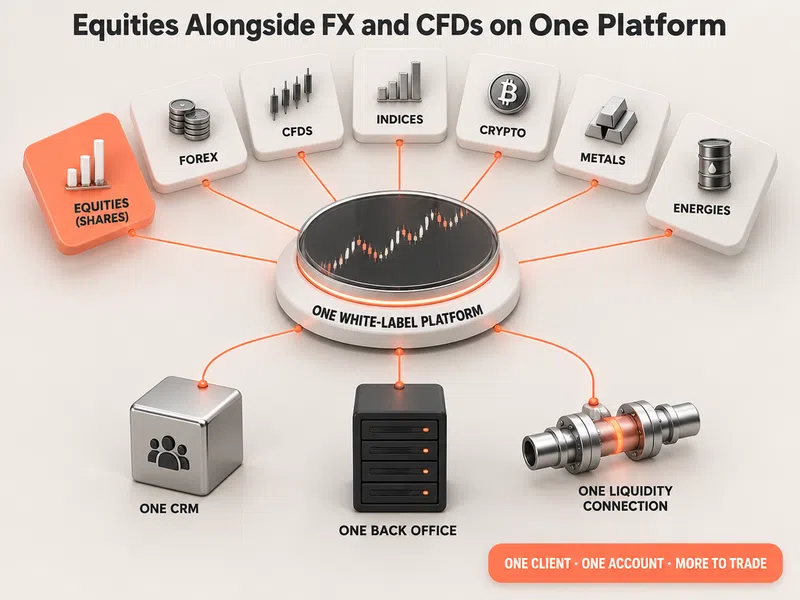
A white-label stock trading platform delivers the first and hardest piece as a managed product. Leverate’s platform provides multi-asset coverage that includes shares alongside FX and CFDs, so an operator can launch an equities offering, or add equities to an existing brokerage, without building trading technology. Because the platform, CRM, back office and liquidity come as connected parts of one stack, the operator gets an equities brokerage that works as a whole rather than a collection of tools that have to be integrated by hand.

Equities vs FX and CFDs: What Changes
Equities differ from FX and CFDs in ways that shape the offering. Shares are tied to real companies, so corporate actions such as dividends and splits have to be handled correctly, and clients often expect a longer-term, investment-oriented experience rather than the high-frequency style common in forex. Instrument ranges are large, market hours follow the underlying exchanges, and leverage on shares is typically lower than on forex. None of this is an obstacle; it simply means the platform and back office must be built to handle equities properly rather than treating them as another line on an FX system.
For an operator, these differences are also an opportunity to differentiate. A broker that presents a clean, investor-friendly equities experience, with the instruments its audience wants and pricing they can trust, stands out from forex-first competitors bolting stocks on as an afterthought. This is where multi-asset technology earns its keep: it lets an operator serve equity investors well while still offering FX and CFDs to traders who want them, capturing more of each client’s activity within one branded platform rather than sending them elsewhere for the assets it cannot support.
Liquidity and Market Access for Stocks
Equities need reliable pricing and execution just as much as any other asset, and that comes from liquidity and market access. A broker offering shares needs a liquidity arrangement that covers the instruments it lists, with pricing tight enough to be competitive and execution fast enough to satisfy investors. Leverate Prime provides multi-asset liquidity that spans shares as well as forex, indices, crypto, metals and energies, so an operator can source pricing across its whole product range from one connection rather than stitching together separate providers for each asset class.
Sourcing liquidity from a single, multi-asset provider has practical advantages beyond convenience. It simplifies integration, keeps execution consistent across the product range, and makes risk management cleaner because exposure is visible in one place. For a new equities broker in particular, a provider that already covers shares removes a significant piece of complexity from the launch, letting the operator focus on the client-facing side of the business. That is the model Leverate is built around: one connection to multi-asset liquidity feeding a single multi-asset platform.
Getting Live: The Practical Path
The fastest and lowest-risk way to launch an equities brokerage is through a white-label, managed stack rather than an in-house build. Building the platform, sourcing liquidity for every instrument, constructing the back office and standing up risk controls is a major undertaking that delays launch by quarters and demands a permanent technical team. A white-label delivers all of it as a managed service, so the operator brands and configures a proven platform and goes live in weeks, putting its capital into acquiring investors rather than into engineering.
So the practical path to starting a stock brokerage firm is to secure multi-asset white-label technology that treats equities as a first-class asset, connect it to multi-asset liquidity that covers shares, wrap it in a CRM and back office that convert and retain clients, and apply risk controls suited to equities. Do that and you launch a credible equities offering quickly, with the option to serve FX and CFD clients on the same platform. Leverate provides exactly this multi-asset foundation, so an operator can start an equities brokerage, or add equities to an existing one, without building the technology itself.
Serving Equity Investors Well
Equity investors expect a different experience from forex traders, and meeting that expectation is how a new stock brokerage builds loyalty. Investors tend to research, hold positions longer, and care about the fundamentals of the companies they buy, so they value clear instrument information, reliable pricing, and a clean way to track a portfolio over time. A platform that presents equities in an investor-friendly way, rather than as fast-moving CFD tickers, signals that the broker understands its audience. That understanding, expressed through the product, is a quiet but powerful differentiator in a market crowded with forex-first operators.
The client relationship around equities also rewards good onboarding and communication. An investor deciding where to hold and trade shares is making a considered choice, so a smooth account-opening flow, transparent information and responsive support carry real weight. A capable CRM and client portal handle this, turning a considered prospect into a funded, long-term investor and keeping them engaged with relevant updates. Because Leverate provides the client portal and CRM alongside the trading platform, an equities broker can deliver this investor experience end to end rather than assembling it from parts, which makes the offering feel coherent to the client.
Adding Equities to an Existing Brokerage
Many operators come to equities not as a first launch but as an expansion, adding shares to an established FX or CFD brokerage to capture more of each client’s activity. On multi-asset technology this is an extension rather than a rebuild: the same white-label trading platform that runs FX and CFDs can add equities, and the same CRM, back office and liquidity connection extend to cover them. That means an existing broker can broaden its product range without standing up a second system, and clients get more to trade in one place instead of opening accounts elsewhere for the assets their current broker lacks.
The commercial logic for adding equities is strong. It deepens each client relationship, opens the broker to investors it could not serve before, and diversifies revenue across asset classes so the business is less exposed to conditions in any single market. Because the technology already exists in a multi-asset stack, the cost of adding equities is modest relative to the upside. For an established broker weighing its next move, extending into equities on the platform it already runs is one of the lowest-friction growth options available, and it is exactly the kind of expansion Leverate’s multi-asset foundation is designed to support.
Risk management deserves its own attention in an equities offering, because shares behave differently from leveraged FX. Exposure concentrates around individual companies and sectors, corporate events can move a single instrument sharply, and market hours create gaps that need handling. A broker offering equities needs risk tools that monitor exposure by instrument and client, apply appropriate limits, and give real-time visibility into the book. This is not a reason to hesitate; it is a reason to build on technology that already includes proper risk controls. Because Leverate’s stack ships with real-time risk management, an equities broker gets these controls as part of the platform rather than having to source them separately.
Ultimately, launching an equities brokerage is less about the size of the undertaking and more about the choices that de-risk it. Choosing multi-asset white-label technology that treats shares as a first-class asset, a liquidity partner that already covers equities, and a CRM and back office that convert and retain investors turns a daunting build into a manageable launch. The operator keeps its focus on brand, market and clients, while the provider carries the technology. That is the fastest, lowest-risk route into equities, and it is the foundation Leverate is built to provide for brokers entering or expanding into the stock market.
Frequently Asked Questions
How do you start a stock brokerage?
You secure the technology to offer equities, connect market access and liquidity, set up client management and risk controls, and handle the setup for your jurisdiction. Leverate supports multi-asset offerings including a white-label stock trading platform.
Can you offer stocks on a white-label platform?
Yes. A white-label stock trading platform lets a firm offer equities under its own brand without building the technology. Leverate provides multi-asset coverage that includes shares alongside FX and CFDs.
How is an equities brokerage different from a forex brokerage?
Equities involve real shares, corporate actions such as dividends and splits, larger instrument ranges, exchange-driven hours and typically lower leverage. The platform and back office must handle these properly rather than treating stocks as an FX add-on.
Do I need separate liquidity for stocks?
You need liquidity that covers the shares you list, but it need not be a separate provider. Leverate Prime offers multi-asset liquidity spanning shares, FX, indices, crypto, metals and energies from one connection.
Can I offer equities alongside forex and CFDs?
Yes. Multi-asset white-label technology lets you serve equity investors and FX or CFD traders on the same branded platform, capturing more of each client’s activity in one place. Leverate’s platform is multi-asset by design.
How long does it take to launch an equities brokerage?
With a managed white-label stack, most operators launch in weeks rather than the quarters an in-house build takes, because the platform, liquidity and back office are already proven and only need branding and configuration.
What technology does an equities brokerage need?
A share-capable trading platform, market access and liquidity, a CRM and back office for onboarding and retention, risk controls suited to equities, and a client portal. Leverate provides these as connected parts of one stack.
Is a white-label cheaper than building an equities platform?
For almost all operators, yes. Building demands large upfront cost and a permanent engineering team, while a white-label delivers proven multi-asset technology as a scalable service and gets you live far faster.
Disclaimer:
This content is based on multiple sources and is provided for educational purposes only. It does not constitute financial, legal, or investment advice.