









The Future of Mobile CFD Trading: Trends Shaping How Brokers Compete
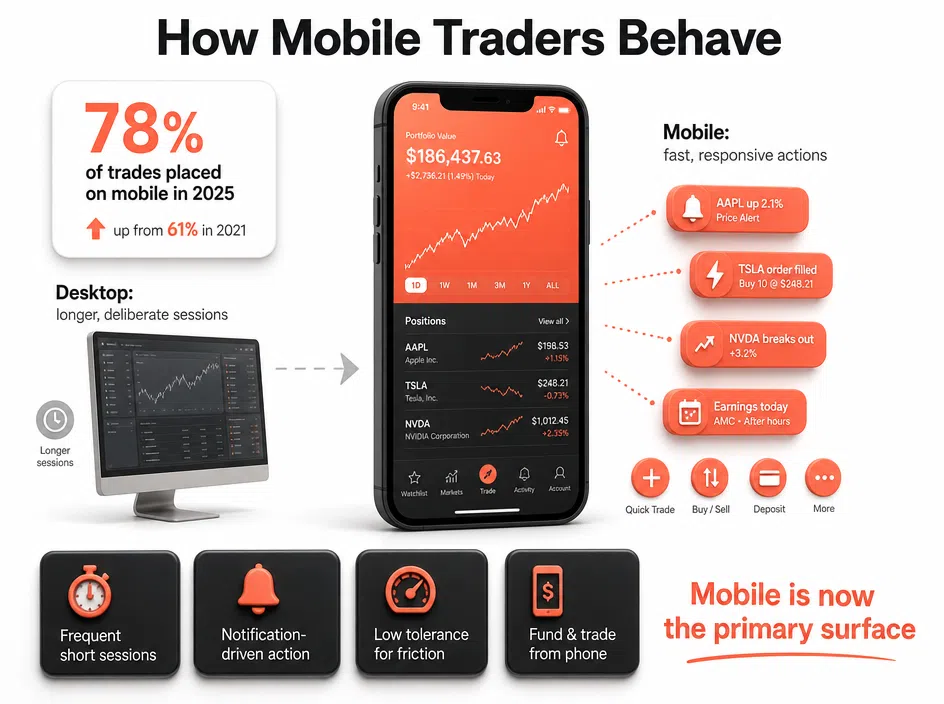
Mobile CFD trading has quietly become the main event. With roughly 78 percent of trades now placed on mobile in 2025, up from 61 percent in 2021, the phone is no longer a companion to the desktop terminal, it is where most clients live. For brokers, that shift changes how clients are won, kept, and lost. This article looks at where mobile CFD trading is heading, how mobile traders behave, and the mobile-first strategies and app capabilities that now decide which brokers pull ahead.
The point is not that mobile matters, which everyone accepts, but that mobile is now the primary surface a brokerage competes on. The firms treating the app as the flagship, rather than a scaled-down copy of the web platform, are the ones setting the pace.
Mobile Is Now the Default, Not the Add-On
For years the mobile app was a convenience layered on top of a desktop-first business. That order has reversed. New traders, particularly younger ones, often open, fund, and run an account entirely from a phone and may never touch a desktop platform. A broker whose mobile experience is a cut-down afterthought is therefore not offering a lesser version of its product, it is offering a lesser version of its whole business to the majority of its clients.
This reframes the investment case. Spending on mobile is no longer about serving a segment; it is about serving the mainstream. The brokers who internalise that are redesigning around the small screen first and letting the desktop follow, rather than the reverse.
How Mobile Traders Behave Differently
Mobile traders are not simply desktop traders on a smaller screen. They check positions more often and in shorter bursts, react faster to notifications, and expect to act on an alert within seconds of receiving it. Their sessions are frequent and brief rather than long and deliberate, and their patience for friction, a slow load, an extra tap, a clumsy funding flow, is far lower. A confusing moment that a desktop user might tolerate will cost a mobile user’s attention entirely.
This behaviour has direct commercial consequences. Because mobile traders act on impulse and notification, timely, relevant prompts drive a large share of their activity, and a smooth path from alert to executed trade is worth more than any additional feature. It also means first impressions are unforgiving: a clumsy onboarding or a laggy first session on mobile ends the relationship before it starts.
Mobile-First Brokerage Strategies
A mobile-first strategy starts by designing the core journeys, registration, funding, first trade, and re-engagement, for the phone before anything else. Onboarding should reach a fundable state in minutes without a desktop detour. Notifications should be genuinely useful rather than noisy, tied to a client’s own positions and interests so they earn attention rather than being switched off. And the funding experience should support the payment methods a mobile audience actually uses in each region.
Beyond the mechanics, mobile-first brokers treat the app as the home of the relationship. Education, social and copy features, and support all belong inside the app rather than pushing the client elsewhere. The strategic goal is that a client never needs to leave the app to do anything important, because every exit is a chance to lose them.
What a Modern Mobile Trading App Must Deliver
The bar for the app itself keeps rising. Clients expect fast, stable execution with charting and order types that match the desktop, a clean interface that hides complexity until it is needed, biometric login and quick funding, and increasingly social and algorithmic tools built in rather than bolted on. Leverate’s white-label trading platform delivers a fully branded mobile app with these capabilities, so a broker offers a flagship mobile experience under its own brand rather than a generic template. Getting the app right is no longer table stakes for a segment; it is the core of the product for the mainstream of CFD trading.

Frequently Asked Questions
Why is mobile CFD trading so important for brokers now?
Because most trading has moved to mobile, roughly 78 percent of trades in 2025. The app is where the majority of clients open, fund, and run accounts, so it is now the primary surface a brokerage competes on rather than an add-on.
How do mobile traders behave differently from desktop traders?
They trade in frequent short bursts, act quickly on notifications, and have very low tolerance for friction. Timely, relevant prompts drive much of their activity, and a clumsy first session can end the relationship immediately.
What is a mobile-first brokerage strategy?
It means designing the core journeys, onboarding, funding, first trade, and re-engagement, for the phone first, then letting the desktop follow. The app becomes the home of the relationship, with education, social features, and support inside it.
What features must a modern mobile trading app have?
Fast, stable execution, charting and order types matching the desktop, a clean interface, biometric login, quick regional funding, and increasingly built-in social and algorithmic tools. Leverate’s platform delivers these in a branded app.
Should the mobile app match the desktop platform?
It should match on capability while being designed natively for the phone, not be a shrunken copy. Mobile-first brokers design for the small screen first and let the desktop mirror it.
How does mobile affect client retention?
Strongly. Because mobile traders act on impulse and notification, a smooth path from alert to trade and an app free of friction keep them active, while any snag pushes them to a rival that is one tap away.
Do brokers need their own branded mobile app?
Yes. A branded app builds the broker’s own equity and keeps the relationship on its platform. Leverate provides a fully branded white-label mobile app rather than a generic template.
What role do notifications play in mobile trading?
A large one. Position-based, relevant notifications drive much of a mobile trader’s activity, but noisy or irrelevant alerts get switched off. The skill is making notifications genuinely useful.
Disclaimer: This content is based on multiple sources and is provided for educational purposes only. It does not constitute financial, legal, or investment advice.