







Build vs Buy: Should You Build Your Own Brokerage Technology?
Every brokerage faces the build-versus-buy question, usually more than once. Should the firm build its trading platform, CRM, and back office in-house, or license a proven stack from a provider? It is tempting to see building as the route to control and differentiation, but the honest answer for most brokers is that building is far more expensive and slower than it looks, while buying has become far more capable than it used to be. This guide works through the real trade-offs, the hidden costs of building, what buying delivers, and how to decide which path fits a given firm.
The decision matters because it shapes cost, speed to market, and the firm’s ability to keep pace for years. Getting it wrong in either direction – over-building what could be bought, or buying something too rigid to differentiate on, is costly to unwind once a business is running on it.
The Case for Building
Building in-house has a genuine appeal: total control. A firm that builds owns its technology outright, can shape every detail to its vision, and is not dependent on a provider’s roadmap. For a small number of very large firms with deep engineering resources and a genuinely unique strategy, that control can justify the cost, because the technology is itself the differentiator and no off-the-shelf option fits.
But this case is narrower than it first appears. Control over technology only creates value if the firm can sustain it, and sustaining a trading stack is a permanent, specialist commitment. For most brokerages, the desire to build comes from wanting differentiation, and differentiation, as we will see, rarely lives in the plumbing that a good provider already supplies well.
The Hidden Costs of Building In-House
The visible cost of building is the initial development, and it is large. The hidden costs are larger. A trading stack needs permanent maintenance as markets, instruments, and platforms change; security and resilience work that never ends; connectivity to liquidity and payments that must be kept current; and a specialist engineering team retained indefinitely to do all of it. These recurring costs routinely dwarf the upfront build, and they arrive whether or not the technology is delivering competitive advantage.
Time is the other hidden cost. A build that takes a year or more is a year the firm is not in market, ceding ground to competitors who launched faster. And the risk of building, that the result is late, over budget, or simply not as good as a specialist’s product, falls entirely on the firm. For most brokers, the true cost of building is not the quote for development; it is the quote plus years of maintenance, plus the opportunity cost of a slower launch, plus the risk of a worse outcome.

What Buying a Proven Platform Delivers
Buying has changed. Modern brokerage platforms are configurable rather than rigid, so a broker can differentiate on brand and experience while the provider handles the engineering underneath. Buying delivers current technology quickly, a roadmap that keeps it current, and the maintenance, security, and connectivity as part of the service. With the brokerage software market on track to nearly double by 2034, providers are investing heavily, which means a bought platform often ships capabilities a single firm could not justify building alone.
Crucially, buying no longer means sacrificing differentiation. A strong provider gives a broker the levers that actually distinguish a brokerage, branding, the markets and instruments offered, execution quality, and the client experience, while taking the undifferentiated plumbing off the firm’s plate. The result is that a broker competes on what clients notice and lets the provider handle what they do not.
Where Differentiation Actually Lives
This is the crux of the decision. Brokers often want to build because they equate owning technology with standing out, but differentiation rarely lives in the core plumbing, the matching engine, the connectivity, the reconciliation logic, which works the same way everywhere and which clients never see. It lives in brand, in the experience, in the markets offered, and in execution quality, all of which a broker can shape on a bought platform. Building the plumbing to differentiate is like a restaurant forging its own cutlery: expensive, and not what diners judge it on.
Seen this way, the build-versus-buy question resolves for most firms. Buy the foundation that is not a differentiator and would be costly to build and maintain, and invest the firm’s energy and capital in the things that actually distinguish it. That is not settling for less; it is spending where it counts.
How to Decide
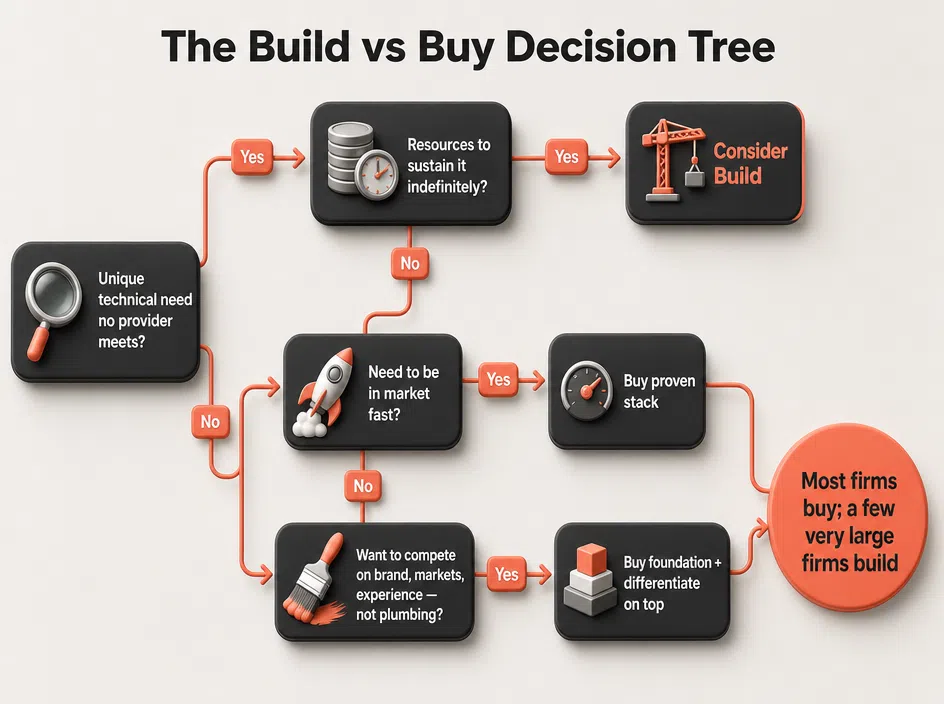
A short set of questions settles most cases. Does the firm have a genuinely unique technical requirement that no provider can meet, and the engineering resources to build and sustain it indefinitely? If not, building is likely to cost more and deliver less than buying. Does the firm need to be in market quickly? Buying wins decisively on speed. And where does the firm actually want to compete, on plumbing, or on brand, markets, and experience? The answer almost always points to buying the foundation and differentiating on top.
For the great majority of brokerages, the pragmatic and profitable choice is to buy a proven, integrated stack and focus on the business. Leverate’s turnkey solution delivers the platform, liquidity, CRM, back office, and risk as one connected, configurable system, so a broker gets control over what differentiates it without the cost and risk of building and maintaining what does not. Build if you are one of the rare firms that genuinely must; buy if you want to compete and grow without carrying an engineering department.
The Hybrid Reality
In practice, build-versus-buy is rarely all-or-nothing. Many successful brokers buy the core, the platform, liquidity, back office, and risk, and build a thin layer of their own on top: a distinctive front-end touch, a proprietary tool, an integration unique to their market. This hybrid captures the best of both, letting a firm differentiate where it genuinely adds value while leaving the heavy, undifferentiated infrastructure to a provider. The mistake is not building at all; it is building the parts that a provider already does better and cheaper.
Configuration is what makes this hybrid possible without a full build. A modern platform that is deeply configurable lets a broker shape branding, instruments, workflows, and client experience to its own vision, achieving much of what firms once thought required custom development. Before committing to build anything, a broker should ask whether configuration of a bought platform can already deliver it, because the answer is increasingly yes, and configuration is faster and cheaper to change than code.
Vendor lock-in is the reasonable fear that pushes some brokers toward building, and it is worth addressing head-on. The mitigation is not to avoid providers but to choose one whose platform is open where it matters, with APIs and data access that keep the broker in control of its own clients and data, and whose track record shows it will not hold a broker hostage. Lock-in is a risk of a bad provider relationship, not of buying itself, and it is managed by choosing the right partner rather than by taking on a build the firm cannot sustain.
Framed by total cost of ownership, the hybrid usually wins comfortably. The full cost of building includes years of maintenance, security, and staffing that rarely appear in the initial business case, while a bought core plus a thin custom layer keeps most of that cost with the provider and concentrates the firm’s spend where it differentiates. Counting the true, multi-year cost of each path, rather than the upfront quote alone, tends to make the sensible choice clear.
The conclusion for most brokers is therefore nuanced but firm: buy the foundation, configure it hard, build only the thin layer that genuinely sets you apart, and choose a provider open enough to let you do all three. Leverate’s turnkey stack is built to support exactly this, a proven, configurable core a broker can shape and extend, so the firm invests its scarce engineering effort where it counts and inherits the rest as a maintained service.
The Bottom Line
Stripped to its essence, build-versus-buy is a question about where a brokerage’s advantage really comes from. Almost no broker wins because it built its own matching engine or reconciliation logic; brokers win on brand, markets, execution, and client experience. Once that is clear, the decision follows: buy the foundation that is not a differentiator and would be costly and slow to build, and pour the firm’s energy into the things clients actually judge it on. Building the plumbing is effort spent where customers never look.
For the rare firm with a genuinely unique technical need and the resources to sustain a build indefinitely, building can be right. For everyone else, and that is the overwhelming majority, buying a proven, configurable stack and shaping it hard is faster, cheaper, lower-risk, and no less distinctive. The modern version of buying is not settling; it is choosing to compete where it matters and letting a specialist carry the rest. Leverate is built to be that specialist, so a broker can make the decision with clear eyes and get on with growing the business.
A useful gut check is to ask, for any component a firm is tempted to build, whether a client would ever know or care that it was built in-house. For the platform’s look and feel, the markets offered, or a unique tool, the answer might be yes. For the matching engine, the reconciliation logic, or the payment plumbing, it is almost always no. That single question tends to sort the build list from the buy list quickly, and it keeps a firm from spending scarce engineering effort where it earns no competitive return.
Frequently Asked Questions
Is it better to build or buy a trading platform?
For most brokers, buying. Building offers control but demands large budgets, long timelines, and permanent maintenance, while a proven platform gets a firm live quickly and stays current. Leverate’s turnkey stack delivers control over what differentiates without the build burden.
What are the hidden costs of building brokerage technology in-house?
Beyond initial development there is ongoing maintenance, security, connectivity, and a permanent engineering team, plus the opportunity cost of a slower launch. These recurring costs often dwarf the upfront build.
When does building in-house make sense?
Rarely, and mainly for very large firms with a genuinely unique technical requirement and the resources to build and sustain it indefinitely. For everyone else, buying is faster, cheaper, and lower-risk.
Does buying a platform limit differentiation?
No longer. Modern platforms are configurable, so a broker differentiates on brand, markets, execution, and experience while the provider handles the plumbing. Differentiation rarely lives in the core technology clients never see.
How does buying affect speed to market?
Decisively. Buying a pre-integrated stack means launching in weeks rather than the quarters a build requires, so the firm is in market and earning far sooner. Leverate’s stack is built for fast launch.
Where does a brokerage actually differentiate?
In brand, the markets and instruments it offers, execution quality, and the client experience, not in the matching engine or reconciliation logic clients never see. A bought platform lets a broker focus on the former.
What are the risks of building?
That the result is late, over budget, or simply not as good as a specialist’s product, with all that risk falling on the firm. Buying transfers much of that risk to a provider whose core business is the technology.
How should a broker decide between build and buy?
Ask whether there is a unique need no provider meets and the resources to sustain a build, how fast the firm must launch, and where it wants to compete. The answers point most firms to buying the foundation and differentiating on top, which Leverate is built to support.
Disclaimer:
This content is based on multiple sources and is provided for educational purposes only. It does not constitute financial, legal, or investment advice.