

Running an MT4 or MT5 brokerage is not simply a matter of acquiring clients and collecting spreads. The cost structure of a platform operation, the way exposure is managed across client books, and the efficiency of back-office workflows all determine whether a brokerage is financially durable or losing margin. Many brokers operating on these platforms have revenue and volume numbers that look healthy on paper but carry operational costs and risk exposures that compress the actual return.
How MT4/MT5 brokers increase profitability is a question with several distinct layers. It is not answered by raising spreads or reducing client incentives alone. It requires analysing where operational inefficiencies and unnecessary costs reduce profitability.
How Do MT4/MT5 Brokers Increase Profitability?
The starting point is understanding where the margin actually comes from. For most MT4/MT5 brokers, the primary revenue lines are spreads or commissions on client trades, income from the B-book component of the trading book, and secondary income from financing charges on overnight positions. Each of these lines is affected by different operational variables, and improving profitability generally means addressing more than one simultaneously.
Spread income is directly linked to trading volume and the spread configuration. Brokers who have set their spreads based on market norms rather than a clear cost model often find that they are either giving margin away unnecessarily on low-risk client segments or over-charging on segments where tighter pricing would drive significantly higher volume. A data-driven review of spread configuration by instrument and client tier can often surface meaningful improvement opportunities without requiring any infrastructure changes.
B-book income, where the broker retains the market exposure on certain client trades rather than passing it to a liquidity provider, is a higher-margin revenue source but also carries risk. The profitability of the B-book component is strongly influenced by how well the broker identifies which client segments to retain internally and which to pass through. This is a risk management decision as much as a revenue decision, and brokers who conflate the two tend to manage neither well.
Scale your brokerage today!
CRM & Client Portal, Trading Platform, MT4 & MT5 - All built for you.
Scale NowWhat Affects Profitability in MT4/MT5 Brokerages?
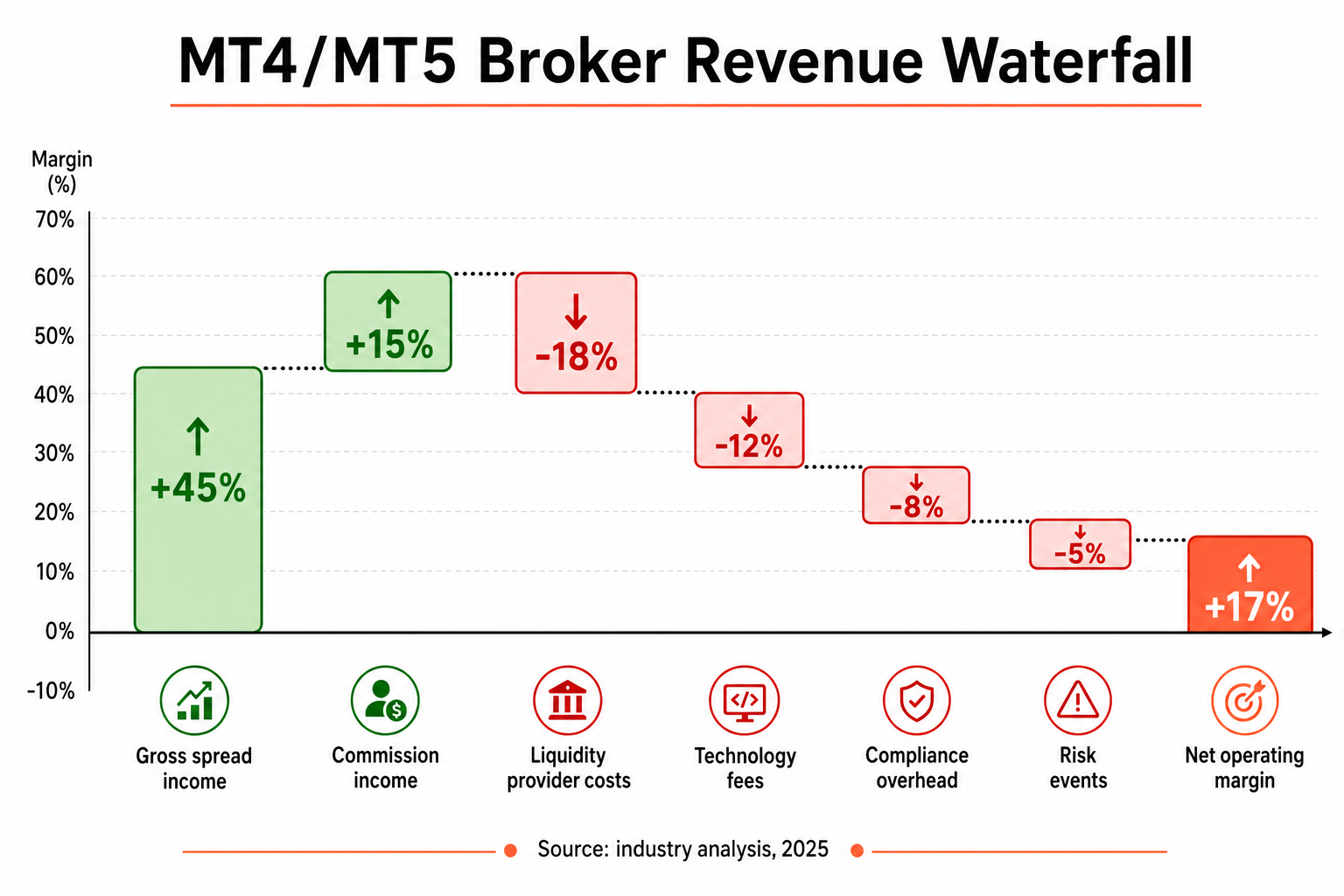
Technology costs represent one of the most controllable variables in the MT4/MT5 broker cost structure. Licensing fees, server infrastructure, third-party integrations, and add-on services each contribute to the fixed cost base. Brokers who have grown their technology stack incrementally, adding integrations and tools as needs arose without reviewing the overall architecture, often carry higher technology costs than their operational requirements justify.
A review of technology spend relative to the function each component serves can identify redundancies. Some brokers are paying for tools that overlap in functionality with features already available within their core platform. Others are maintaining separate systems for functions such as client reporting or risk monitoring that could be consolidated into a single environment with meaningful cost savings.
According to a 2025 industry survey reported by Finance Magnates, technology and operational infrastructure costs account for a significant share of total operating expenses for mid-tier CFD and forex brokers, with some operators spending in excess of 30% of gross revenue on platform and integration costs before accounting for staff or compliance overhead.
Source: Finance Magnates, 2025
Regulatory compliance costs are less controllable but can be managed more efficiently through automation. Manual compliance processes, particularly in client onboarding and transaction monitoring, are both slow and expensive. Automating these workflows through integrated compliance tooling within the broker’s operating environment can reduce the per-client compliance cost and free up staff capacity for higher-value activity.
How Does Cost Optimisation Improve Broker Margins?
Cost optimisation in the MT4/MT5 context is not about reducing service quality or stripping out features. It is about aligning expenditure with the revenue it supports. The question to ask of each cost line is what client value or revenue it enables, and whether there is a more efficient way to deliver the same outcome.
Liquidity costs are a significant area for many brokers. The margin paid to a prime broker or liquidity provider on each trade is directly subtracted from the broker’s spread income. Brokers who have not renegotiated their liquidity arrangements as their volume has grown are often paying rates that reflect their position as a smaller counterparty, even though their current volumes would justify a material improvement in terms.
| Cost Category | Optimisation Approach | Typical Impact |
|---|---|---|
| Liquidity costs | Volume-based renegotiation, consolidated providers | Improved margin per trade |
| Technology fees | Stack audit, consolidate overlapping tools | Reduced fixed cost base |
| Compliance processing | Onboarding and monitoring automation | Lower per-client compliance cost |
| Back office operations | Integrated reporting and workflow tools | Reduced manual processing time |
What Is Broker Exposure and How Does It Affect Profit?
Broker exposure refers to the net market risk the brokerage carries on its own balance sheet as a result of client trading activity. In a pure A-book model, the broker carries no market exposure because all client orders are immediately offset with a liquidity provider. In a B-book or hybrid model, the broker retains some exposure, which means that client positions that move in the client’s favour create a cost to the broker.
Exposure management is one of the most consequential determinants of MT4/MT5 broker profitability in a hybrid model. A broker that retains too much exposure on the wrong client segments can face significant losses during volatile market periods. A broker that over-hedges its book pays more in liquidity costs than necessary and reduces the potential return from the B-book component.
The MT4 and MT5 platforms provide risk management data but do not automatically make exposure management decisions. Brokers typically use a separate risk management layer, sometimes referred to as a bridge or risk console, to monitor aggregate exposure and determine when hedging action is required. Integrating this layer with the core trading platform is a design decision that affects both the speed of risk response and the ongoing cost of management.
How Do Brokers Balance Risk and Profitability?
Balancing profitability with exposure control risk and profitability in an MT4/MT5 brokerage comes down to client segmentation. Not all clients present the same risk profile. Traders who have historically generated losses on the platform, could potentially present lower risk from a B-book perspective than traders who consistently produce gains, since the broker is on the opposite side of those trades. Routing decisions, whether to keep a client’s trades on the B-book or pass them to the A-book, ideally reflect this segmentation rather than being applied uniformly.
Leverate’s MT4/5 solutions include risk management tooling that can support this kind of client-level analysis. The Broker Portal provides the administrative environment for monitoring exposure, reviewing client activity, and configuring routing rules without requiring a separate technology investment. For brokers looking to build a more systematic approach to how MT4/MT5 brokers increase profitability, Leverate’s ecosystem connects trading infrastructure with Back Office Solutions and liquidity access in a single managed environment. Visit leverate.com/mt5-mt4-white-label/ for more information.
**Disclaimer:
**This content is based on multiple sources and is provided for educational purposes only. It does not constitute financial, legal, or investment advice.