








Which Asset Class Should You Add Next? A 2026 Expansion Decision Guide
Adding a new asset class can expand trading activity, improve retention and attract new clients. But market popularity alone does not guarantee a strong business case.
A broker asset class expansion decision should compare expected return, client demand and operational risk. A large market may still deliver weak ROI if acquisition, compliance and support costs are high. A smaller opportunity may perform better when it fits the existing book and runs on infrastructure already in place.
This guide helps a multi-asset brokerage compare crypto, equities CFDs, commodities CFDs and indices CFDs. Here, ROI refers only to the brokerage’s commercial return, not trader profit.
Key Takeaways
- The best asset class depends on the broker’s clients, regions, licences and existing infrastructure.
- Crypto and equities CFDs may attract new audiences, but usually require a stronger acquisition and risk-management case.
- Commodities and indices often fit an existing FX/CFD client base with less launch friction.
- Reusing the same platform, CRM, liquidity and risk systems can materially improve the expected return.
How to Score the Options: ROI, Demand and Risk
A broker should score each candidate against its own operation rather than rely on broad market rankings.
A simple model is to give each asset class a score from one to five across three areas:
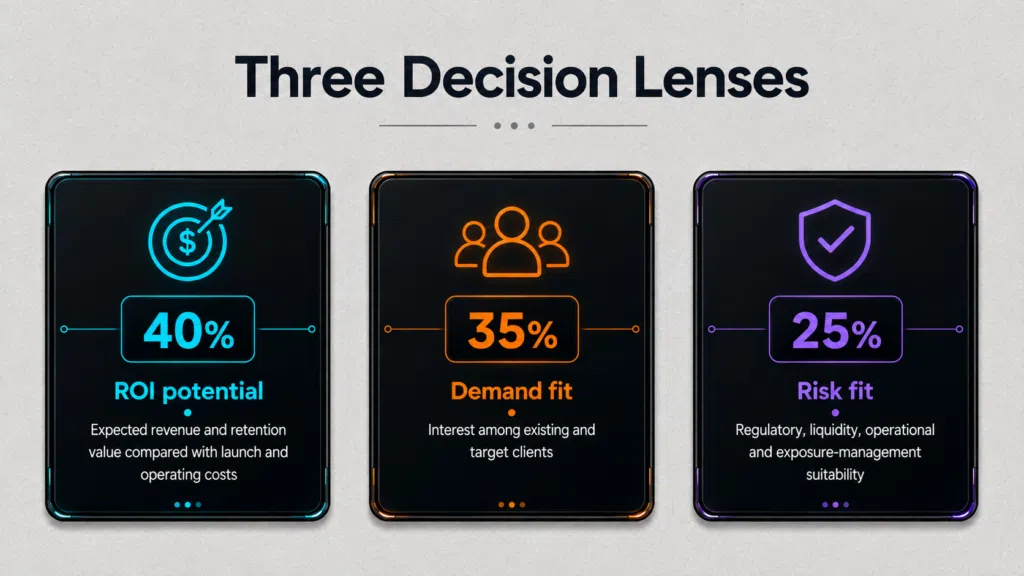
The weights can change. A broker entering a tightly regulated market may place more weight on risk fit. A broker with a strong licence and established risk team may focus more heavily on demand and revenue.
ROI potential
Return on Investment begins with expected income, but it cannot end there.
Depending on the brokerage model, a new asset class may generate revenue through spreads, commissions, overnight financing or increased overall trading activity. It may also improve client retention by giving traders fewer reasons to maintain accounts with competing platforms.
Those benefits should be measured against:
- Liquidity and market-data costs
- Platform or integration costs
- Marketing and acquisition spend
- Compliance and legal review
- Additional support requirements
- Risk-management overhead
- Ongoing instrument maintenance
A high-volume asset class can still deliver weak ROI if the broker must build a new acquisition funnel, connect several external systems and hire specialist staff to support it.
The reverse is also true. An asset class with moderate revenue potential may produce a strong return when the broker can offer it to existing clients at a low additional cost.
Demand fit
Demand should be divided into two categories.
The first is existing-book demand. Are current clients already interested in these instruments? Do their trading patterns suggest a natural crossover? FX traders who follow inflation, central banks and geopolitical events may already understand gold, oil and major indices.
The second is new-audience demand. Could the asset class help the broker enter a segment it currently struggles to reach? Crypto CFDs may appeal to crypto-native clients. Equities CFDs may attract people who follow individual companies but want to trade through a CFD platform.
Regional fit matters as well. Client interest in US equities, commodities or crypto can vary considerably between APAC, LATAM, MENA and European markets. A broker should use its own lead, deposit and trading data wherever possible rather than assume global attention will translate into local activity.
Risk fit
Risk fit covers more than market volatility.
The broker should assess:
- Whether the asset class fits its current licences
- Which jurisdictions it can legally offer it in
- Applicable leverage and marketing restrictions
- Liquidity quality during volatile periods
- Hedging and net-exposure requirements
- AML and KYC implications
- The ability of operations and support teams to manage the product
The score should reflect the broker’s actual capabilities. Crypto may receive a strong risk-fit score for a broker with suitable licences, established AML controls and experienced liquidity partners. The same asset class may score poorly for a traditional FX broker entering it for the first time.
Once all three scores are assigned, the broker can calculate a weighted result:
ROI score × 40% + demand score × 35% + risk-fit score × 25%
The result is a structured way to expose weak assumptions before money is committed.
Crypto and Equities CFDs: The New-Audience Plays
Crypto and equities CFDs stand out because they can reach clients beyond a traditional FX audience.
That potential is valuable, but attracting a new audience usually costs more than selling another product to an existing one.
Crypto CFD
For a traditional FX/CFD broker, crypto can provide access to a client segment that may not respond strongly to currency-focused marketing.
Crypto markets are familiar to clients who already use exchanges, wallets and digital payment services. Adding crypto CFDs can allow a broker to serve this audience without requiring clients to take ownership of the underlying coins.
Crypto may also expand activity beyond the strongest hours for FX, equities and indices. However, extended availability creates its own operational demands. The broker needs dependable pricing, clear trading conditions and risk controls that continue working during periods of sharp volatility.
The business case should include:
- Expected demand from crypto-native clients
- Acquisition cost for that audience
- Available crypto instruments
- Liquidity during volatile periods
- Exposure and margin controls
- AML and KYC requirements
- Restrictions within each target jurisdiction
Crypto can also support the funding side of the brokerage. Leverate’s CoinPayments is among the payment gateways that brokers can use to support transactions across different regions. This can add a crypto payment rail, although the broker must still apply its own compliance and operational procedures.
Crypto therefore tends to score well for new-audience potential, but its final ROI depends heavily on regulatory fit and the cost of supporting the segment properly.
Equities CFDs
Equities CFDs offer another route into a broader audience.
The underlying companies are already familiar. Clients may follow major technology, banking, energy or consumer brands even if they have little interest in currency pairs. This gives brokers clearer marketing themes and more frequent company-specific events around which to build content and campaigns.
Equities can also deepen a multi-asset offering by allowing clients to trade individual companies alongside currencies, commodities and indices from one account.
The trade-off is greater product complexity.
A broker offering individual equity CFDs may need to manage:
- A much larger instrument list
- Market-data costs
- Different trading sessions
- Corporate actions
- Dividend adjustments
- Symbol-specific liquidity
- Regional leverage and marketing rules
Offering 24/5 equity trading can strengthen the demand case. Leverate has announced 24/5 equity CFD access to major US stocks through Leverate Prime and SiRiX. This can be particularly relevant for clients in APAC, LATAM and MENA who would otherwise need to trade US shares during inconvenient local hours.
That does not make equities the automatic winner. The broker still needs to estimate how many clients will use the extended hours, how much volume they may generate and whether the additional product-management requirements are justified.
Crypto and equities CFDs can both support audience expansion. They should receive high scores only when the broker has a credible plan to reach and serve those new clients.
Commodities and Indices: The Low-Friction Plays
Commodities and indices are less likely to transform the broker’s target audience. Their advantage is usually a closer fit with the existing book.
For many FX/CFD brokers, that can produce a faster and more predictable return.

Commodities CFDs
Gold, silver, oil and natural gas already sit close to the subjects followed by many FX traders.
Interest rates, inflation, currency movements, supply disruptions and geopolitical events can influence both FX and commodity markets. This makes commodities CFDs easier to introduce through existing market commentary, education and client communication.
Demand may also be concentrated among a relatively small number of recognisable instruments. A broker does not necessarily need hundreds of commodity products to create a credible offering.
However, low launch friction does not mean low risk.
Energy and agricultural markets can react sharply to supply events, weather, geopolitical developments and changes in global demand. Commodity instruments may also involve different trading hours, rollover arrangements and liquidity conditions.
The broker should assess whether its support team can explain these features clearly and whether its risk infrastructure can manage exposure during sudden price movements.
Leverate reports that its multi-asset infrastructure supports precious metals, energies and other major CFD categories, with centralised liquidity and risk-management tools.
For an established FX broker, commodities may score strongly because client education, acquisition channels and infrastructure can often be reused.
Indices CFDs
Indices offer broad exposure to markets such as the US, UK, Germany or Japan through a smaller number of instruments than individual equities.
They are generally easy for existing CFD clients to understand. Instead of assessing one company, the client is trading the movement of a wider market benchmark.
From the broker’s perspective, indices can improve product completeness without introducing the same instrument volume and corporate-action workload as individual equities.
Their main limitation is audience expansion.
A broker that already serves active FX and CFD traders may find solid demand for indices, but adding them may not attract an entirely new type of client. Competitors are also likely to offer the same major benchmarks, limiting their value as a point of differentiation.
The business case is therefore usually based on:
- Retaining current clients
- Increasing cross-asset activity
- Supporting more market events
- Giving clients fewer reasons to use another platform
- Expanding the product range at relatively low cost
Indices may not produce the highest headline growth forecast. Their lower launch cost and close fit with an existing book can still produce a better risk-adjusted return than a more ambitious expansion.
For brokers already running a mature FX operation, indices and commodities are often the most practical first steps towards a broader multi-asset brokerage.
Making the Call: Why Reused Infrastructure Changes the ROI
Infrastructure cost can change the ranking completely.
Suppose equities CFDs have the strongest demand forecast, but require new market-data connections, operational processes and support resources. Commodities may have a smaller revenue forecast, but can be launched through systems the broker already uses.
In that case, commodities may produce the better return.
A broker should identify which parts of the current operation can be reused:
- Trading platform
- CRM and Client Portal
- Liquidity connections
- Broker Portal
- Payment systems
- KYC and AML workflows
- Reporting
- Risk and exposure controls
- Support processes
Leverate positions its CFD infrastructure as a shared environment covering the trading platform, CRM, liquidity and risk management. Its Broker Portal acts as a central hub for trading, performance and compliance, while Leverate Prime covers major classes including forex, indices, crypto, precious metals, energies and shares.
This means brokers do not necessarily need separate core systems for each asset class. Leverate reports that supported classes can be managed through the existing platform and Broker Portal, although activation time and requirements will depend on the broker’s agreement, configuration, licences and documentation.
A directional comparison might look like this:

These are starting assumptions, not universal scores.
A crypto-focused broker may rate crypto as both low-friction and low-risk because the necessary expertise is already present. An FX broker with limited crypto experience may reach the opposite conclusion.
The final decision should also be tested against several scenarios:
- What happens if trading volume is 30% below forecast?
- What if launch costs are higher than expected?
- How much revenue comes from existing clients rather than new acquisition?
- Which regulatory changes could weaken the case?
- Can the asset class still justify itself without optimistic growth assumptions?
A strong decision should survive a conservative forecast.
Final Thoughts
There is no single asset class with the best ROI for every broker.
Crypto and equities CFDs may be the better options for firms seeking new audiences, wider trading hours and stronger product differentiation. Commodities and indices may suit brokers focused on retention, cross-selling and lower-friction expansion.
Market size should inform the decision, but it should not make it.
The right asset class is the one that produces the strongest commercial return after demand, launch costs, operational effort and regulatory fit have all been considered. When the broker can reuse its existing platform, CRM, liquidity and risk infrastructure, that cost advantage may matter more than whichever market currently receives the most attention.
FAQs
1. Which asset class has the best ROI for brokers?
There is no universal winner. Brokers should score each option against demand, expected revenue, launch costs, risk, region, licences and the composition of their existing book.
2. Should I add the asset class with the biggest market or the lowest launch cost?
Neither factor should be considered alone. A large market offers little value if acquisition and operating costs are too high, while a lower-cost launch can deliver stronger ROI when it serves proven demand.
3. How long does it take to add a new asset class?
It can be relatively fast when the asset class runs on infrastructure the broker already uses. Leverate reports that supported products and settings can be managed through the Broker Portal, but actual timing depends on configuration, licensing and approval requirements.
4. Do I need separate systems for each asset class?
Not necessarily. Commodities, crypto, indices and equities CFDs can operate across the same core platform, CRM, liquidity and risk-management environment when the infrastructure supports multiple asset classes.
5. Which asset class best fills after-hours trading gaps?
24/5 equities CFDs can extend access to major US stocks beyond normal market sessions. This may be particularly useful for APAC, LATAM and MENA clients trading in their own local time zones.
6. Is crypto worth adding for a traditional FX/CFD broker?
It can provide access to crypto-native clients and add a crypto funding rail through integrations such as CoinPayments. Brokers should weigh that opportunity against volatility, jurisdictional restrictions and AML/KYC requirements.
7. Are commodities and indices worth adding if they do not bring new audiences?
Yes. They can improve product completeness, retention and cross-selling among existing clients while generally requiring less acquisition effort than a move into a completely new audience.
8. How do I weigh regulatory fit when choosing?
Assess whether each asset class can be offered under the broker’s existing licences and within its target jurisdictions. Regulatory fit should form part of the risk score before projected revenue is considered.
Disclaimer:
This content is based on multiple sources and is provided for educational purposes only. It does not constitute financial, legal, or investment advice.