
Choosing a Trading Platform Provider: A Broker’s Evaluation Framework
The trading platform is the face of a brokerage, the thing clients touch every day, so choosing a trading platform provider is one of the highest-stakes decisions a broker makes.
The Leverate team builds trading platform, CRM, client portal and liquidity technology for brokers and prop firms worldwide.
The trading platform is the face of a brokerage, the thing clients touch every day, so choosing a trading platform provider is one of the highest-stakes decisions a broker makes.
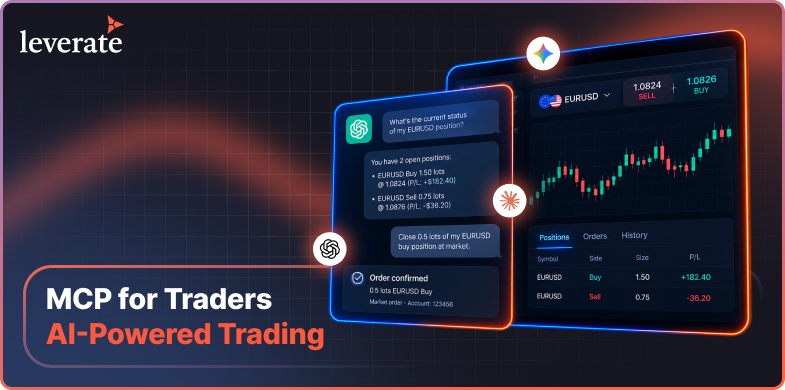
Traders already run their research through an AI assistant. They just have nowhere to point it. Ask about gold and the assistant answers from general knowledge. Ask what that means for the position sitting in the account, and it cannot see the account at all.
Every brokerage faces the build-versus-buy question, usually more than once. Should the firm build its trading platform, CRM, and back office in-house, or license a proven stack from a provider? It is tempting to see building as the route to control and differentiation, but the honest answer for most brokers is that building is far more expensive and slower than it looks, while buying has become far more capable than it used to be.
CRM & Client Portal, Trading Platform, MT4 & MT5 - All built for you.
A broker can lose a funded client before that client has placed a single trade. Research from Fenergo, reported by FinTech Global in 2025, found that 70 percent of financial institutions lost clients in the previous year because onboarding took too long, up from 67 percent the year before and 48 percent two years earlier. The number is moving in the wrong direction, and it is moving in an industry where the technology to fix it has existed for a decade.
Not all order flow is equal. Some client trades are, over time, profitable for a broker to internalise; some are consistently costly. That second category, toxic flow, is one of the quietest threats to a brokerage’s margins, because it looks like ordinary volume until the losses add up. Managing it is not about refusing clients but about seeing flow clearly and routing it intelligently.
For years, artificial intelligence in trading meant analytics: models that surfaced insights for a human to act on. Agentic trading is different. Here, AI agents do not just advise; they act, retrieving data, testing strategies, and executing within rules set by the trader. That shift from assistant to agent changes what traders expect from a platform and what brokers must prepare for, in data access, oversight, and control.
Crypto is no longer a question of whether a broker offers it but how. The two routes, CFD-on-crypto and crypto-native, look similar to a client but are worlds apart for the broker, in custody, risk, technology, and the liquidity behind them.
Starting a broker-dealer is often described as a licensing exercise, but for the founders actually doing it, most of the work is operational and technical. Registration and capital requirements set the timeline, yet what determines whether the firm can trade well on day one is the technology and operations behind it. This guide focuses on that side: the systems and setup a broker-dealer needs to be ready to trade, and how to stop the build from becoming the thing that holds the launch back.
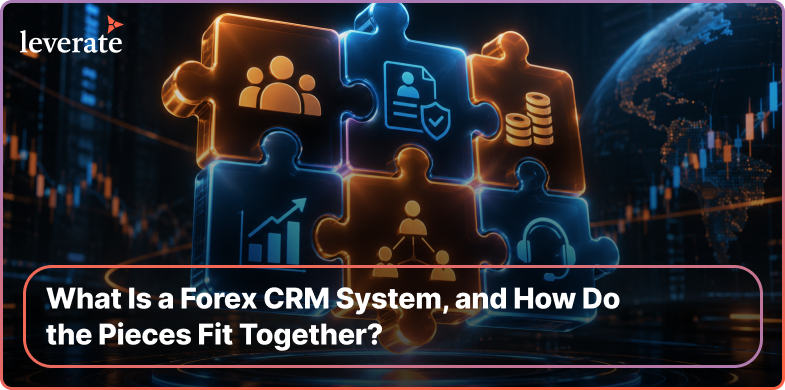
Ask ten brokers what forex broker solutions means, and you will get ten answers, because the term covers everything a firm needs to launch and run a brokerage. That breadth is the point: a brokerage is not one product but a connected set of systems, and getting the full set right is what separates firms that scale from those that stall.
Every brokerage has a visible half and a hidden half. Clients see the trading platform; the business runs on the back office. Back office software for brokers is the operational core that turns trades and sign-ups into a functioning company, handling accounts, payments, reporting, and the partner and risk machinery that keeps everything moving. It rarely gets the attention the platform does, yet a weak back office quietly caps how large and how efficiently a brokerage can grow.
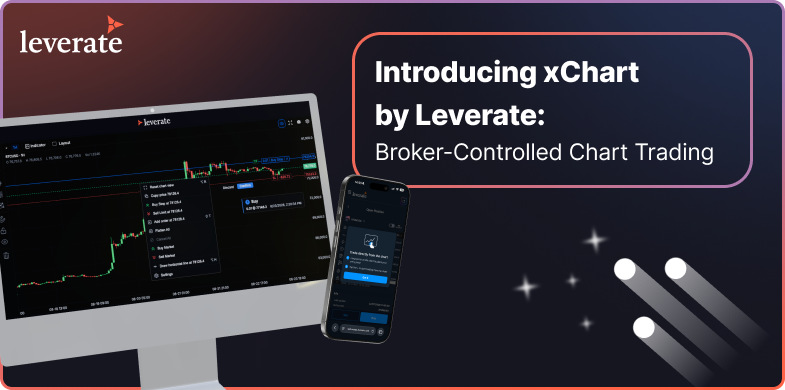
We have just deployed xChart, our new charting and trade-from-chart engine, across the Leverate platform on desktop and mobile. It is live now as the default chart engine for every broker on the platform.
Learning how to start a trading firm in 2026 looks very different from a few years ago. The proprietary trading model, where a firm funds vetted traders and shares their profits, has professionalised sharply since the 2025 shake-out, and the firms launching now are building on sounder foundations than the wave that came before.
CRM & Client Portal, Trading Platform, MT4 & MT5 - All built for you.